**By | Lü Ye**
In early 2026, the global tech industry finds itself in an absurd state of coexistence: on one side, Silicon Valley titans paint visions of AI benefiting all at their launch events; on the other, the global hardware supply chain is undergoing an unprecedented “robbery.”
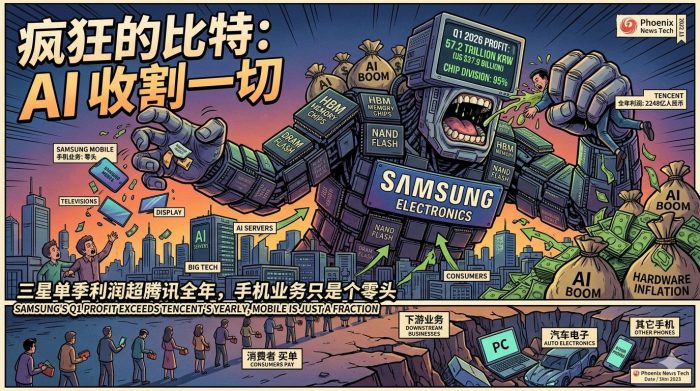
Yesterday, Samsung Electronics’ preliminary results for Q1 2026 provided a chilling and stark footnote to this absurdity with a set of frenzied figures: a single-quarter profit of 57.2 trillion Korean won (approximately $379 billion).
What does this number signify? It is not only nearly triple Samsung’s previous historical single-quarter record but also accomplishes a highly symbolic leap in an instant—Samsung’s quarterly profit has already surpassed Tencent’s *entire* net profit for the year 2025. Yet, within Samsung, this feels more like a “dismemberment-style” victory: the chip division contributed 95% of the profit, while Samsung’s once-signature businesses—mobile phones, home appliances, and display panels—have collectively shrunk to a mere “rounding error” on the financial statement.
### Memory Chips: The “Digital OPEC” of the AI Era
In the past, we were accustomed to viewing Samsung as an “electronics general store,” sweeping the globe through the vertical integration of phones, screens, and chips. But the Q1 2026 report tells us Samsung has transformed into an “energy company.” What it exports is not oil, but the essential fuel of the AI era—storage for bits.
“95% of profit from memory”—this is, in essence, a premeditated “AI inflation.”
In the AI narrative, NVIDIA is the one selling shovels, but Samsung and SK Hynix are the ones selling the dirt—without High Bandwidth Memory (HBM), even the most powerful GPU is just scrap metal incapable of processing data. A year ago, an HBM chip sold for $30; now, its price has quadrupled, jumping to $150.
Even more insane is that this inflation is creating a “chain-reaction effect.” To free up production capacity for the more profitable HBM, manufacturers like Samsung have drastically cut production schedules for ordinary server DRAM and NAND flash memory. The result: even if you just want to buy an ordinary cloud server or assemble a computer, you must pay a premium for that “vanished capacity.”
This is no longer a normal industry cycle recovery. A cycle is “ebbs and flows,” but the current memory market is a “tsunami.” Leveraging its near-monopolistic pricing power in the global memory market, Samsung has effectively formed a digital version of “OPEC.”
### Mobile Business: The “Free Gift” Under the Empire’s Setting Sun
There was a time when the mobile business (MX Division) was Samsung’s crown jewel. But against the backdrop of a 57.2 trillion won profit, the few trillion won contributed by the mobile business appears so pale.
This reveals a harsh truth: in the face of the gluttonous feast of AI infrastructure, the value of end-device innovation is depreciating.
When storage costs are rising at 300%, no matter how foldable Samsung phones become or what AI features they embed, their hardware gross margins are being “eaten” by their own chip division. This is an extremely bizarre case of “the left hand robbing the right”: the harder Samsung Semiconductor raises prices, the weaker the price competitiveness of Samsung phones in the market becomes.
If the mobile business is just a rounding error, will Samsung remain a consumer electronics company in the future? As the profit structure tilts decisively towards B2B infrastructure, Samsung is regressing—or evolving—from a “brand that pleases consumers” into a “resource supplier that harvests the industry.”
### The Sacrifice Downstream: Who is Paying for the 57 Trillion Won?
The myth of Samsung’s quarterly profit exceeding Tencent’s annual profit is, in essence, a global wealth transfer.
Where is the money coming from?
* **The first layer of sacrifice is the internet giants.** Tencent, Alibaba, Amazon, Microsoft—these titans, desperate not to fall behind in the AI race, have to endure contract prices for memory chips that have doubled quarter-over-quarter.
* **The second layer of sacrifice is the device manufacturers.** Xiaomi, OPPO, Volkswagen, Tesla—when the storage cost in their Bill of Materials (BOM) skyrockets from 10% to 30%, they either endure losses or raise prices.
Ultimately, all cost pressures seep through the capillaries of the industrial chain down to every ordinary consumer.
In 2026, you’ll find phones have become more expensive, cloud storage subscription fees have increased, and even the smoothness of a car’s navigation system might require an extra payment—behind all this lies a contribution from Samsung’s “explosive” financial report.
### Conclusion: The Endpoint of Inflation
Samsung’s financial report is a product of the intertwining of the AI bubble and reality. It proves that before algorithms change the world, hardware resources will first complete a reorganization of power.
Samsung is enjoying an “out-of-control”狂欢 (huānkuáng, revelry/carnival), but this狂欢 is built upon the extreme squeezing of downstream profits. When hardware inflation plunges the consumer electronics market into a slump, when internet giants scale back AI computing investments due to excessive costs, how long can this one-sided红利 (hónglì, dividend/bonus) last?
Samsung is approaching NVIDIA’s profit altitude, but its danger lies precisely here: it has become too heavy, so heavy that it makes the entire digital world feel short of breath.
Great companies should lower society’s total cost in their expansion, not create inflation using monopolistic pricing power. Samsung may have won the报表 (bàobiǎo, report/statement), but it might be losing its grip on the future consumer electronics world. With the mobile business reduced to a rounding error, Samsung needs to strive harder in the consumer market—Apple and Huawei won’t slacken their pace of progress.