

ShanghaiApril 22, 2026 /PRNewswire/ — Recently, Professor Shen Gang, Chief Scientist of GS Technology and Product Line R&D at Angelalign Technology and Taikang Dental, along with his team, published an academic paper titled “A New Classification System for Malocclusions with Facial Convexity” in the first issue of 2026 of the international specialized journal for clear aligner orthodontics, the Journal of Aligner Orthodontics (hereinafter referred to as “JAO”). This marks the first time Professor Shen Gang’s research paper on the classification of malocclusions has been published in an internationally authoritative orthodontic academic journal.
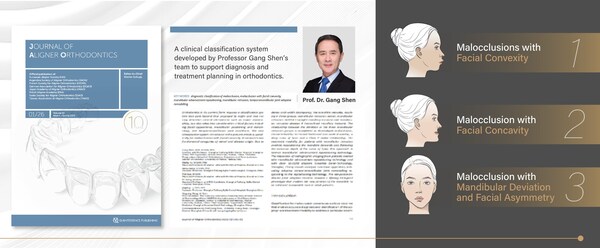
Professor Shen Gang’s diagnostic classification system for malocclusions transcends the traditional Angle’s classification framework based on molar relationships. It takes facial profile as the entry point for examination and comprehensively evaluates multiple factors including the patient’s dental occlusion, alveolar characteristics, jaw position, mandibular morphology, dental arch relationship, and temporomandibular joint status. This systematically constructs a diagnostic and therapeutic system for facial convexity malocclusions, encompassing clinical manifestations, pathogenesis, treatment strategies, and corresponding appliances.
The Shen Gang diagnostic classification system divides facial convexity malocclusions into two basic types: alveolar and skeletal. Building upon this, if mandibular retrusion is present, it further derives three other types involving jaw position factors: positional, mixed type I, and mixed type II.
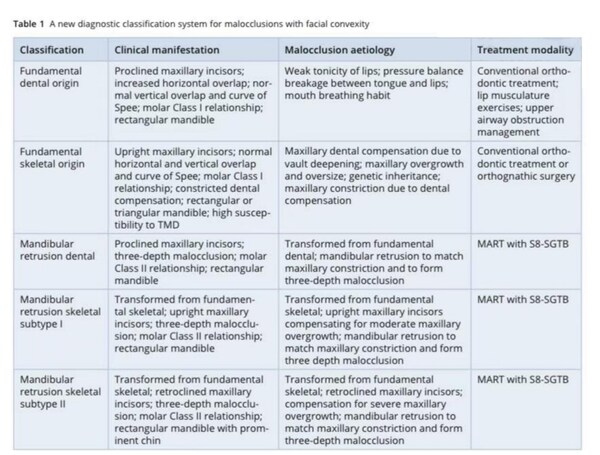
Source: Journal of Aligner Orthodontics, 01/20
In-depth Analysis of Facial Convexity Malocclusions: From Pathological Mechanisms to Classified Diagnosis and Treatment
In the paper, Professor Shen Gang’s team conducted an in-depth exploration of the pathological mechanisms of various subtypes of facial convexity malocclusions and proposed differentiated treatment strategies. The research focused on analyzing the clinical applicability, biomechanical principles, and standardized operational procedures of the “Mandibular Anterior Repositioning Technique” (MART). Simultaneously, through radiographic and histological methods, it confirmed that even in adults, the temporomandibular joint undergoes sustainable, lifelong adaptive remodeling, thereby making the repositioned mandible more stable.
The study clearly states that reasonably leveling the occlusal curve is an important prerequisite for achieving the expected results of jaw repositioning. Furthermore, the paper emphasizes the scientific assessment of the necessity for tooth extraction in patients with facial convexity malocclusions during treatment, based on refined diagnostic classification results, thereby providing clinicians with more evidence-based medical decision-making references.
Innovative Diagnostic Perspective: Mandibular Morphology Analysis and Risk Assessment
As a significant component of this research, Professor Shen Gang’s team proposed a new diagnostic perspective for facial convexity malocclusions with notable clinical significance—”Mandibular Morphology Analysis.” Through systematic evaluation of the overall contour of the mandibular body and the degree of symphysis concavity in cephalometric lateral radiographs, the study summarized two main mandibular morphologies:
- Flat Rectangular Shape: Commonly seen in alveolar-type facial convexity and cases accompanied by mandibular retrusion factors. These patients typically exhibit a deep overbite pattern, a deeper symphysis concavity, and a more prominent chin protrusion, making them ideal candidates for mandibular anterior repositioning therapy.
- Heavy Triangular Shape: Often associated with skeletal-type facial convexity. This morphology is frequently accompanied by higher susceptibility of the temporomandibular joint, with more pronounced tendencies for condylar resorption and retrusion.
Additionally, the article systematically differentiates between “mandibular retrusion” and “mandibular deficiency” clinically, assisting clinicians in making more precise technical route choices between conventional extraction orthodontics and jaw repositioning orthopedics.
Chinese Orthodontic Expertise Enhances International Influence
The Journal of Aligner Orthodontics, as a global authoritative academic platform in the field of clear aligner orthodontics, consistently focuses on forward-looking research with technology-driven value. This is not the first time research achievements from Professor Shen Gang’s team have been featured in this journal. In 2025, their paper “Treatment of Adult Deep Overbite Malocclusion with Mandibular Anterior Repositioning Technique” was officially published in the fourth issue of the journal. The diagnostic classification research for facial convexity malocclusions published this time serves as the theoretical foundation and a key clinical prerequisite for jaw repositioning technology. The publication of this achievement not only provides new ideas for the diagnosis and treatment of facial convexity malocclusions for global orthodontists but also further validates the theoretical advancement of jaw repositioning solutions, represented by Angelalign’s GS Technology, in managing complex cases.
In recent years, Angelalign has adhered to a technology development path of “originating from clinical practice and returning to clinical practice,” transforming the expertise of clinical specialists into digital invisible orthodontic solutions through continuous investment in scientific research. The inclusion of this paper by Professor Shen Gang’s orthodontic team in an internationally authoritative journal once again demonstrates the competitiveness and voice of China’s original orthodontic technology within the international mainstream academic community.