

BeijingApril 27, 2026 /PRNewswire/ — On April 4, 2026, the Molecular Medicine Team of Lu Daopei Hospital published its latest research findings online in the internationally renowned oncology journal British Journal of Cancer. The study, titled “TCF3::HLF-positive B-ALL: Comprehensive Clinical and Molecular Characteristics of 34 Patients from a Single Center,” represents the largest and most comprehensive single-center clinical and whole transcriptome sequencing (WTS) analysis report globally for this extremely rare and high-risk leukemia to date.
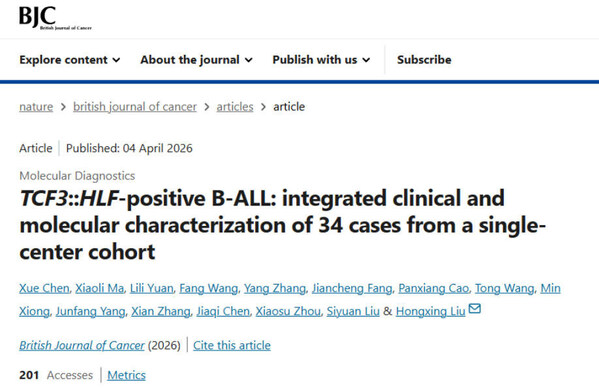
This study not only highlights the international leading level of the Lu Daopei Molecular Medicine Team in the fields of precision medicine and molecular diagnostics but also sheds new light on improving treatment prospects for these extremely high-risk patients.
Focusing on a “Hard Nut to Crack” in Leukemia: The Rare and Fatal TCF3::HLF-positive B-ALL
TCF3::HLF-positive B-cell acute lymphoblastic leukemia (B-ALL) is a rare and highly aggressive subtype. Previous studies have reported that this subtype accounts for approximately 1% of B-ALL cases. Among 2,136 B-ALL patients screened at Lu Daopei Hospital, the detection rate was 1.59% (34 cases in total).
This subtype disrupts normal B-cell differentiation, leading to cell regression into an immature mixed hematopoietic state. Patients often exhibit strong resistance to conventional chemotherapy, with historically poor prognoses. Based on its unique molecular and clinical characteristics, TCF3::HLF-positive B-ALL was officially classified as a distinct disease entity in the 2022 WHO Classification of Tumours of Haematopoietic and Lymphoid Tissues.
However, prior to the publication of this study, systematic reports on this subtype in global literature remained very limited, with fewer than 50 total reported cases. Furthermore, there was a lack of in-depth research based on whole transcriptome sequencing (WTS), leaving its molecular features and potential therapeutic targets insufficiently elucidated.
Breaking Through Sequencing Bottlenecks: Systematically Analyzing Key Molecular Features
Leveraging a robust platform of whole transcriptome sequencing (WTS) and targeted sequencing, the Lu Daopei Molecular Medicine Team conducted a meticulous genetic-level analysis of these 34 patients:
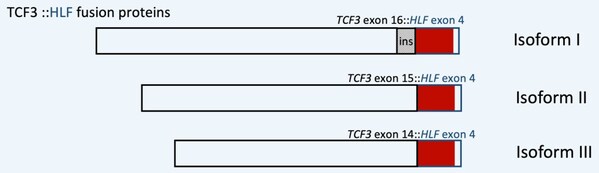
- Discovery of Three Fusion Isoforms:
The research team precisely identified three TCF3::HLF fusion subtypes and clarified that Isoform III is an alternative splicing product of Isoform II. Previous literature has frequently misidentified Isoform III and Isoform II isoforms.
- Identification of Key Mutagenic Pathways (RAS and CD33):
Gene mutation screening revealed that among patients with mutations, up to 85.7% carried RAS pathway mutations (e.g., NRAS, KRAS), suggesting this pathway may play a significant role in disease development and progression, providing a basis for potential targeted therapies.
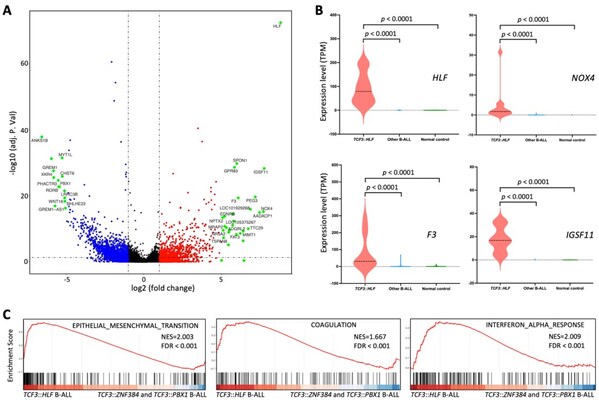
- Transcriptome Reveals Molecular Features Associated with Invasiveness:
Whole transcriptome analysis revealed that the aggressiveness of this leukemia stems from significant transcriptional remodeling within the cells, characterized by marked activation of epithelial-mesenchymal transition (EMT), abnormal coagulation activation, and immune dysregulation pathways. This “pro-migratory, pro-thrombotic” phenotypic shift may explain its highly aggressive clinical behavior.
Bridging Lives: Practical Strategies with CAR-T and Hematopoietic Stem Cell Transplantation (allo-HSCT)
Beyond breakthroughs at the basic molecular level, the research team, based on long-term follow-up data (the cohort’s 5-year overall survival rate was 35.2%), provided clinically valuable treatment strategies for management:
- Allogeneic Hematopoietic Stem Cell Transplantation (allo-HSCT) is a Key Treatment Strategy for Achieving Long-Term Survival:
Study data showed that patients who underwent allo-HSCT had significantly improved overall survival (OS) and event-free survival (EFS) (p < 0.0001). Patients who did not undergo transplantation had extremely poor prognoses, with most experiencing early relapse after diagnosis.
- CAR-T Cell Therapy Can Serve as an Effective Bridging Strategy Before Transplantation:
For this type of leukemia, which is highly resistant to chemotherapy, although CAR-T therapy alone is unlikely to provide durable remission, it plays a crucial role in inducing minimal residual disease (MRD) negativity and facilitating patients’ smooth transition to the transplantation phase. In this study, 11 patients achieved MRD negativity through CAR-T therapy and subsequently underwent successful transplantation during their first complete remission (CR1).
Conclusion and Outlook
The study published by the Lu Daopei Molecular Medicine Team in British Journal of Cancer fills an international gap in large-scale whole transcriptome and comprehensive clinical analysis of TCF3::HLF-positive B-ALL, providing important evidence for personalized diagnosis and treatment of this extremely high-risk subtype.
From identifying potential molecular targets (such as RAS pathway abnormalities) to exploring the “CAR-T bridging combined with allogeneic hematopoietic stem cell transplantation” treatment strategy, this study offers new insights for optimizing treatment pathways for these patients! In the future, the team will continue to leverage advanced molecular diagnostic technologies and leading genomic analysis capabilities to support precise clinical diagnosis and treatment, bringing tangible therapeutic benefits to more patients with rare and difficult-to-treat hematological diseases.
Dr. Xue Chen and Associate Chief Technician Xiaoli Ma from the Lu Daopei Molecular Medicine Laboratory are the co-first authors of the paper, and Director Hongxing Liu is the corresponding author.
– Author Biographies–
Dr. Xue Chen
Molecular Medicine Laboratory, Lu Daopei Hospital
Doctor of Hematology, Peking University Health Science Center; Licensed Pathologist/Laboratory Physician; Deputy Supervisor of the Molecular Medicine Laboratory and Core Member of Genomics Analysis at Lu Daopei Hospital. Responsible for the clinical application and continuous improvement of projects related to hereditary hematological diseases and fusion genes. Analyzed and summarized data from over 20,000 fusion gene screenings and more than 3,000 acute leukemia transcriptome sequencing cases, accumulating extensive practical experience in the molecular classification of complex hematological diseases. Published over 30 academic papers as first author in internationally renowned journals such as Nature Medicine, Blood, Blood Cancer Journal, American Journal of Hematology, Blood Advances, and British Journal of Cancer, with a cumulative impact factor of 175. Has presented academic reports at hematology annual meetings in China, the United States, Japan, and South Korea, as well as at the American Society of Human Genetics Annual Meeting.
Xiaoli Ma, Associate Chief Technician
Molecular Medicine Laboratory, Hebei Yanda Lu Daopei Hospital
Associate Chief Laboratory Technician, Assistant Researcher. Joined the Lu Daopei Molecular Medicine Team in 2014 and has since been responsible for nucleic acid extraction, leukemia fusion gene detection, and report interpretation, accumulating extensive experience in nucleic acid extraction from various specimen types and fusion gene detection. A core member of the Molecular Medicine Laboratory’s genomics analysis team, has published academic papers as first author and presented research findings at conferences such as the Japanese Society of Hematology (JSH) Annual Meeting and the International Society for Laboratory Hematology (ISLH) Annual Meeting.
Director Hongxing Liu
Executive Director of Beijing Lu Daopei Institute of Hematology; Director of the Department of Pathology and Laboratory Medicine, Lu Daopei Hospital
Researcher, Licensed Laboratory Physician/Pathologist. Has 3 years of clinical physician experience and 23 years of experience in experimental diagnosis and research of hematological diseases. Has made multiple internationally original discoveries or achieved internationally leading research results in the molecular classification of leukemia and pathogenic molecular mechanisms, directly contributing to the precise diagnosis and improved treatment of hematological diseases and influencing international diagnostic and treatment guidelines. Has published over 170 papers as corresponding/first author in academic journals such as Nature Medicine, Blood, Science Bulletin, Blood Cancer Journal, and American Journal of Hematology.