

BeijingApril 27, 2026 /PRNewswire/ — On April 9, 2026, the authoritative hematology journal Haematologica published online two correspondence papers on atypical acute promyelocytic leukemia (aAPL). The studies were completed by the Lu Daopei Molecular Medicine Team in collaboration with the Second Hospital of Shanxi Medical University and Tai’an City Central Hospital, respectively, revealing two distinct molecular mechanisms of aAPL pathogenesis and primary resistance to all-trans retinoic acid (ATRA).
Article One:
Assisting the teams of Professor Wang Hongwei and Professor Xu Zhifang from the Second Hospital of Shanxi Medical University and Shanxi University of Chinese Medicine, reporting a novel fusion gene and re-validating the “tripartite fusion” resistance mechanism.
Paper Title: Novel ligand-binding domain truncated CPSF7::RARA::CPSF7 tripartite fusion confers primary ATRA resistance in atypical acute promyelocytic leukemia
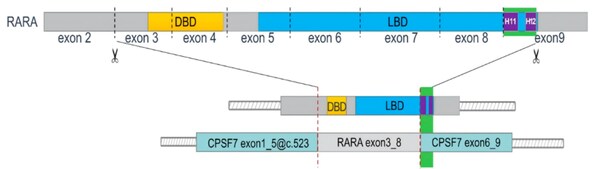
Key Findings
- First report of a new retinoic acid receptor (RAR) fusion partner gene, CPSF7, further expanding the diversity of fusion genes in aAPL.
- Re-validated the reproducibility of the “tripartite fusion” gene previously discovered by the Lu Daopei Molecular Medicine Team and its critical role in primary ATRA resistance.
Researcher Liu Hongxing from the Lu Daopei Molecular Medicine Team is the co-corresponding author of this paper.
Article Two:
In collaboration with Director Liu Qinqin from Tai’an City Central Hospital, revealing a novel resistance mechanism of “bipartite fusion plus cis-mutation.”
Paper Title: Bipartite NUP98::RARA-E412* fusion with a cis-aligned ligand binding domain truncation mutation in atypical acute promyelocytic leukemia
Key Findings
- Reports a newly discovered mechanism of pathogenesis and resistance: aAPL pathogenesis and primary ATRA resistance caused by a “bipartite RAR fusion combined with a cis-truncating mutation.”
- For the first time, the study identifies in an aAPL case with NUP98::RARA fusion that, although the patient carries a bipartite fusion gene, the fusion transcript simultaneously harbors a nonsense mutation in the ligand-binding domain.
- Convergent pathogenic mechanism: The study further clarifies that this cis-mutation directly leads to truncation of the critical 12th helix (H12) in the LBD domain. This mutation-mediated LBD truncation mechanism functionally converges with the previously discovered “tripartite fusion,” rendering leukemia cells completely insensitive to ATRA. It represents another key molecular mechanism driving aAPL pathogenesis and primary ATRA resistance.
Dr. Chen Jiaqi and Dr. Zhou Xiaosu from the Lu Daopei Molecular Medicine Team are the co-first authors of this paper, and Researcher Liu Hongxing is the primary corresponding author.
These two “companion” studies, published simultaneously in an international authoritative journal, further enrich the molecular genetic landscape of aAPL and systematically reveal novel pathogenic mechanisms and the molecular basis of primary ATRA resistance. The findings not only provide direct guidance for precise diagnosis and clinical decision-making for patients but also offer important directions for future research into novel therapeutic strategies. In recent years, the Lu Daopei Molecular Medicine Team, in collaboration with multiple domestic partner hospitals, has continuously advanced research in the aAPL field and actively promoted the transition from molecular understanding to precise clinical practice, demonstrating a leading influence in this area.
Both papers are available for free download on the official website of Haematologica.
-Author Biographies-
Dr. Chen Jiaqi Molecular Medicine Laboratory, Hebei Yanda Lu Daopei Hospital; Beijing Lu Daopei Institute of Hematology. Ph.D. in Pharmacology from Jilin University. Joined the Lu Daopei Molecular Medicine Team in 2017, primarily responsible for clinical applications and related research of pharmacogenomics projects, and a key member of the relapsed/refractory and atypical APL project group. Author of over 30 academic papers, with multiple presentations and exchanges at international and domestic conferences including ASH, JSH, KCA, and ISLH.
Dr. Zhou Xiaosu Associate Researcher, Precision Medicine Center, Beijing Lu Daopei Institute of Hematology; Beijing “Yicheng Outstanding Talent”; Ph.D. from Ocean University of China, postdoctoral fellow at Peking Union Medical College. Joined the Lu Daopei Molecular Medicine Team after postdoctoral work, focusing on the development of molecular diagnostic technologies for hematologic tumors and immunotherapy-related research. Later transferred to the Institute of Hematology, responsible for gene function and pathogenic mechanism studies. Member of the Tumor Genetic Diagnosis Committee of the Chinese Anti-Cancer Association and the Laboratory Medicine Committee of the Beijing Non-Governmental Medical Institutions Association. First author of several papers in journals including Blood, American Journal of Hematology, and Haematologica, with some results featured as cover papers and invited expert commentaries.
President Liu Hongxing Executive President, Beijing Lu Daopei Institute of Hematology; Director, Department of Pathology and Laboratory Medicine, Lu Daopei Hospital. Researcher, licensed physician in laboratory medicine/pathology. Has 3 years of clinical practice and 23 years of experience in experimental diagnosis and related research of hematologic diseases. Has made multiple internationally original discoveries or leading research achievements in new molecular subtypes and pathogenic mechanisms of leukemia, directly contributing to precise diagnosis and improved treatment of hematologic diseases, influencing and rewriting international diagnostic guidelines. Corresponding/first author of over 170 papers published in academic journals including Nature Medicine, Blood, Science Bulletin, Blood Cancer Journal, and American Journal of Hematology.