

San FranciscoApril 28, 2026 /PRNewswire/ — Dreame Nebula NEXT, a globally oriented high-end new energy brand, made another appearance in Silicon Valley, USA, on April 27, following its debut at CES and the Super Bowl in 2026, hosting an exclusive automotive launch event. Themed “DRIVE NEXT — From transportation to transformation,” the event unveiled the cutting-edge rocket car and several core technologies, drawing significant attention from the global tech and automotive industries.
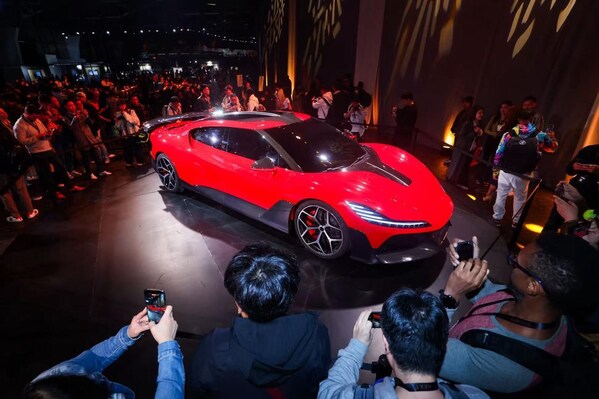
Dreame Nebula NEXT unveils rocket car, drawing significant attention from the global tech and automotive industries.
“N+1” Philosophy: Breaking Through the Anti-Involution Trend Amid the industry’s deep entrenchment in price wars, Dreame Nebula NEXT has chosen a path of upward breakthrough against the tide of involution. At the launch event, Dreame Nebula NEXT reiterated its car-making philosophy of “technology first, product second.” Its theoretical foundation lies in the “N+1” model: building upon the world’s best products by doing a little more and a little better, creating an ultimate experience that surpasses users’ daily needs. Dreame’s goal is to push core technologies to the ceiling of physical limits, then make them the floor beneath ordinary users’ feet.
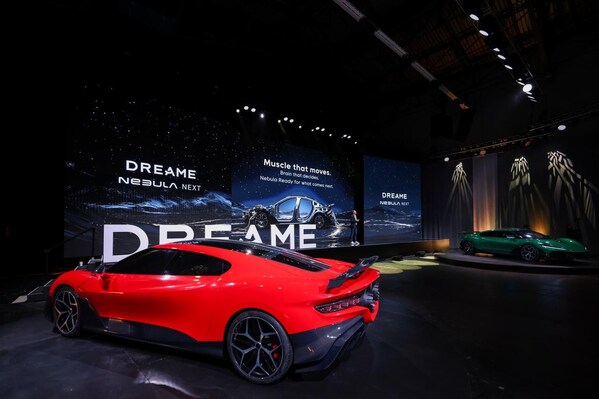
The rocket car unveiled by Dreame Nebula NEXT is equipped with a custom dual solid rocket booster system.
Challenging Physical Limits: Rocket Power and Hardcore New Energy Core Technologies Share the Stage The core technology foundation revealed at this launch event is a direct challenge to engineering limits. The “Nebula NEXT 01 Concept JET Edition” rocket car, equipped with a custom dual solid rocket booster system, stunned the audience. This “fastest on Earth” land lightning, a futuristic mobility tool, delivers a 150-millisecond rapid response, unleashing a maximum thrust of up to 100kN, achieving an astonishing 0-100 km/h acceleration in 0.9 seconds, redefining the power boundaries of mobile travel.
To realize the rocket car, Nebula NEXT has undertaken a comprehensive system-wide upgrade of the chassis architecture, aerodynamics, and vehicle control system. Leveraging self-developed vehicle control technology, rocket thrust seamlessly integrates with the original vehicle power; a dedicated super suspension ensures stability and safety under extreme acceleration conditions. Self-developed wind-control technology optimizes airflow from the rocket exhaust, enabling efficient synergy between tail flame thrust and vehicle aerodynamics for stable high-speed ground-hugging travel.
The significance of this rocket car extends beyond hardcore performance parameters; it represents the brand’s forward-looking exploration for the future. The rocket car is the starting point for exploring ultimate mobility. In the future, the brand will continue to launch cutting-edge products such as aerospace-powered vehicles, deepening the integration of aerospace technology and the automotive industry, continuously breaking performance ceilings, and reshaping future mobility forms.
In chassis technology, atomic-level technological reconstruction completely resolves the physical limitations that traditional chassis have faced for nearly a century in terms of space, power, handling, and comfort. The Tianxun intelligent chassis features a full wire-controlled architecture and a 14-degree-of-freedom nonlinear control architecture, with a response time within 1 millisecond. Paired with electromagnetic fully active suspension and fully dry wire-controlled braking, it reduces the turning radius to under 5 meters, lowers overall energy consumption by over 50%, and supports advanced functions such as lateral parking, in-place turns, and stability during tire blowouts.
The crystalline solid-state power battery unveiled on-site adopts a sulfide route and is a 60Ah (ampere-hour) large-capacity solid-state battery capable of mass production. In laboratory tests, its single-cell energy density exceeds 450Wh/kg—more than double that of traditional lithium-ion batteries—and lays the foundation for a future target of 800Wh/kg. At the same volume, its energy storage is nearly double that of traditional batteries, and it supports 1-2C fast charging. Most critically, in terms of safety, laboratory tests show that even under standard needle puncture, extrusion, and heating conditions, this battery does not catch fire or explode. The battery is currently in the mass production preparation phase.
From Software-Defined to AI-Defined: Building a High-Level Intelligent Symbiont Beyond hardware breakthroughs, Dreame Nebula NEXT has proposed a major industry thesis: the current era is “Software-Defined Vehicles” (SDV), and the next stop is “AI-Defined Vehicles” (AIDV). At the electronic and electrical architecture level, Dreame has built a high-performance vehicle communication and computing platform to support real-time coordination across the entire vehicle system.
In the intelligent cockpit, the Metis Meta-Intelligence Agent is introduced, based on on-device large model deployment, transforming the intelligent cockpit from a command-based “remote control” into a dedicated butler that actively understands users, enabling proactive services and cross-device scheduling, making the vehicle a “central brain” connecting home robots and other ecosystem devices.
On the autonomous driving front, for the first time, the underlying architecture integrates the intelligent cockpit, autonomous driving, and intelligent chassis, unveiling a truly thoughtful, learning-capable, and co-driving high-level general-purpose brain. Nebula NEXT has released the next-generation vehicle-mounted LiDAR—DHX1—developed in collaboration with core partners! This product is co-developed by Nebula NEXT and its top global core partners, based on their 6D full-color thousand-line LiDAR platform, deeply tailored to Nebula NEXT’s exclusive autonomous driving needs, serving as the “eye of intelligent driving” custom-made for Nebula NEXT. It supports up to 4320-line full-color 4K ultra-high-definition perception, with a maximum detection range of 600 meters, still reaching 400 meters at 10% reflectivity, and can clearly identify small targets such as water barriers at 300 meters and small animals at 280 meters.
Summit Dialogue: A Clash of Wits Between Legendary Pioneers and Chinese New Forces The ultimate technological exploration has captured the attention of the global tech community. At the event, Sebastian Thrun, former Google Vice President, co-founder of Google X, entrepreneur, computer scientist, and known as the father of modern autonomous driving, was invited on stage for a summit dialogue with Jake Ma, executive of Dreame Nebula NEXT, on the future of mobility.
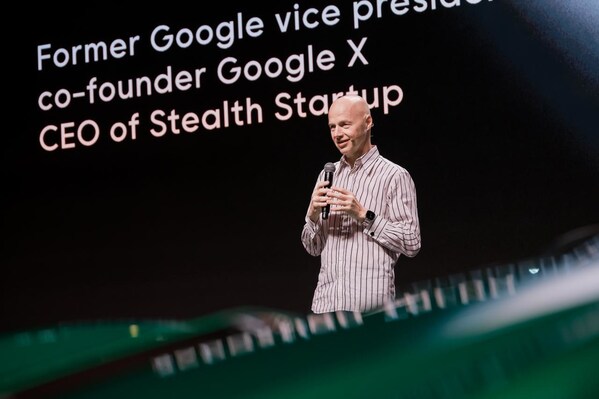
Sebastian Thrun, former Google Vice President, co-founder of Google X, entrepreneur, and computer scientist, known as the father of modern autonomous driving, was invited on stage for an exchange.
The two focused on transforming cutting-edge AI research results into practical vehicle systems, delving into the deep integration of full-stack AI. Thrun highly praised Dreame’s forward-looking exploration in autonomous driving and cross-device AI ecosystems. During the dialogue, Ma emphasized: “We are not just building a car; we are creating a new brain for the physical world.” This powerful dialogue between academia and industry not only sparked media attention at the event but also underscored Dreame’s long-term strategic investment in intelligent technology and system-level engineering.
“Chinese innovation, global ambition, human mission.” The successful DREAME NEXT automotive event was not only a comprehensive showcase of the ultimate performance of intelligent vehicles but also a powerful charge by Chinese intelligent manufacturing to the top of the global industrial value chain. The four-day DREAME NEXT launch event is ongoing. Following the automotive segment, Dreame will continue to demonstrate its full “Human-Vehicle-Home” ecosystem capabilities. More exciting achievements from Dreame Nebula NEXT will continue to be unveiled; please stay tuned.