

CairoApril 30, 2026 /PRNewswire/ — During the North Africa leg of the Huawei Data Communication Innovation Summit 2026 (HNS 2026), Huawei, together with industry organizations and customers, released the Galaxy AI Campus All-Domain Security Technical White Paper (hereinafter referred to as the “White Paper”) for overseas markets. The White Paper proposes for the first time four security dimensions—connection, asset, space, and privacy—to build a three-dimensional, all-domain security architecture, marking a new phase for AI campus security from point protection to “all-domain awareness and proactive intelligent defense.”
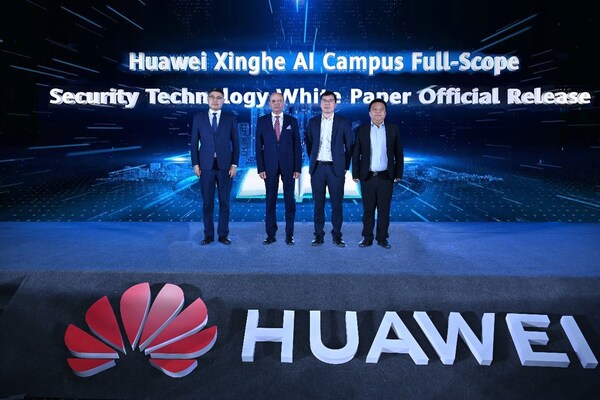
Huawei jointly releases the Galaxy AI Campus All-Domain Security Technical White Paper with industry organizations (from left to right: Yang Jiayuan, Vice President of Huawei Data Communication Product Line; Mohamed Ben Amor, Secretary General of the Arab ICT Organization; Ye Hailiang, Director of Northern Africa Enterprise Network Marketing and Solution Sales; Zhu Yaming, Vice President of Huawei Data Communication Product Line Campus Network Domain)
The White Paper systematically constructs an all-domain security technical architecture, providing the first comprehensive framework for global campus network security. Zhu Yaming, Vice President of Huawei Data Communication Product Line Campus Network Domain, stated: “Security is the cornerstone of AI campuses. Through the integration of ‘digital + physical’ domains, Huawei achieves three-dimensional protection from connection and asset security to space and privacy security, driving campuses from passive defense to proactive awareness and intelligent guardianship.” The four security dimensions include:
Connection Security: To address the vulnerability of air interface data to attacks, Huawei exclusively introduces Wi-Fi Shield technology, which completely prevents data packet capture at the physical layer. On the wired side, end-to-end MACsec combined with PQC (Post-Quantum Cryptography) algorithms provides long-term security for data transmission in the quantum era, ensuring end-to-end data leakage prevention.
Asset Security: In response to the surge in network attack risks from the proliferation of dumb terminals in sectors such as government and finance, Huawei’s clustering recognition technology achieves a 95% automatic recognition rate for dumb terminals. Combined with terminal abnormal behavior detection and local switch inference, it enables second-level detection and proactive blocking of abnormal traffic, effectively preventing network intrusion spread and ensuring terminals are visible, manageable, and protected against unauthorized connections and counterfeiting.
Space Security: Huawei’s Wi-Fi APs, through CSI (Channel State Information) intelligent sensing technology, allow a single AP to detect spatial security status, preventing unauthorized intrusion in sensitive areas. This technology only analyzes wireless signal perturbation characteristics, safeguarding spatial security while maximizing personal privacy protection.
Privacy Security: In scenarios such as conference rooms and hotel rooms, covert filming incidents are frequent, and traditional methods for detecting hidden imaging devices suffer from low efficiency and high miss rates. Huawei launches the industry’s first SmartEye Anti-Spy AP, featuring comprehensive and accurate detection capabilities, to protect privacy security in scenarios like executive offices and hotel rooms, preventing leakage of business secrets and personal privacy.
In the future, Huawei will continue to collaborate with customers and industry organizations to implement the core technical indicators of the White Paper across various industries, injecting strong momentum into the high-quality development of secure and intelligent campuses.
For more information about the White Paper, please visit:
https://e.huawei.com/en/documents/products/enterprise-network/c1d4f9aa8b514ac188db924a0cb237dd