

ShenzhenMay 11, 2026 /PRNewswire/ — On May 9, Suzhou Sonavox Electronics, a global automotive acoustics giant, officially signed a strategic cooperation agreement with Daimon Robotics, a leader in embodied intelligence.
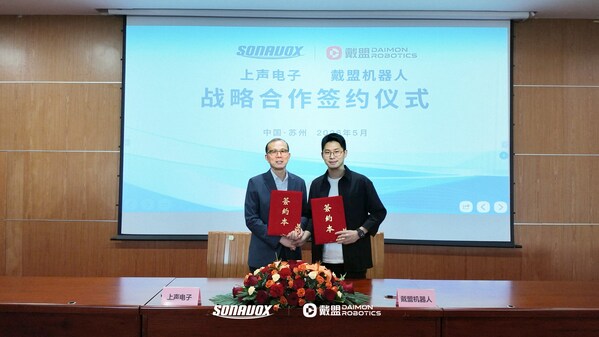
One is a manufacturing “hidden champion” serving Volkswagen, Tesla, and BYD; the other is a rising star in robotics, holding world-leading tactile sensing technology. Their collaboration targets the hottest track today: the industrialization of embodied intelligence.
This powerful alliance undoubtedly sends a significant signal: embodied intelligence has officially moved from the “demo era” into the “production line payoff period,” and the path of “being deployable, iterable, and replicable” is being pioneered by top players.
Many may not know that Sonavox Electronics is an undisputed “hidden champion” in the automotive acoustics field. Founded in 1992 and listed on the STAR Market, this Chinese domestic company is one of the world’s largest manufacturers of automotive acoustic products, with a global market share of 16.1% and a domestic market share that has ranked first for many years. Well-known automotive brands such as Volkswagen Group (including high-end models from Lamborghini, Porsche, Audi, and Bentley), Ford, General Motors, Tesla, SAIC, BYD, NIO, and Leapmotor are all long-term clients of Sonavox.
Notably, Sonavox Electronics not only provides acoustic products to these automakers but also deeply participates in product co-development and mass production delivery, possessing a complete chain capability of “R&D validation – engineering delivery – large-scale manufacturing.” For embodied intelligence companies, entering such a mass production system and co-development rhythm means a partnership leaning toward long-termism: longer engineering iteration cycles, stricter quality systems, and more realistic cost and yield targets.
With embodied intelligence currently booming, the market is not short of so-called robotics companies. Why did Sonavox specifically choose Daimon?
The answer lies in three key words: tactile sensing, data closed loop, and dexterous manipulation.
Zhou Jianming, Chairman of Sonavox Electronics, hit the nail on the head: “This is a crucial step for Sonavox to upgrade from automotive acoustics to embodied intelligence plus automotive electronics.”
In automotive electronics manufacturing, acoustic products are becoming increasingly precise, demanding higher precision and more flexible operations on the production line. Particularly in challenging areas like precision assembly, flexible grasping, complex process operations, and quality inspection, traditional automation has hit a ceiling—the shortage is not of automated programs for robotic arms, but of robots’ fine manipulation capabilities.
Daimon, precisely, is one of the few companies globally with the full-chain capability of “high-resolution tactile sensing + multimodal data collection + manipulation model training.”
In other words, Daimon enables robots to truly develop “hands that can think.”
Stability, precision, longevity, and mass production are undoubtedly the core competition of embodied intelligence. The value of tactile sensing has thus shifted from “icing on the cake” to “a decisive factor.”
This is precisely Daimon’s strength: it builds systematic capabilities around tactile sensing and dexterous manipulation—visual-tactile sensing technology, teleoperation and multimodal data collection, manipulation model training and scenario deployment. This set of capabilities acts more like the “foundation” of embodied intelligence rather than a single product.
More critically, in April this year, Daimon, in collaboration with multiple institutions, released the world’s largest multimodal physical world dataset containing tactile data, covering tactile, visual, trajectory, and instruction modalities. This provides sustainable data supply for “model R&D – scenario training – industrial deployment.” The partnership with Sonavox further elevates this data and model capability to continuous iteration on “real industrial tasks,” forming a rolling engineering flywheel.
The combination of “tactile sensing + production line + listed company system” is raising the bar for embodied intelligence deployment—and also means the window of opportunity will increasingly converge toward the leaders.
Taking this collaboration as an example, we can see the key factors to consider when betting on the embodied intelligence track:
“Real production lines” are an absolutely scarce resource
What embodied intelligence needs most to scale is a sustainable, reproducible, and engineerable real-task environment. Sonavox’s global production lines, rich process tasks, and mass production manufacturing system mean Daimon’s capabilities will be continuously validated and iterated under real industrial constraints—a crucial step from “demonstrable” to “deliverable.”
A high-quality physical interaction data closed loop is key
For robots to learn stable assembly, insertion, grasping, and inspection, vision alone is far from sufficient. The key lies in the details at the moment of contact: force, friction, deformation, and slip.
Daimon’s positioning is essentially as an embodied intelligence tactile infrastructure: providing a data foundation for “teaching models to perform correct actions in the physical world” through visual-tactile sensing, multimodal data collection, and manipulation model training. This collaboration connects “data collection – model training – engineering validation” into a closed loop, continuously rolling on real production line tasks.
Replicable scenario-specific solutions
From the disclosed cooperation plan, the two parties will prioritize joint validation in areas like precision assembly, flexible grasping, complex process operations, quality inspection, and data collection within automotive electronics manufacturing. They will gradually develop embodied intelligence solutions tailored for industrial manufacturing. This means their goal is not merely to “build a robot,” but to construct “transferable capability modules + replicable industry templates,” with potential spillover effects extending beyond a single client.
If such collaborations succeed, they often bring two changes: the technology provider upgrades from a “capability supplier” to a “co-builder of production line solutions”; the production line owner moves from “point automation” to “data-driven adaptive intelligent manufacturing.” In this process, tactile sensing is becoming a dividing line in the industry.
Embodied intelligence is beginning to show a more defined path to industrialization—and once the path is validated, the next competition will be about who can replicate it faster across more production lines, more countries, and more product categories.