

This article was originally published on the WeChat public account “Cloud Data Intelligence Observer” by author Guo Tao. Reproduced with permission.
BeijingMay 13, 2026 /PRNewswire/ — In the AI era, after computing power took the spotlight, attention has now turned to storage. While computing power determines the ceiling of AI, storage determines whether AI can truly be implemented, and whether it can be used well, used for a long time, and affordably.
Media Observation: In the Token Economy Era, How Should Storage Play Its Leading Role?
Behind the Storage Price Surge
Recently, a wave of storage product price increases has continued to spread, with tight supply across core components including DRAM, NAND flash, hard disk drives, and tape. In particular, delivery cycles for large-capacity 20TB and 24TB hard drives have been significantly extended. Wu Lei, General Manager of IBM Storage, Greater China Group, noted a phenomenon: even with ample budgets, many enterprises are finding it difficult to get storage products delivered quickly. This situation closely mirrors the acute shortage of GPUs, where “a single card is hard to come by,” indicating a comprehensive escalation of supply-demand imbalances and multiplying global supply chain and cost pressures.
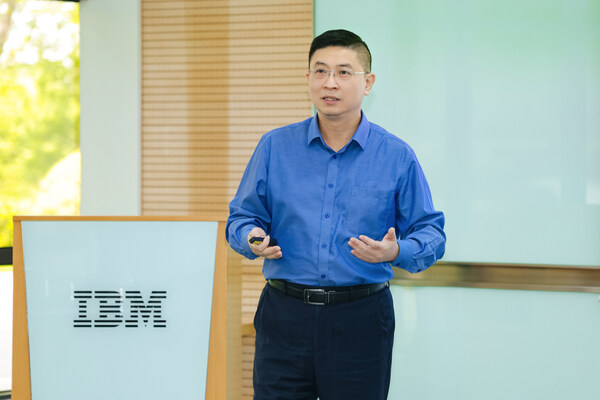
Wu Lei, General Manager of IBM Storage, Greater China Group
In reality, the imbalance in the storage supply chain is just the tip of the iceberg. The rapid iteration of innovative technologies, the emergence of new workloads, and the high demands of enterprise users for security and automated operations are the greatest sources of pressure.
Looking at the shift in business needs, as AI moves fully from the model training phase into an explosion of inference, enterprise storage requirements have fundamentally changed. AI inference inevitably relies on an enterprise’s massive, multi-type, real-time internal data. The inability to reuse and activate data has become a common pain point. Additionally, with the rapid iteration of large models and the surge in parameter counts, higher demands are placed on storage in terms of response speed, concurrency, and data mobility.
Furthermore, from the perspective of daily enterprise security and operations practices, weaknesses such as complex technical architectures, escalating attacks, and a shortage of professional talent are further magnified. On the security front, hackers leverage AI technology to dramatically increase the speed and destructiveness of ransomware attacks. Traditional security response mechanisms are nearly obsolete, requiring threat detection, identification, and response at the second or even millisecond level; otherwise, enterprises face massive data loss. On the operations front, enterprises have widely adopted heterogeneous architectures combining “hybrid multi-cloud and multi-vendor equipment,” which raises the labor costs and technical barriers for operations teams.
It cannot be ignored that enterprise data scales are in a long-term phase of accelerated explosion, jumping from hundreds of terabytes to tens of exabytes. This data includes a mix of structured, semi-structured, and unstructured data, covering diverse sources like IoT devices, smart vehicles, medical imaging, and industrial sensors. At the same time, industries such as finance, healthcare, government, and automotive have strict compliance requirements, and long-term data retention increases storage difficulty and cost.
On one hand, data must serve business needs, efficiently converting massive amounts of data into real business value. On the other hand, data requires long-term compliant retention and full-lifecycle security control. The superposition of these dual pressures forces enterprises to seek new storage technologies, architectures, and solutions.
Let AI Go to the Data
Wu Lei pointed out that the core storage concept of “Let AI Go to the Data” directly addresses the pain points of traditional storage models and will become key for enterprises building AI competitiveness.
In the past, enterprises commonly adopted traditional methods of “data movement and multi-copy duplication.” To meet AI processing needs, data had to be copied, uploaded, and processed centrally. This approach was workable in the era of small-scale data but falls short in the “Token Economy” era of exabyte-scale data and high-concurrency inference.
Shifting from “Data Goes to AI” to “Let AI Go to the Data” represents a paradigm change. Wu Lei explained that enabling AI to proactively move to the data, understand it, and process it locally will fundamentally solve the problem of data movement.
Traditional multi-copy approaches not only incur high network and storage costs but also lead to a series of issues such as loss of data consistency, increased difficulty in security control, and complex compliance traceability. Sometimes, enterprises cannot even determine which copy is the true, latest data, potentially leading to distorted AI inference results or significant waste of computing power.
IBM’s solution is centered on a “single-copy architecture + Content-Aware Storage (CAS)” technology core. This allows storage to actively perceive data changes and synchronize them with AI models instantly upon data update, eliminating the need for manual re-copying or repeated data processing. This achieves a state where data is updated once and available globally. This new architecture significantly reduces data transfer and security control costs, ensures data uniqueness, accuracy, and real-time availability, and effectively eliminates bottlenecks related to messy data, excessive copies, and low efficiency.
Building on this, IBM has further proposed the concept of an “AI Factory,” aiming to create an end-to-end AI data platform covering data collection, integration, preparation, training, model adaptation, inference, and archiving. This allows data to flow freely throughout its lifecycle and continuously generate value.
Wu Lei used a culinary analogy for the evolution of storage in the token economy era. Traditional storage is like a home kitchen; SAN/NAS is like a pre-processing factory; application storage is like a ready meal. The new “AI+” requires storage to become a “personal chef” – intelligent storage that can dispatch on demand, proactively serve, and respond to AI workloads in real-time, maximizing data value.
In summary, letting AI go to the data means upgrading storage from a passive “data container” to an active “intelligent data service layer.” This allows AI to process data locally, learn in real-time, and infer efficiently where data is generated, achieving no data movement, more efficient AI, controllable costs, and traceable security. This transforms AI from a demo project into scalable productivity, building the most solid digital foundation for AI implementation.
Moving Towards Autonomous Storage, Practicing Efficiency and Effectiveness
Guided by the “Let AI Go to the Data” philosophy, IBM is deploying new storage products and technologies to build a data bridge for AI implementation.
1. Continuously Updating High-Performance AI Storage, Building the Computing Power Base and Data Engine for AI Factories
As the core engine of IBM’s AI Factory, the IBM Storage Scale System 6000/3500 targets high-computing-power scenarios such as large model training, multi-modal data processing, and ten-thousand-GPU clusters, providing end-to-end AI data pipeline support.
Specifically, for large model training checkpoints, it offers an architecture with extreme high throughput and low latency, ensuring critical checkpoint data is written quickly without losing progress or wasting computing power, significantly improving GPU effective utilization. It can uniformly handle mixed workloads including text, images, audio, video, and sensor data, adapting to the entire process from data preparation and distributed training to model adaptation and inference. A global unified namespace effectively bridges edge, data center, private cloud, and public cloud, enabling data to be updated once and available globally. It achieves deep ecosystem synergy with NVIDIA, for example, supporting high-speed protocols like GPUDirect, significantly reducing data movement overhead.
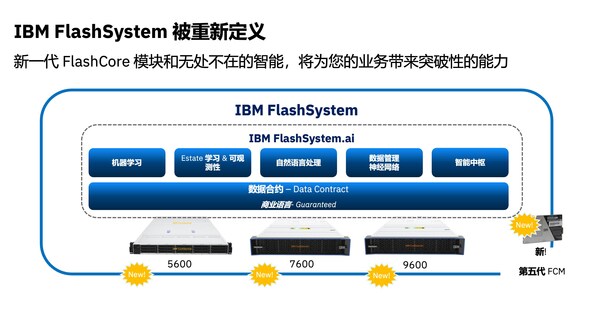
IBM FlashSystem Redefined
IBM Storage Ceph primarily targets AI workload scenarios requiring high IOPS, high concurrency, and cloud-native capabilities, providing unified, elastic, and horizontally scalable distributed storage. It uses a unified architecture combining block, file, and object protocols, simplifying cloud-native and virtualized environment deployment. It is compatible with the S3 API, adapting well to containers, microservices, and AI cloud platforms. Notably, it can start small and scale smoothly on demand, making it particularly suitable for long-term growth scenarios like data lakes, AI platforms, and massive small files.
2. Introducing AI Agents, Redefining the Core of Next-Generation Flash Storage
IBM is redefining enterprise all-flash storage by deeply integrating AI agents with self-developed hardware chips to create autonomous, secure, and efficient core business storage.
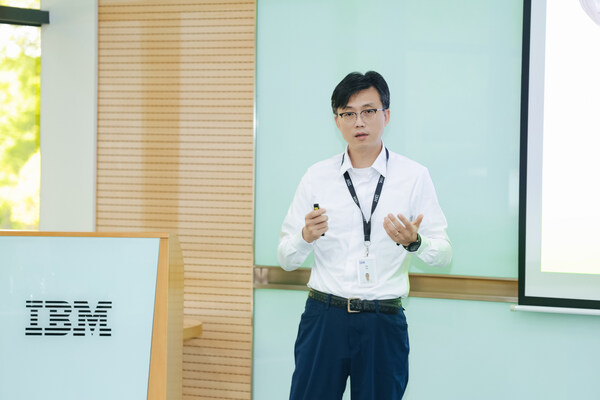
Jin Xin, Sales General Manager of IBM Storage Business, China
The new FlashSystem.ai is the intelligent hub for AI-driven autonomous storage. Positioned as a “never-resting intelligent storage administrator,” it upgrades storage from a passive device to an autonomous, self-governing intelligent layer. Jin Xin, Sales General Manager of IBM Storage Business, China, summarized the features and advantages of FlashSystem.ai: First, it supports natural language interaction, lowering the barrier of command lines and professional expertise, allowing even regular administrators to operate efficiently. Second, it achieves proactive performance optimization, for example, adapting to business workloads within hours, intelligently tuning resources, and migrating loads to improve overall efficiency and stability. Third, it provides second-level ransomware detection, for instance, identifying anomalies through I/O characteristics and issuing alerts within 60 seconds, combined with hardware-level protection for faster recovery. Fourth, it enables automated compliance auditing, automatically generating explainable audit reports, significantly reducing compliance documentation time and costs. Fifth, in terms of security, the system only supports safe operations like “add, expand, optimize” while strictly limiting high-risk actions like deletion, ensuring data security by design. Sixth, management efficiency is greatly improved, reducing manual storage management workload by up to 90%.
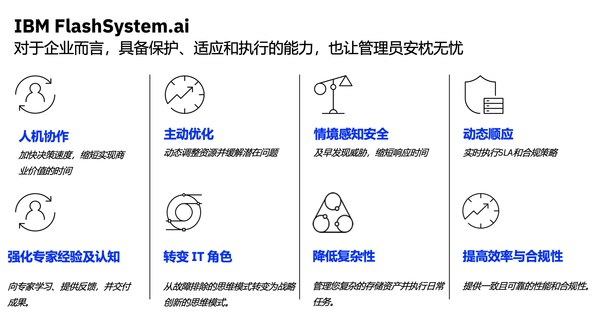
IBM FlashSystem.ai
Jin Xin also specifically highlighted IBM’s self-developed hardware-level black technology – the Fifth Generation FlashCore Module (FCM 5). Its importance and uniqueness lie in: enabling hardware-level compression, deduplication, encryption, and anomaly detection without consuming controller performance, supporting up to 5:1 hardware compression/deduplication, significantly reducing cost per TB. It employs quantum-safe encryption, using hardware-level encryption to withstand future quantum computing threats, effectively meeting long-term data security and compliance requirements. Currently, the fifth-generation FCM supports the entire IBM FlashSystem 5600/7600/9600 product line, covering everything from edge to core critical business.
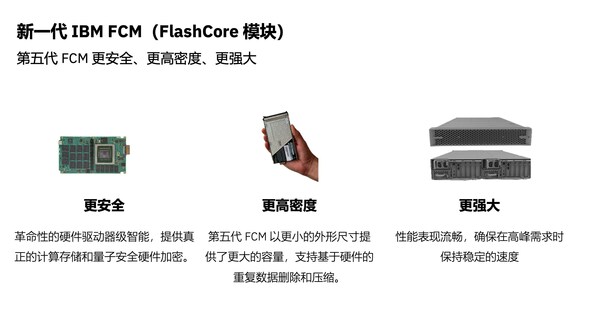
New Generation IBM FCM
Driven by AI agents, IBM FlashSystem.ai encapsulates trained AI models in local containers, replacing command lines and graphical interfaces with natural language interaction. This enables self-service management, automated operations, and proactive optimization of storage, aiming to manage large-scale, cross-brand, cross-era complex storage architectures with minimal human effort, achieving high efficiency, high resilience, low cost, and strong compliance, safeguarding business innovation.
If AI storage is the essential “basic skill” for the AI era, solving the matching problem between computing power and data, then IBM’s proposed “Autonomous Storage” is the “advanced form” of storage in the AI era, addressing the enterprise’s need for autonomous control over data, architecture, and operations. The two are interconnected and progressive, together forming IBM’s complete storage strategy for the “AI+” era. AI storage is the capability layer, while autonomous storage is the management/control layer. On top of AI storage, AI agents achieve autonomy, self-healing, self-optimization, and self-security. Autonomous storage can be understood as the implementation of IBM’s “Digital Autonomy” strategy at the storage layer, whose core is to give enterprises absolute control over their data and architecture, free from vendor or cloud lock-in, allowing them to autonomously plan their IT evolution path. It is foreseeable that future enterprise storage will be a fusion of “AI storage capabilities + Autonomous storage architecture.”
3. Tape: The Ultimate Destination for Data
As optical disc storage gradually exits, tape has become the “only” choice for supporting long-cycle (over 30 years), highly reliable, and low-cost storage, with reliability exceeding hard drives by 3 to 4 orders of magnitude. The latest LTO-10E tape offers a single-cartridge capacity of 40TB, with continuous leadership in capacity, density, and bandwidth. IBM tape drives can precisely locate in real-time during high-speed operation, ensuring zero deviation and high stability in data read/write. The tape is also thinner and tougher, supporting high-speed stable operation without easy stretching or breaking. It also features built-in quantum-safe encryption and supports WORM (Write Once Read Many) functionality, meeting long-term retention requirements for industries like finance, healthcare, and government. Its cost per unit capacity is significantly lower than hard drives, flash storage, and public cloud archiving.
Media Observation: In the Token Economy Era, How Should Storage Play Its Leading Role?
4. Full-Scenario Tiered Storage
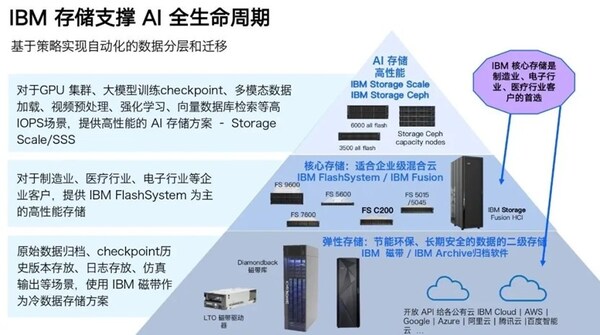
Beyond continuous innovation in technology and products, IBM has built a tiered storage system covering the entire data lifecycle, centered on policy-driven, intelligent awareness, and application transparency, balancing performance, cost, security, and compliance.
IBM FlashSystem all-flash storage is used for hot data, targeting high-concurrency, low-latency scenarios like ERP, core databases, real-time transactions, and AI inference, providing microsecond-level response and 7×24 high availability. Warm data can be stored on IBM Storage Scale/Storage Ceph, meeting the needs of AI training, data lakes, data analytics, virtualization, and hybrid cloud for large capacity, high throughput, and elastic scaling. Tape libraries are used for long-term retention of cold data, primarily for long-term archiving, compliance retention, and infrequently accessed data, achieving extreme low cost, high reliability, and long lifespan.
Media Observation: In the Token Economy Era, How Should Storage Play Its Leading Role?
Jin Xin stated that the core value of full-scenario tiered storage lies in its ability to automatically tier data based on access frequency, importance, and lifecycle, enabling intelligent automated migration without manual intervention. It is openly compatible with mainstream public clouds and effectively leverages existing infrastructure. Against the backdrop of tight supply chains and doubling hardware costs, it practically implements cost reduction and efficiency improvement.
Storage: Playing Its Leading Role
In the token economy era, storage is not a supporting actor but the foundation and lifeline for the large-scale implementation of AI. To some extent, it determines whether AI can run, because only low-latency, high-throughput, high-concurrency storage can continuously improve computing power utilization. It determines whether AI is economical, because intelligent tiered storage can optimize costs, giving AI stronger profitability. It determines AI’s security and compliance, with quantum-safe encryption and long-term retention being basic guarantees for business continuity.
Facing future storage challenges, “Let AI Go to the Data” and “Autonomous Storage” are the two cornerstones of IBM’s storage strategy, comprehensively leading enterprise storage towards intelligence, autonomy, efficiency, and security. Storage will evolve from a passive container to an active intelligent service layer. AI agents will transition from a bonus feature to a standard component, deeply integrated into the entire process of operations, optimization, security, and compliance. The full-stack tiered storage solution combining all-flash, distributed storage, and tape will better help enterprises achieve data autonomy in multi-cloud, heterogeneous, and deeply AI-implemented environments.