

 |
Hong KongMay 14, 2026 /PRNewswire/ — On May 13, 2026, METiS TechBio (7666.HK), the “world’s first AI-driven drug delivery stock,” which received early-stage investment and ecosystem empowerment from XtalPi (2228.HK), was officially listed on the Hong Kong Stock Exchange. The IPO raised over HK$2.1 billion, with a public subscription multiple exceeding 6,900 times, setting a new record for Hong Kong’s healthcare sector in 2026. This marks another milestone in the AI drug discovery field, following XtalPi’s listing as the “first AI pharma stock” on the Hong Kong Stock Exchange in 2024. The successful listing of the first ecosystem-empowered project not only brings substantial equity value returns to XtalPi but also strongly validates its investment and empowerment model as an ecosystem platform company. The AI innovation ecosystem built by XtalPi has fully entered a phase of value realization.
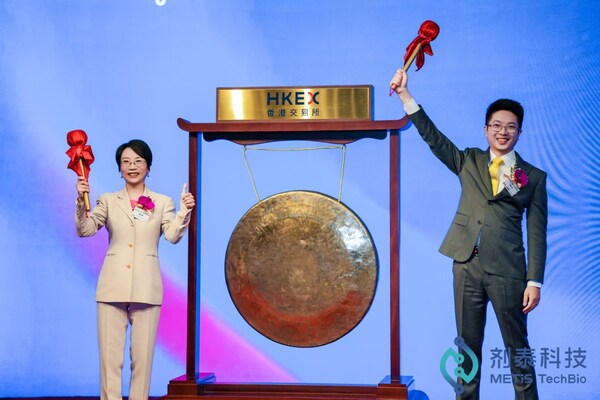
Dr. Laida Lai (right), co-founder and CEO of METiS TechBio, and Academician Hongmin Chen (left), co-founder, celebrate the company’s successful listing
XtalPi was METiS TechBio’s earliest investor and ecosystem enabler, deeply involved in its entrepreneurial vision, team building, and early-stage technology empowerment. Both companies’ founding teams hail from MIT, share AI as their core technology to build reusable underlying R&D platforms, and have successively gained recognition from globally renowned pharmaceutical companies and top investment institutions. From a leading laboratory to the capital market, this path of technology industrialization took XtalPi 10 years to explore, while METiS TechBio achieved it in just 6 years. Today, METiS TechBio has built the world’s largest library of millions of ionizable lipids. Its AI-empowered formulation drug, MTS-004, has advanced to Phase III clinical trials, making it the fastest-progressing AI-developed drug pipeline in China.
Thus, among the three AI pharma companies listed on the Hong Kong Stock Exchange, XtalPi and its invested company METiS TechBio occupy two seats. This is not only a “meeting at the summit” for the two sibling companies but also marks the substantive validation by the public market of XtalPi’s hard-tech investment and empowerment model as a platform-based leading enterprise.
Entrepreneurial Consensus Originating from MIT:
Bridging Cutting-Edge Concepts to Tackle Industry Pain Points
The entrepreneurial intersection of XtalPi and METiS can be traced back to a startup project open house event at the Massachusetts Institute of Technology (MIT) campus in the fall of 2016.
At that time, XtalPi, founded just over a year earlier, was dedicated to applying cutting-edge AI to solve the key challenge of drug crystal form prediction in new drug R&D. During that event, XtalPi co-founder Shuhao Wen met Laida Lai, who was still a PhD student at MIT. Lai’s lab, the Myerson Lab, was a joint laboratory established by Novartis and MIT, with research directions naturally spanning academic frontiers and industrial applications—highly aligned with XtalPi’s philosophy of transforming underlying physics and AI algorithms into real industrial innovation. Based on similar scientific backgrounds and pragmatic business acumen, Wen immediately invited Lai to join XtalPi as an early executive, driving the closed-loop construction of the company’s AI prediction and wet-lab validation system.
At the time, AI pharma was still a forward-looking and controversial direction. Drug R&D cycles are long, and most early-stage drug discovery algorithms struggled to obtain experimental closed-loop validation in the short term. The industry was cautious, and few investors dared to bet. However, XtalPi chose a different path: targeting the specific, verifiable technical link of crystal form prediction and participating in global blind tests to quickly validate the leading advantages of its quantum physics + AI algorithms in accuracy, efficiency, and the complexity of systems they could handle. This secured a decade-long strategic collaboration order with Pfizer, gaining public endorsement from a globally renowned pharmaceutical company. This milestone not only validated XtalPi’s technological path but also made it clear to Lai, who was then contemplating his next entrepreneurial venture, that with the rapid development of technology, markets, and computing power, AI would become an inevitable trend in the pharmaceutical industry.
True collaborative entrepreneurship and ecosystem co-building occurred a few years later. When Lai decided to start his own venture, the XtalPi team deeply participated in project discussions. Following Wen’s suggestion, he decided to apply AI capabilities to another highly barrier-ridden and promising area in drug R&D—formulation development and drug delivery—and further focused on macromolecular drug delivery. Formulation and drug delivery are closer to clinical application, more practical, and easier to achieve rapid validation and closed-loop platform capabilities. Subsequently, XtalPi’s scientific advisor, Academician Hongmin Chen, a member of both the U.S. National Academy of Sciences and the National Academy of Engineering, along with AI algorithm expert Wenshou Wang, officially joined. Corresponding to XtalPi, the name “METiS TechBio” was born. The team was officially established in 2020, focusing on AI-driven nano-delivery systems, creating an industrial chain synergy of “design + delivery” with XtalPi’s drug discovery and design capabilities. Wen Shuhao served as a board member of METiS, and XtalPi’s Chief Strategy Officer Yide Jiang served as an industry advisor.
By then, XtalPi had completed its technological and commercial accumulation in AI drug R&D. It not only injected early-stage capital into METiS but also, on the technical front, leveraged its established quantum physics algorithms and cloud supercomputing capabilities to empower METiS to quickly build its own R&D platform in its early stages.
Thus, both XtalPi and METiS chose to enter the industry from key links in preclinical drug R&D. One moved upstream, building an AI + robotics one-stop drug discovery platform spanning multiple drug modalities like small molecules, antibodies, peptides, siRNA, and molecular glues. The other delved downstream, self-developing the world’s first AI nano-delivery platform, establishing over 10 pipeline projects in just 6 years. Each has grown into a benchmark AI pharma company with scarce R&D capabilities and multiple innovative drugs advancing into clinical stages.
World’s First AI Drug Delivery Stock:
A Scarce Technology Platform Breaking the “Drug Delivery” Bottleneck
The high market attention on METiS TechBio’s listing stems from its core focus on one of the most challenging engineering problems in the era of nucleic acid and gene therapy—how to precisely deliver drugs to the lesion site.
Traditional lipid nanoparticle (LNP) delivery has fundamental limitations: most LNPs are passively captured by the liver, with extremely low extrahepatic delivery efficiency, severely restricting the clinical application of next-generation therapies like mRNA and gene editing. METiS’s self-developed world’s first AI nano-delivery platform, NanoForge, achieves a systemic breakthrough at this bottleneck. Like a precision-guided rocket, it aims to solve the “last mile” problem of new molecular drug development, bringing molecules and targets that traditional delivery methods cannot handle within range, breaking the curse of promising molecules failing clinically due to delivery issues.
Based on the NanoForge platform, METiS TechBio has developed three core technical solutions: AiLNP (AI nano-delivery system design platform), AiRNA (AI mRNA sequence design platform), and AiTEM (AI small molecule formulation design platform). Combining algorithms, intelligent agents, and high-throughput screening experiments, these cover multiple drug modalities including small and large molecules. This series of platform capability breakthroughs propels delivery system development from “empirical trial and error” into an engineering era of “AI-driven design,” bridging the R&D gap from “in vitro effective” to “in vivo effective,” enabling highly promising molecules to rapidly achieve clinical translation while enhancing drug safety and efficacy. METiS has pioneered precise targeted delivery to 8 key organs and tissues: liver, lungs, heart, muscles, tumor tissues, immune system, central nervous system, and gastrointestinal tract. Its liver-targeted delivery efficiency exceeds the industry benchmark by 20 times.
In terms of commercialization strategy, METiS TechBio adopts a dual-wheel-driven business model of “platform collaboration + product collaboration,” forming a synergistic ecosystem of “technology iteration – commercial application – real-world data feedback.” METiS TechBio has established partnerships with over 30 pharmaceutical and biotechnology partners globally. In 6 years, it has laid out over 10 pipeline products. Among them, MTS-004 is China’s first AI-empowered formulation new drug to complete Phase III clinical trials and the only PBA (pseudobulbar affect) drug in China to complete clinical trials, potentially filling a significant clinical treatment gap. It took only 38 months from project initiation to completion of Phase III trials. MTS-105 has the potential to be the world’s first in vivo mRNA-encoded TCE solid tumor therapy, targeting liver cancer and other advanced solid tumors with liver metastases. It has entered the investigator-initiated trial (IIT) stage and received U.S. FDA Orphan Drug Designation.
METiS TechBio’s platform strength has been dually validated by clinical trials and licensing collaborations. Its single-target platform collaboration deal value can reach $109 million, and the milestone total for MTS-004 in the PBA indication approaches RMB 1.85 billion, providing the company with sustainable revenue and clear commercialization potential.
Notably, as the “world’s first AI drug delivery stock,” METiS TechBio and the “first AI pharma stock” and “first AI + robotics stock” XtalPi have different technical focuses but share the same underlying logic: both deeply integrate AI models, AI agents, and high-throughput experimental systems, possess a core engine for continuously and autonomously generating high-quality data, and have built interdisciplinary, scalable, and reusable engineering platforms spanning multiple drug modalities like small molecules, large molecules, and nucleic acids. They drive dual growth in pipeline expansion and business collaboration through platform capabilities. XtalPi has defined a new paradigm for molecular discovery, while METiS fills a key piece of the drug delivery puzzle. The successive listings of the two companies demonstrate that AI has transcended being a “bolt-on tool” to become the core driving force for drug innovation breakthroughs and the underlying infrastructure throughout the entire chain, systematically enabling clinical translation and value creation at scale.
The First Ecosystem Platform Enterprise
in the AI for Science Field
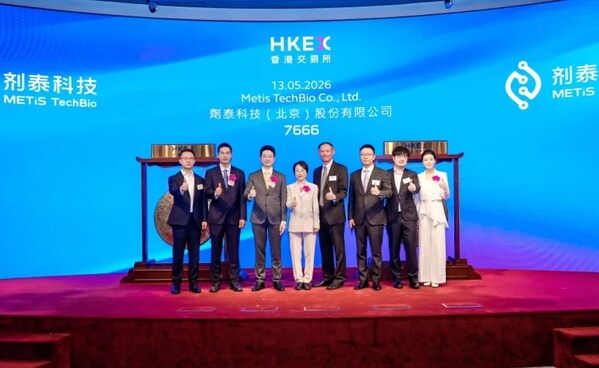
Dr. Yide Jiang (fourth from right), Chief Strategy Officer of XtalPi, attends the METiS TechBio listing ceremony with the METiS core team and investor representatives
XtalPi’s essence is that of an ecosystem platform enterprise. This attribute determines that its growth logic does not rely on the success or failure of a single pipeline or project but rather deploys a diverse innovation ecosystem through reusable underlying capabilities, systematically driving the dense emergence of innovative outcomes and reaping corresponding financial and commercial returns. XtalPi’s diverse ecosystem network and industrial implementation capabilities have become one of the scarcest resources in the AI for Science era, creating its unique investment and incubation model.
To date, XtalPi has invested in and incubated over 30 technology startups with unique technological advantages, covering core areas such as new drugs, new materials, and underlying algorithms. Its ecosystem layout has transcended traditional financial investment, evolving into deep ecosystem platform empowerment. METiS TechBio, as the first successfully IPO’d investment case, validates XtalPi’s investment vision and the feasibility of this empowerment path, marking the construction of a unique moat for XtalPi’s industrial implementation capabilities in the AI for Science field.
For a long time, new drug and new material R&D have been plagued by underlying contradictions: high trial-and-error costs, long validation cycles, and the difficulty of scaling experience. To break this industrial deadlock, XtalPi has consolidated quantum physics, AI, and large-scale robotic automation experimental capabilities into three core competitive advantages—a continuously iterable AI + robotics underlying platform, large-scale engineering innovation capabilities, and an open innovation ecosystem with synergistic advantages.
With these three capabilities combined, XtalPi is becoming the “global scientific infrastructure” of the AI for Science era. By continuously reusing algorithms and automated experimental clusters to accumulate interdisciplinary real-world data, the platform can consistently and systematically drive source innovation, tackling industrial challenges that are both highly difficult and highly rewarding.
Currently, this underlying platform has demonstrated high cross-modality and cross-track transferability. Across broad fields like small molecules, antibodies, peptides, nucleic acids, and molecular glues, XtalPi’s system empowerment capabilities are accelerating the transformation into tangible results for invested companies: assisting Sigilon Therapeutics (AI + organoid new drug discovery) , Leman Biologics (ultra-low-dose next-generation cell therapy) , Moda Biologics (next-generation platform drugs under immunometabolic mechanisms) , and ReviR Therapeutics (AI + RNA targeting rare diseases and autoimmune diseases) in achieving clinical translation for multiple innovative drugs; empowering Yashuo Technology (AI + organ-on-a-chip) , Deep Principle (AI new material discovery) , and Kemai Biologics (one-click antibody generation) in achieving milestone progress. These densely implemented cases prove that XtalPi has established an efficient, replicable business closed loop, continuously creating value for the industry and investors.
Looking ahead, XtalPi will continue to adhere to long-termism. As a technology enabler and ecosystem builder, it will rely on standardized, large-scale AI and robotics platforms to transform cutting-edge algorithms into real innovation and productivity in the fields of new drugs and new materials. At the vast frontier of AI for Science, XtalPi is committed to enabling more scientific truths and “crazy but correct” ideas originating from professional laboratories to take root in the industrial soil with higher certainty, transforming into forces that drive the industry forward and enhance human health and well-being, continuing to sound the victory bell of commercialization.
About METiS TechBio
AI Nano-Delivery, Unlocking a Healthy Future. METiS TechBio is a biotechnology company driven by artificial intelligence (AI) for nanomaterial innovation, dedicated to using targeted drug delivery and drug discovery technologies to help living organisms overcome disease and aging, regaining health and vitality.
Founded in 2020 by Dr. Hongmin Chen, a member of the U.S. National Academy of Engineering, and MIT scientists Dr. Laida Lai and Dr. Wenshou Wang, METiS TechBio has obtained key qualifications including the National Specialized and New “Little Giant” Enterprise and National High-Tech Enterprise. The company has independently developed the world’s first AI-driven nano-delivery platform, NanoForge, which currently hosts the world’s largest library of millions of LNP lipids. Based on NanoForge, it has built three core solutions: AiLNP (AI nano-delivery system design platform), AiRNA (AI mRNA sequence design platform), and AiTEM (AI small molecule formulation design platform).
The company has achieved precise targeted delivery capabilities to 8 key organs or tissues, including the liver, lungs, muscles, and immune cells, making breakthrough progress in the challenging problem of multi-organ, multi-tissue targeted delivery. This provides drug development opportunities for tumors, metabolic diseases, autoimmune diseases, neurodegenerative diseases, and also offers the potential for anti-aging at the organ level.