

“Yizhuang Arrow” Secures Its Ninth Victory of the Year
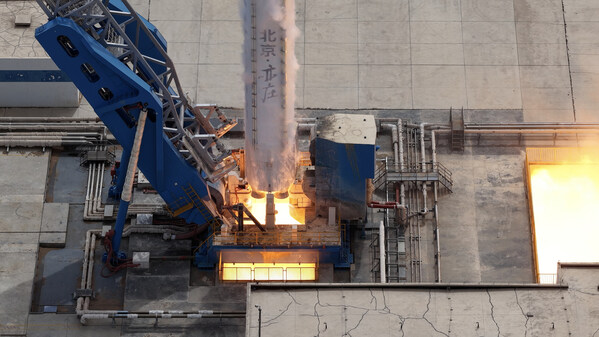
BeijingMay 15, 2026 /PRNewswire/ — At 11:00 on May 14, the Zhuque-2 Improved Y5 carrier rocket ignited and lifted off from the LandSpace liquid oxygen methane launch pad in the Dongfeng Commercial Aerospace Innovation Pilot Zone. It completed all flight tasks as scheduled, achieving a successful launch mission. As this rocket, adorned with the “Beijing Yizhuang” logo, soared into the sky, the “Yizhuang Arrow” has successfully executed nine launch missions in 2026, sending the city card of “Beijing Yizhuang,” defined by innovation, into the vast universe through Yizhuang enterprises.
Multiple Technologies Are Industry Firsts, Flexibly Adapting to Diverse Mission Requirements
The Zhuque-2 Improved Y5 is a two-stage, low-temperature, extended-length liquid carrier rocket developed through systematic iterative design, fully inheriting mature technical solutions from previous missions. It has a diameter of 3.35 meters, a maximum fairing diameter of 4.2 meters, and a total length of approximately 55.9 meters. The rocket’s liftoff mass is 267 tons (excluding payload), with a liftoff thrust of 338 tons. In this mission, the Zhuque-2 Improved Y5 successfully delivered a 2.8-ton customized test payload, designed for large-scale constellation networking, into a 900-kilometer low Earth orbit, marking that this rocket model has broken through the capability for heavy payload launches and is now equipped for multi-satellite deployment missions.
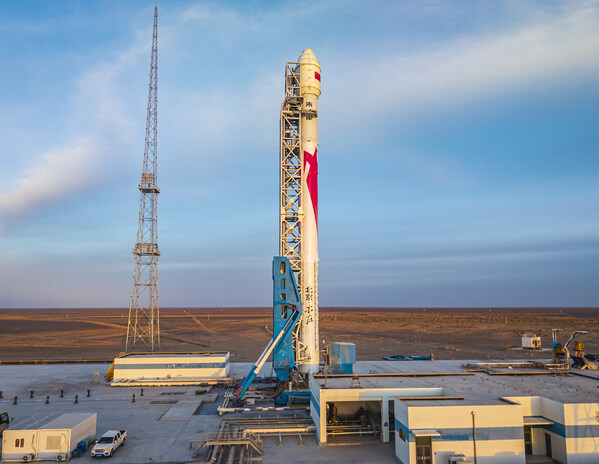
“The ‘evolution’ of the Zhuque-2 Improved Y5 is not a simple technical upgrade but a full-dimensional optimization from rocket body structure and propulsion systems to launch procedures,” said a representative from LandSpace. “Through measures such as extending the first stage, increasing propellant loading, reducing structural weight, and enhancing the first-stage engine thrust, we have further released and optimized the rocket’s launch efficiency, significantly improving overall performance and strengthening our launch service capabilities for multi-orbit mission profiles.”
Specifically, the Zhuque-2 Improved Y5 incorporates multiple industry-first technologies. For example, it pioneers a “tank-pressure ignition + high-orbit deorbit” technical solution for the second stage’s third ignition, using engine tank-pressure ignition and final-stage passivation forces to achieve rapid high-orbit deorbit. This ensures ignition reliability while effectively solving traditional high-orbit deorbit challenges, responding to national requirements for rocket final-stage deorbit and space debris mitigation, thereby protecting valuable orbital resources. The first stage introduces an industry-first engine online fault diagnosis and self-correction technology, and the second stage debuts a propellant utilization system. For potential scenarios such as low engine thrust or mixture ratio deviations, the system can automatically diagnose and respond during flight, significantly enhancing flight reliability and launch service capabilities, steadily advancing carrier rockets toward “smart rockets.”
The Zhuque-2 Improved Y5 is the first product of the extended-length variant of the Zhuque-2 Improved model. This model has achieved a payload capacity of 4 tons to a 500-kilometer sun-synchronous orbit and 6 tons to low Earth orbit, making it one of the leading medium-lift liquid carrier rockets currently in service in China’s commercial aerospace sector. It can flexibly adapt to diverse mission needs, such as multi-satellite deployment and high-capacity launches, and can form a combined launch service solution with the Zhuque-3 large reusable carrier rocket, enhancing China’s capability for high-capacity, low-cost, and high-frequency space access.
A LandSpace representative stated: “The success of this mission has provided the company with valuable flight data, offering a solid foundation for cross-model technical iteration and upgrades, continuously strengthening the performance improvement and launch service capabilities of the Zhuque series carrier rockets. Standing at the historical starting point of the 15th Five-Year Plan, LandSpace remains deeply committed to liquid oxygen methane core technology. By leveraging the scale and low-cost development of carrier rockets, we are building a complete and standardized commercial launch service ecosystem, offering customers diverse launch service solutions, including constellation deployment, dedicated launches, and shared rides. This will provide strong momentum for building aerospace as an emerging pillar industry and accelerating the development of satellite internet.”
Unleashing the Full Industrial Ecosystem Dividend, Building a Commercial Aerospace Value Community
On the body of the Zhuque-2 Improved Y5, the logos “Beijing Yizhuang” and “Send Packages with JD Express” are particularly eye-catching. This not only represents a collaboration between LandSpace and JD Group, empowering each other, but also deeply reflects the dream of strengthening the nation and the sense of home among Yizhuang enterprises.
As a key hub for China’s commercial aerospace industry, Beijing Yizhuang has gathered over 220 aerospace enterprises, forming an industrial cluster covering rockets, satellites, subsystems, components, and aerospace applications, with a complete industrial chain. To support the innovative development of the commercial aerospace industry, Beijing Yizhuang has introduced the “Commercial Aerospace 18 Policies,” established the Beijing Reusable Rocket Technology Innovation Center, and formed the Zhongguancun Yichuang Commercial Aerospace Alliance to help enterprises grow and upgrade. Earlier this year, the Beijing Rocket Avenue, the country’s first large-scale common research and production base for commercial aerospace, was officially put into use. Focusing on key aspects of commercial aerospace innovation and development, the Rocket Avenue features “Four Centers” and “Six Common Platforms.” To address common pain points such as insufficient test service supply, long waiting times, and high costs, the Beijing Rocket Avenue provides over ten shared services, including satellite and rocket R&D testing, intelligent manufacturing platforms, space-ground integrated operation and control, component reliability, and space debris protection, supporting high-quality development and high-level safety in commercial aerospace. Supported by the Beijing Rocket Avenue, nine production capacity projects are under construction in the 1.65-square-kilometer Aerospace Street, accelerating the formation of “thousand-satellite production and launch” capabilities. In the vast cosmos, six satellite projects are entering orbit, building a new pattern of integrated satellite-rocket development, deep integration of communication, navigation, and remote sensing, and space-ground integration.
On this fertile ground, Yizhuang enterprises are driving rapid innovation with pioneering spirit. As the LandSpace representative noted: “This Zhuque-2 Improved Y5 mission is a concentrated showcase of the achievements of the Beijing Yizhuang commercial aerospace industrial cluster. The prominent ‘Beijing • Yizhuang’ logo on the rocket body confirms that it relies on a complete industrial chain, policy platform support, and core element empowerment, providing comprehensive support and leadership for aerospace engineering development and industrial implementation.”
Notably, during the previous transport of the Zhuque-2 Improved Y5, JD Logistics’ sixth-generation unmanned delivery vehicle, “Lone Wolf,” participated in support operations. Currently, Beijing Yizhuang is pooling efforts from all sides to drive the commercial aerospace industry from single-point breakthroughs to system integration, jointly building a globally competitive commercial aerospace value community.
A representative from the Beijing Economic-Technological Development Area stated: “The 15th Five-Year Plan outline emphasizes accelerating the construction of a space power and developing strategic emerging industries such as aerospace. Guided by this, during the 15th Five-Year Plan period, Beijing Yizhuang will aim for the goal of ‘thousand enterprises collaborating, thousand satellites entering orbit, and hundred-billion revenue.’ We will accelerate the large-scale construction of the satellite internet industry, benchmark against world-class standards to speed up satellite and rocket innovation and R&D, focus on exploring application blue oceans, activate industrial momentum, and look to the future by accelerating the layout of emerging aerospace industries such as space situational awareness, space computing, and space manufacturing. We will promote the deep integration of aerospace technology with artificial intelligence, accelerating the establishment of a new global landmark for aerospace industry innovation and development.”