

Plans to further expand capacity building, cross-sector collaboration, and outcome-driven funding models across four markets in 2026
SHANGHAIMay 21, 2026 /PRNewswire/ — On May 19, 2026, CapitaLand Group officially launched the second edition of the “Community Resilience Grant Programme,” with a total funding amount of SGD 4 million to support 12 non-profit organizations from China, India, Singapore, and Vietnam, focusing on the development of children and youth. CapitaLand’s philanthropic platform, the CapitaLand Hope Foundation, will provide an initial fund of SGD 3.5 million and innovatively establish an “Impact Incentive Fund,” allowing funded organizations to qualify for additional financial rewards upon achieving predetermined outcome goals.

CapitaLand Community Resilience Grant Programme Key Visual
The programme was officially announced at the 2026 Philanthropy in Asia Summit (PAS2026). During the summit, the CapitaLand Hope Foundation hosted a panel discussion titled “From Commitment to Impact: Fostering Community Resilience Through Support for Children and Youth,” focusing on how collaborative and outcome-driven philanthropic models can create long-term, sustainable impact for vulnerable children and youth.
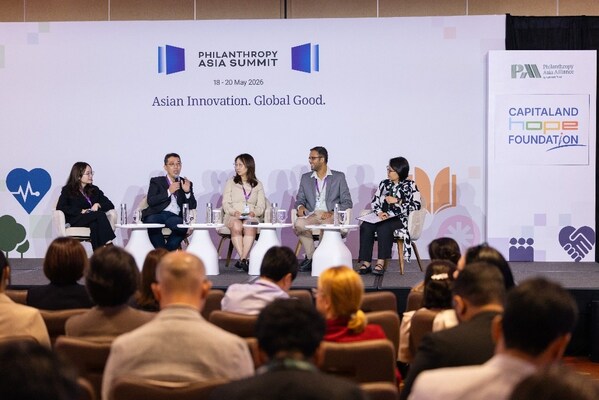
2026 Philanthropy in Asia Summit Panel Discussion (from left to right): Huynh Thi My Lam, Head of Communications and Fundraising, Children’s Welfare Association of Ho Chi Minh City; Dr. Lim Shien Ming, CEO, Presbyterian Community Services; Xu Shan, Deputy Director, China Philanthropy Research Institute, Beijing Normal University; Vaibhav Kumar, Co-founder and CEO, SwaTaleem Foundation; Patsian Low, Head of Markets and Deputy CEO, AVPN (Moderator)
Building a Philanthropic Platform with Lasting Impact
Following the inaugural “CapitaLand Community Resilience Grant Programme” in 2025, which provided a total of SGD 3.4 million to 12 non-profit organizations, this year’s programme has been further upgraded and expanded based on past experience. Unlike the first edition, which focused on selecting high-potential non-profits, this edition shifts towards a systematic ecosystem support model, emphasizing the strengthening of non-profit capacity building, expanding partner networks, and placing greater importance on achieving project outcomes.
Li Shaoqiang, Chairman of CapitaLand China Corporate Social Responsibility and CEO of CapitaLand Development (China), stated: “At CapitaLand, we consistently uphold our long-term commitment of ‘Building for Tomorrow.’ The second edition of the ‘Community Resilience Grant Programme’ not only reflects CapitaLand’s continued increase in philanthropic investment but also demonstrates our gradual transition from traditional financial support towards a systematic philanthropic model centered on capacity building, cross-sector collaboration, and outcome orientation. By collaborating with partners and the broader social ecosystem, we empower non-profit organizations to continuously expand their impact, creating a more inclusive and resilient future for communities.”
Deepening Collaboration to Build a Co-creation Ecosystem
In 2026, the “CapitaLand Community Resilience Grant Programme” will further deepen collaborative efforts with multiple partners:
1) As one of Asia’s largest social investment networks, the Asian Venture Philanthropy Network (AVPN) will enhance the quality of project selection and execution by sourcing high-quality applications, conducting due diligence, providing outcome assessments, and facilitating cross-regional learning and capacity building.
2) The Philanthropy in Asia Alliance (PAA), as part of the Temasek Trust ecosystem, will focus on identifying non-profit organizations with proven outcomes and leverage its network resources to promote the wider scaling of high-impact solutions.
3) The China Philanthropy Research Institute (CPRI) at Beijing Normal University, serving as the programme’s strategic partner in China and the executing agency for the China region in 2026, will be responsible for local project selection and implementation, further strengthening the programme’s professional support and localized execution capabilities in the Chinese market.
Xu Shan, Deputy Director of the China Philanthropy Research Institute, commented: “By systematically supporting children and youth in acquiring coping skills and building social support networks, this programme is an innovative and necessary step to enhance community resilience. This year, the programme will shift from ‘broad thematic funding’ to ‘deep engagement in urban communities,’ focusing on three areas: education, skills development, and mental health, forming a synergistic support system. While attracting more social funding, it precisely addresses the multi-dimensional challenges faced by urban children and youth. By empowering local non-profit organizations to implement sustainable projects, it helps enhance their adaptive capacities and co-create an inclusive future.”
Application Process and Key Focus Areas
The application period for the 2026 “CapitaLand Community Resilience Grant Programme” is from now until June 22, 2026. Against the backdrop of increasing climate risks and socio-economic challenges, the programme invites non-profit organizations to submit proposals supporting children and youth in the following three areas:
- Educational Support
- Skills Development
- Mental Health
For application criteria and details, please visit: http://www.bnu1.org/show_3675.html
The list of funded organizations will be announced in November 2026, with the project implementation period running from January 2027 to December 2028. For more information on the 2026 “CapitaLand Community Resilience Grant Programme,” please refer to Appendix A.
Voices from the Frontline: Perspectives on Community Resilience Practice from Different Regions
During the panel discussion at the 2026 Philanthropy in Asia Summit, philanthropic practitioners from across Asia engaged in in-depth exchanges on how to translate philanthropic ideals into sustainable community impact. The panelists shared their experiences and practical outcomes in addressing systemic challenges, building partnerships, and driving project implementation, offering diverse perspectives on supporting vulnerable children and youth. For more details on the panelists and their remarks, please refer to Appendix B.
Appendix A: Overview of the 2026 “CapitaLand Community Resilience Grant Programme”
|
Basic Information |
|
|
About the “CapitaLand Community Resilience Grant Programme” |
The “CapitaLand Community Resilience Grant Programme” is a multi-year, outcome-driven, resource-integrated funding platform initiated by the CapitaLand Hope Foundation, the philanthropic arm of CapitaLand Group. This programme marks a shift from traditional charity towards a collaborative, systematic support model in philanthropy. It aims to empower vulnerable children and youth in Asia, helping them enhance their ability to cope with adversity and promoting a more equitable and sustainable future. Following the successful implementation of the first edition in 2025, the programme launches its second edition in 2026. |
|
Funding Scale |
Total SGD 4 million |
|
Covered Countries |
China, India, Singapore, Vietnam |
|
Number of Funded Organizations |
12 (3 per country) |
|
Funding Period |
Two years per project |
|
Key Focus Areas (China Region) |
1. Educational Support 2. Skills Development Focusing on the future-oriented core competencies of youth, helping them acquire the technical and life skills needed to thrive in society. 3. Mental Health Emphasizing the strengthening of social-emotional learning and community support to effectively enhance the psychological resilience of children and youth and their sense of social support. |
|
Application Period |
From now until June 22 http://www.bnu1.org/show_3675.html |
|
Result Announcement Date |
November 2026 |
|
Partners |
|
Appendix B: Panel Discussion Guest Perspectives
2026 Philanthropy in Asia Summit Panel Discussion: “From Commitment to Impact: Fostering Community Resilience Through Support for Children and Youth”
China
Xu Shan, Deputy Director, China Philanthropy Research Institute:
“The foundation of a resilient community lies in how multiple stakeholders collaborate and mobilize resources to support the growth and development of children and youth. Smaller communities are often more vulnerable to various risks and therefore require diverse external resources to support community development and maintain a well-functioning ecosystem.
As the executing agency for the 2026 ‘CapitaLand Community Resilience Grant Programme’ in China, the China Philanthropy Research Institute believes this programme holds significant practical relevance and strategic value. It shifts from broad thematic funding towards a model more focused on local practice, making it more targeted in the urban context. By integrating psychosocial support, resource network building, and grassroots capacity enhancement, this programme will help create a more equitable development environment for children and youth.”
India
Vaibhav Kumar, Co-founder and CEO, SwaTaleem Foundation:
“In our experience collaborating with the Indian government on philanthropic projects, we have deeply realized that building trust relationships and long-term cooperation mechanisms is as important as project design itself. Government collaboration requires patience and alignment with existing policy priorities, while maintaining flexibility without compromising project quality. Sustained community engagement and building credibility through tangible outcomes help foster stronger recognition within the system, thereby promoting the long-term scaling of projects.
The ‘CapitaLand Community Resilience Grant Programme’ not only provides financial support but also creates diverse development opportunities for project beneficiaries and implementation teams by building a supportive ecosystem. For example, organizing visits for adolescent girls to CapitaLand’s office in Bangalore, India, involving them in CapitaLand employee volunteer activities, and providing learning resource support during International Women’s Day have effectively broadened their horizons and enhanced their confidence and motivation for development. This collaboration has also brought more partnership opportunities, social attention, and institutional support channels to our organization, further enhancing our long-term impact.”
(SwaTaleem Foundation was a funded organization under the 2025 “CapitaLand Community Resilience Grant Programme” in India)
Singapore
Dr. Lim Shien Ming, CEO, Presbyterian Community Services (PCS):
“A resilient ecosystem supporting the development of children and youth should provide an inclusive environment and equal development opportunities, addressing individual needs holistically. PCS helps its beneficiaries progressively realize their potential through the ‘3E Model’: Engage, Equip, and Empower.
With the support of the ‘CapitaLand Community Resilience Grant Programme,’ the ‘CareAbilities Programme (CAP)’ has become more systematic and sustainable. This includes providing living allowances for participants and integrating CapitaLand volunteers and resource support to help them build confidence and communication skills. Furthermore, leveraging the resource network of the CapitaLand Hope Foundation, the organization has been able to explore more customized vocational training pathways, such as training for facility and activity management roles tailored for youth with special needs, thereby expanding their employment avenues and social participation opportunities.”
(Presbyterian Community Services was a funded organization under the 2025 “CapitaLand Community Resilience Grant Programme” in Singapore)
Vietnam
Huynh Thi My Lam, Head of Communications and Fundraising, Children’s Welfare Association of Ho Chi Minh City:
“In the field of services for children and youth, we believe ‘resilience’ is not just the ability to cope with difficulties, but also the capacity to adapt, recover, and sustainably develop in the face of challenges such as poverty, migration, and social pressures during urbanization. In Vietnam’s urban environment, key challenges include a lack of coordination between social service systems, the education system, and families, as well as limited resources and opportunities for children to voice their concerns. Practice shows that multi-stakeholder collaboration mechanisms—especially cooperation between businesses, non-profit organizations, and the government—play a crucial role in establishing comprehensive and sustainable support systems.
With the support of the ‘CapitaLand Community Resilience Grant Programme,’ we have significantly expanded educational resources, life skills training, child rights advocacy, vocational training, and mental health support. This helps vulnerable children and their families enhance their resilience, confidence, and development opportunities, moving towards a more equitable future.”
(Children’s Welfare Association of Ho Chi Minh City was a funded organization under the 2025 “CapitaLand Community Resilience Grant Programme” in Vietnam)