

 |
——Two IBM Consulting Partners Discuss Gathering Global Talent to Nurture Global Enterprises
BeijingMay 25, 2026 /PRNewswire/ — Treasuring wisdom, practicing truth. “Turning Classics into Gold – Chief Council Hall” is a high-end roundtable dialogue series co-created by 21st Century Business Herald and IBM. May this series serve as an internal reference for you to navigate cycles and lead the times. This article is compiled from interviews, and the use of related content has been authorized.
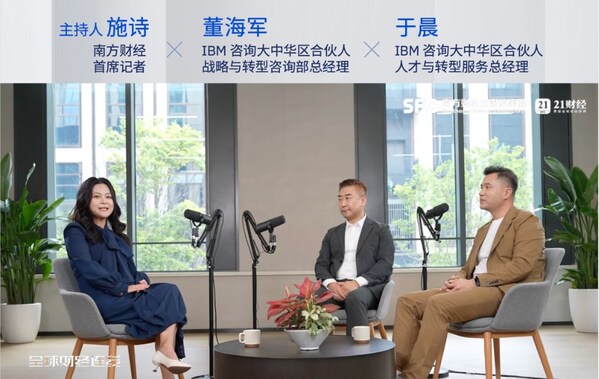
Shi Shi, Chief Reporter of Southern Finance; Dong Haijun, Partner of IBM Consulting Greater China Group, General Manager of Strategy and Transformation Consulting; Yu Chen, Partner of IBM Consulting Greater China Group, General Manager of Talent and Transformation Services
Origin of the Topic: The Subject Has Changed, “People” Become a Strategic Imperative
At the Shanghai F1 circuit over a month ago, Shi Shi, Chief Reporter of Southern Finance, noticed a subtle shift: an increasing presence of Chinese elements. From the Winter Olympics to the upcoming World Cup, Chinese brands are making密集 appearances on world-class stages. Behind this brand export, a deeper question about “the next level of Chinese enterprises going global” emerges.
A decade ago, going global meant shipping “Made in China” products worldwide. Today, R&D, manufacturing, and after-sales services are all being globally reorganized. Dong Haijun, Partner of IBM Consulting Greater China Group and General Manager of Strategy and Transformation Consulting, summarizes this change as moving from “commodity trade” to “full value chain globalization.” Now, the world is no longer flat—trade barriers and geopolitical conflicts make each region vastly different from before, fragmenting markets into pieces that companies must tackle one by one. On the surface, going global is an extension of the value chain, but in reality, it increasingly involves holistic restructuring, which means greater challenges. This is where the topic originates.
Yu Chen, Partner of IBM Consulting Greater China Group and General Manager of Talent and Transformation Services, notes that in the past, talent primarily focused on running markets and channels. Now, with R&D, manufacturing and supply chains, management, and after-sales all going global, companies are expanding their entire system overseas. This inevitably changes their talent needs. They require operational talent that can take root locally and serve local markets precisely—and such people are extremely scarce. Consequently, the most common lament from clients is: “I want to go global, but I don’t have the people.”
More fundamentally, when Chinese enterprises step out as brands, they are no longer “participants” but “disruptors” of the old order. Do they have the capability to break rules and establish new ones? Without a flag-bearing “leader” and their localized team, nothing is possible. This is the starting point that enterprises must confront in the 2.0 era of going global.
The Trap of “Expatriate Dependency”: Unusable “Locals” and2.6-Times-Costlier “Own People”
Products and brands have gone global, but where are the people to “hold the fort”? Shi Shi raises her question: Should going-global enterprises recruit locals or send people from home?
Using locals has clear advantages—they understand local markets, culture, and regulations, and can truly integrate into the community. However, Dong Haijun points out two difficulties. The first is the clash of management cultures. Differences in religious beliefs, ethnic customs, and lifestyles across countries are significant. Managers from the parent company are accustomed to managing in their familiar ways, which often leads to friction overseas. For example, Vietnamese employees are used to drinking coffee four times a day—twice in the morning and twice in the afternoon. If a factory doesn’t even have a decent coffee room, employees won’t stay, and management can’t move forward. The second difficulty is that even if willing to hire locals, finding truly qualified candidates is tough. Many companies turn to Chinese nationals living long-term abroad. Yu Chen agrees this can be a “shortcut,” but he also emphasizes a prerequisite: the individual must match the company’s “cultural core”; otherwise, retaining talent and building organizational synergy remain unresolved issues.
It might seem more straightforward and reliable to “expatriate” Chinese employees—clear advantages include low trust costs, aligned values, and strong execution. Setting aside the issue of “culture shock,” let’s look purely at economics. Yu Chen does the math: under full compliance, the cost of sending one expatriate employee is 2.6 times that of hiring locally for the same position. That’s expensive! Social insurance, taxes, family, children’s education—everything costs money. More critically, “expatriation” is essentially a short-term measure. It’s just a starting point; people always return home. They can’t take root or integrate into local society. While sending people short-term to bring management concepts and professional skills works, “localized talent” is the answer for long-term sustainability.
Thus, a dilemma emerges: hire locals and risk poor management and integration, or use your own people at high cost without them taking root. Both paths are difficult—which to choose? The two partners’ answer isn’t an either/or but a return to a more fundamental question: What kind of person are you really looking for?
Who to Recruit? Find “Co-builders” by Cultural “Core,” Break the Ice with Trust
The difficulty in finding people lies in trusting an “outsider.” Companies are used to their own people. Expatriation is expensive but has low trust costs. Trusting someone unfamiliar requires breaking habits, which takes time. But going global often demands quick results, leaving no patience to understand and root in the local environment, so trust relationships never form.
Shi Shi presses: Where does trust come from?
Yu Chen believes it has nothing to do with skin color or nationality but with a person’s “core.” Companies should seek those who truly identify with the company’s values. He recalls a Lebanese businessman he met in Africa who said: “We Lebanese never had a home, so when I came here, I put down roots.” When you’re willing to take root, local acceptance improves, and trust gradually builds—people need to see you genuinely want to stay. Yu Chen also highlights a deeper challenge: companies must operate in ways suited to local markets, but headquarters lack talent capable of managing this “integrated structure”—someone who understands unified values while embracing differences and harmonizing varying paces. In a single domestic market, you can’t train—or mass-produce—people who can handle a fragmented global landscape. The people you need most are precisely what your home country can’t provide.
This makes one thing crucial: the parent company must clearly distill its cultural core, discerning which values are non-negotiable and which methods can be flexible. Integrity, innovation, customer-centricity—these must be global constants. But how they are implemented—in work habits, communication styles, incentives—should align with local cultures. If employees in Brazil or Nigeria can’t genuinely identify with the company’s core, the path to globalization won’t go far.
Dong Haijun gives a small example: A client’s factory in Vietnam specially designed excellent coffee rooms because Vietnamese employees drink coffee four times a day. The cultural core remained unchanged—encouraging employees to work better—but the expression adapted locally. A consistent core with localized forms: that’s what globalization should look like.
On trust, Dong Haijun cites Laozi: “When trust is insufficient, there is distrust.” If you don’t give trust first, don’t blame others for not trusting you. When going-global companies start hiring, they often take in everyone indiscriminately, hiring unsuitable people, which can even destroy trust. This leads to hesitation and a retreat to the old path of expatriation—a short-sighted move, in Dong’s view. The real solution lies locally. “You need to find those who, even in a foreign land, can read and identify with your corporate vision and are willing to achieve it in locally appropriate ways.”
Find the right people, dare to trust, and take root—accomplish these three things, and you have the prerequisite to unlock the talent dilemma.
Mismatch of Scale and Capability: Making Gears of Different Speeds into a Single Global Machine
Dong Haijun uses a metaphor to capture the essence of global operations: Each country’s business is like a different type of gear—varying speeds and rhythms. Global operations mean integrating these different gears into one large machine, making them work in sync. This is “globally integrated operations.” It’s not about managing everywhere the same way, but under unified values, allowing different regions to achieve the same business goals at different speeds and in different ways. This ability to navigate complexity has no standard answer.
The talent dilemma may reflect the biggest challenge for Chinese enterprises: scale has grown too fast, but capabilities haven’t kept up. Over the past 40 years, Chinese companies grew rapidly driven by opportunities. More opportunities led to explosive scale growth, but capabilities didn’t improve in tandem. This created an illusion that capabilities matched scale. Chinese companies leveraged the former to accumulate capital, technology, and products, giving them confidence to go global. But in overseas competitive environments, they struggle to manage local business and operations, revealing that scale leadership doesn’t equal capability leadership—exposing weaknesses.
Yu Chen offers a telling statistic: The average age of Chinese CEOs is 15 years younger than their Western counterparts. What does 15 years mean? It’s like looking back at ourselves 15 years ago. How you view people, society, and markets isn’t learned—it’s accumulated through experience. This 15-year age gap may represent a 15-year experience gap, leading to a “capability mismatch.”
A truly global enterprise must first be capability-led. The advantage of leading companies comes from systematized capabilities, not isolated successes. Therefore, Chinese enterprises going global shouldn’t just run faster but gradually fill capability gaps. Behind capabilities lie experience and governance systems that take time to develop—and this is where AI can play a role.
A Stage That Cannot Be Skipped:AI Isn’t Overtaking on Curves, It’s Accelerating Remedial Learning
When discussing talent, we can’t avoid the technological variable reshaping everything—artificial intelligence. Many companies think AI can help them skip stages and jump directly into the fast lane of global operations. But Dong Haijun clearly states: No, it can’t. If processes aren’t clear and data quality is poor, you can’t leap into the AI era. He calls this “AI debt” or “technical debt”—the process and data lessons owed from the past can’t be escaped by AI.
But the good news is that AI can accelerate remedial learning. In the past, IBM took 15 years for process-driven transformation and 10 years for data-driven transformation. With AI, processes might take 5 years and data 2 years. AI isn’t about overtaking on curves—curves are often the riskiest places—but about quickly patching past gaps and shortening catch-up time.
Yu Chen shares a similar view: Overtaking on curves in F1 relies on technical accumulation and calculated risk—two things Chinese companies currently lack. Instead of thinking about overtaking, it’s better to honestly accelerate remedial learning. For CEOs, AI strategy must be deeply intertwined with talent strategy. The AI talent you need isn’t just algorithm engineers but those with “structured thinking”—people who can use AI tools to first clarify chaotic business processes and standardize scattered data assets. Only after completing this step can AI become the underlying operating system for your globally integrated operations, enabling employees in different countries to collaborate efficiently under the same data standards and language system.
So, how do you build a global talent platform? Through Shi Shi’s interaction with the two partners, a three-layer construction method emerged:
First layer, foundational: Consistent organizational logic, tightly integrating organization, leadership, and culture. This is globally unified and determines how the company views its core talent.
Second layer, talent operations: Selection, recruitment, development, and retention should form small closed loops based on local management models and talent supply—i.e., individual companies on a large platform. Wherever they are, employees should feel both part of the local scene and part of a global enterprise.
Third layer, technology-driven: Employee experience must be connected through technology. Dong Haijun says if data isn’t global, the company can’t be global. For example, when he visits the U.S. office, access controls, meeting systems, management terminology, and business definitions are all consistent. Without global data standards, employees can’t communicate across locations. Employee experience must be technology-driven. In Yu Chen’s words: Going global requires technology and people to walk on two legs—neither is dispensable.
Yu Chen believes the hardest talent for going-global companies to find possesses two abilities: first, structured thinking—the ability to help the company build systems and structures overseas, rather than just outputting a department or a link; second, strategic determination—going global often takes a long time to see returns, and without patience and endurance, you can’t sustain it.
True acceleration isn’t overtaking on curves but filling capability gaps earlier.
How to Become a “Globally Respected Multinational Enterprise”?
No one has the answer, but maintain excitement and prepare for global governance while in motion.
At the end of the interview, Shi Shi posed a question she was particularly eager to ask: In the AI era, how can Chinese enterprises become “globally respected multinationals”? Dong Haijun is candid: Probably no ready-made answer exists in the world. Our globalization has just begun; AI globally has also just started. The application of AI has a long way to go, and no one knows how it will evolve, but this will undoubtedly reshape our future social form. In the future, true AI won’t just be a tool but a digital worker with social identity, self-growth, and self-goals. By then, society’s value and distribution systems will be restructured. In his view, this is a test for Chinese enterprises, but for companies from developed countries with over 200 years of industrial civilization, the impact may be even greater.
Yu Chen also captures a subtle emotion: Many Chinese entrepreneurs talk about going global not with excitement but anxiety. He says people should return to that moment of starting a business—that excitement about uncertainty. Compared to finding answers, maintaining this excitement is essentially what we must pursue.
In Germany’s Ruhr industrial area, Yu Chen accompanied a vice chairman through a day of meetings. On the way back to the hotel, discussing the day’s feelings, the vice chairman said only two words: “Old.” Not that people were old, but the entire environment and society felt “old”—infrastructure was complete but lacked vitality; industrial workers were professional but lethargic. In Vietnam, however, Dong Haijun saw all young people, faces full of hope for the future, eyes shining. This is the gap globalization must face: some regions are young, some mature, some lazy, some fiercely competitive. The international division of labor is constantly evolving, meaning opportunities exist for everyone globally. So the question is: What gives Chinese enterprises the edge to succeed on this path?
Yu Chen admits: Building a global enterprise is truly, extremely difficult! But he also believes that anywhere in the world, if there isn’t even a Chinese restaurant, it’s probably the end of the earth. The Chinese character determines that in complex environments and amidst hardships, we can still maintain an open mindset, strong absorptive capacity, and resilience—this is the key to sustaining us.
Dong Haijun takes this judgment further: An open mindset and a proactive learning spirit are our trump cards. But the current environment surpasses any era in history. The arrival of AI is likely not a simple technological iteration but a situation humanity has never faced before. Why can we still have confidence? Because this nation has weathered so many storms and arrived where it is today, relying on our growth potential. It’s truly hard, but we can truly endure.
Message for the Future
Under the dual waves of AI and globalization, what Chinese enterprises need most isn’t technology itself but a mindset to navigate uncertainty, a core that withstands different cultural tests, and the integrated governance capability to assemble differentiated gears into a smoothly running machine—this is the hardest capability and the most important. They need the experience and determination of a 60-year-old CEO and the vitality and risk appetite of a 30-year-old.
Facing the future, those who have always walked alongside going-global enterprises offer this message:
Dong Haijun: Don’t rush. Learn from the excellent, do your own thing well, embrace differences, and contribute value to society.
Yu Chen: Go out first! Step out, and the answers will grow on their own.
Maintain excitement. Mountains may be a thousand ren high, but each step counts.
To watch the full video, please visit: m.21jingji.com/live/show/5229.html