

ShenzhenMay 25, 2026 /PRNewswire/ — At a critical juncture where AI technology is transitioning from model competition to industrial implementation, on May 25, Xunce (3317.HK) officially launched the world’s first TokenOS operating system — TokenONE.
TokenONE takes Token as the core asset unit, constructing an industrial production system from raw data to high-energy scenario Tokens. It directly addresses the current bottleneck of enterprise-level scenario data scarcity that restricts AI implementation, and provides a solution for the most challenging “last mile” problem in large-scale AI industrial deployment, ushering in an industrial revolution akin to a “Token Factory”…
AIEra’s New Operating System, Ten Major Product Highlights Build a Moat
As a new-generation operating system for the AI-native era, following Windows in the PC era and iOS/Android in the mobile internet era, the TokenOS operating system — TokenONE — transforms enterprise data into data Tokens that can be directly invoked by models. It ensures that every model invocation generates quantifiable and traceable business value and decisions, driving the large-scale commercial implementation of Token Factories across industries.
Throughout the entire chain of data refining, delivery, decision-making, and metering, TokenONE ensures that every model invocation and application is no longer just a consumption of computing power, but a quantifiable, traceable, and optimizable output of business value. It allows each unit of Token to directly drive business decisions, making the output of large models measurable.
TokenONE leverages ten differentiated technical and product advantages to build the core capabilities of a Token Factory, creating a closed loop from data to value.
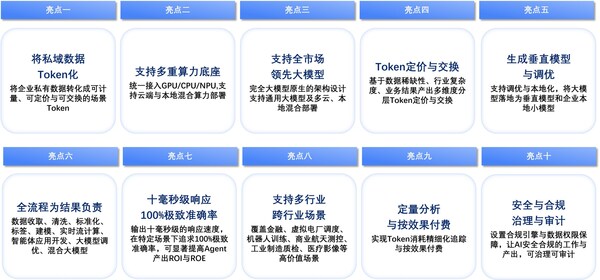
“Dormant Data“Transformed into“High-Energy AI Fuel“, Igniting the“TokenFactory“Industrial Revolution
Currently, although large AI models have massive parameter counts, they are extremely lacking in enterprise-level scenario data. For example, risk control logic in the financial industry is hidden in transaction records and risk reports; manufacturing process know-how is embedded in equipment logs and quality inspection documents; and diagnostic experience in the medical field is scattered across imaging archives and medical record systems. This high-quality data, industry knowledge, and scenario experience accumulated by enterprises remains in a “dormant” state, unable to be precisely utilized by AI.
TokenONEprecisely targets this pain point. It transforms non-standard, unusable scenario knowledge into standardized, tradable, and auditable scenario Tokens, achieving data Tokenization. This turns dormant data into high-energy AI production materials, making large-scale industrial implementation of scenario Tokens possible.
At the “industrial” output level of the Token Factory, TokenONE employs nine standardized steps and five core processes to complete the full-chain industrial production of raw data from “raw material entry” to “value realization.” This upgrades data processing from a “manual workshop-style” operation to a replicable, scalable, and auditable large-scale output system.
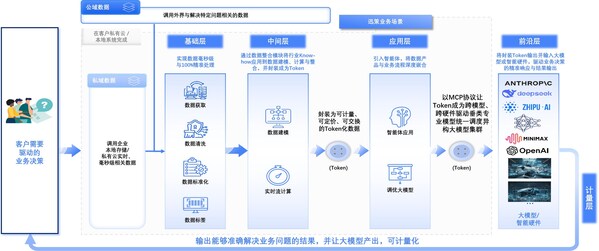
Foundation Layer—Standardization of Raw Material Entry. TokenONE connects multi-source heterogeneous data from both inside and outside the enterprise. Through intelligent cleaning and standardization engines, it transforms “messy” raw data into uniformly specified “industrial raw materials.”
Middle Layer—Core Refinery. Standardized data enters the core production line of the Token Factory. The real-time computing engine completes deep processing with millisecond-level response times, combined with precise mapping of vertical scenario tags, ultimately packaging it into measurable, priceable, and exchangeable scenario Tokens.
Application Layer + Frontier Layer—Value Realization. The packaged scenario Tokens are precisely injected into various AI Agents. Through model tuning modules, they empower large models and intelligent hardware, directly driving business decisions. Each downstream invocation is a realization of value.
Metering Layer—World’s First Operating System Charged by Invocation. From hardware isolation to system attestation, it ensures bills are tamper-proof and transparent for both parties, achieving security compliance and governance auditing. It breaks the industry’s billing “black box,” helping enterprises identify ineffective and inefficient consumption, transforming AI investment from “passive consumption” to “actively managed” controllable assets.
Industrial Propeller for Large-Scale AI Implementation, Building Scenario Token Factories Across Thousands of Industries
The current AI industry is at a critical turning point, transitioning from the first half focused on model parameter competition to the second half of realizing real value. The bridge is precisely the Tokenization and industrial supply of scenario data. TokenONE emerges as this industrial-level bridge, providing industry customers with ready-to-use standardized scenario Tokens, lowering the barrier to AI implementation; offering large model vendors large-scale vertical data supply, systematically solving the pain point of lacking scenario data; and establishing a benchmark for “Token production” for the entire AI industry, accelerating AI’s journey from the lab to various industries, ensuring AI delivers real value.
In the future, Xunce will continue to extend TokenONE as its underlying architecture, collaborating with industry leaders to build vertical scenario Token Factories, covering high-value fields such as healthcare, high-end manufacturing, finance, and energy and power. This will allow the industrial capability of data Tokenization to permeate every key industry, forming a new type of infrastructure network for the deep integration of AI and the real economy.
Business Model: A Closed Loop from Data Governance to Token Economy
To put the commercial essence of TokenONE more plainly — it is akin to a “Tokenized upgrade” of Palantir’s Ontology, i.e., Ontology 2.0. Palantir used ontology to break down data silos in government and enterprises, achieving data-driven decision intelligence, but the data itself remained a “static asset.”
TokenONE goes a step further by endowing data with measurable, priceable, and tradable economic attributes through Tokenization packaging, upgrading data from “static” to “circulating,” from “static assets” to “dynamic production materials.” Ontology 1.0 solved “how data is understood,” while TokenONE breaks through how data can be industrially produced and monetized.
This commercial core is externalized into two billing paths that align with the growth rhythm of customers:
Token Pay-as-You-Go — Lowers the decision-making threshold for enterprises to adopt AI. Billed monthly or quarterly based on actual Token consumption, paying for what you use. This “verify first, invest later” design allows the value of the AI system to grow in sync with the enterprise’s actual usage.
Full Buyout — Once an enterprise has fully validated the business value of the AI system and has a clear expectation of long-term use, it can smoothly upgrade to a buyout model, obtaining full ownership of the system and absolute data sovereignty. Historical pay-as-you-go records can be proportionally deducted from the buyout total price, fully protecting the customer’s prior investment.
The pricing logic also breaks away from the old “computing power stacking” framework, instead building around the business value of Tokens: the price per single invocation depends on data scarcity, real-time requirements, and industry complexity; the number of invocations reflects the customer’s actual depth of use in real business; and module depth measures the degree of system integration into the customer’s processes — the more integrations and deeper embedding, the higher the overall value.
Market data is validating the explosive potential of this model. In April 2026, Xunce’s Token invocation ARR grew 300% quarter-over-quarter, with Token-based payment model revenue accounting for about 5%, targeting an increase to 20%-30% by the end of 2026. More notably, the pricing space — Xunce’s vertical Token invocation price has reached $10-$100 per million Tokens, more than ten times the price of general large models, and continues to rise with scenario professional depth. This means Xunce is completing a systematic leap from traditional subscription models to Token payment and value-sharing models, with the Token business model becoming the company’s new growth engine.
Conclusion
The current AI industry is in a transition period from “laboratory invention” to “real commercial monetization.” Large model vendors are fiercely competing on parameters, but more and more people realize: a model lacking scenario data is like an engine without fuel.
Just as iOS/Android unified the underlying logic of the mobile internet, Xunce’s TokenONE is defining the underlying rules of the AI era — starting from real industry scenarios, using data to connect technological resources, making large-scale implementation of scenario Token Factories possible. As more vertical industry Token Factories are deployed, Xunce is poised to become a core platform with phenomenal influence in the AI era and a leading driver of AI implementation.