

HangzhouMay 26, 2026 /PRNewswire/ — With the 2026 FIFA World Cup in the United States, Canada, and Mexico approaching, the global sports consumption boom is heating up, ushering in a new wave of growth opportunities for the footwear and apparel market. According to industry forecasts, this World Cup is expected to bring an additional 15%-20% growth dividend to the global footwear and apparel market, with brand orders surging explosively.
However, the pulse-like consumption peaks driven by sports events pose a severe test to the resilience and efficiency of the supply chain. With orders arriving early and demand fluctuating sharply, traditional static inventory models are no longer suitable. Against this backdrop, Best Supply Chain, which has been deeply rooted in the footwear and apparel supply chain sector for 18 years, believes that brand core competitiveness has shifted from marketing buzz to the flexible capabilities and deep services of the supply chain. Leveraging digital and intelligent supply chain solutions, Best Supply Chain builds “certainty” for footwear and apparel brands amid market volatility, helping them convert traffic heat into sustainable profit growth.
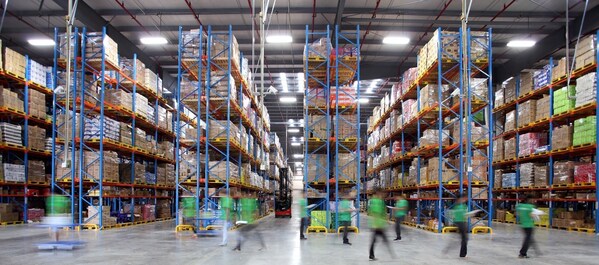
Inside Best Supply Chain’s cloud warehouse, workers operate swiftly among high-density shelves, showcasing the efficient operations of digital and intelligent warehousing
Flexible Warehouse Network: Pre-positioning Goods Downstream to Accelerate Response Near Consumers
The traditional linear supply chain of “factory-warehouse-store” for footwear and apparel has now been upgraded to a distributed, networked warehouse system. Consumers seek a “order-now, receive-now” logistics experience, which relies on an efficient restructuring of the entire supply chain. Best Supply Chain believes that the key to coping with high-demand volatility in a major sports year is to break spatial constraints, avoiding the concentration of goods in central warehouses, which reduces time delays and consumer enthusiasm.
Relying on 360 cloud warehouses nationwide, Best Supply Chain has built a distributed warehouse network with broad coverage and agile response. Its core logic involves pre-positioning goods downstream and shipping from the nearest location. During major promotional events like the World Cup, 618, and Double 11, the digital and intelligent system can monitor regional hot-selling categories and traffic trends in real time, intelligently executing dynamic inventory scheduling to ensure hot-selling products are shipped from nearby locations and delivered quickly.
Additionally, this warehouse network boasts strong emergency reorganization capabilities, enabling the full-process setup of a new sub-warehouse—including site selection, equipment installation, system integration, and personnel deployment—within 48 hours at best. This allows it to smoothly handle sudden order spikes, ensuring that industry dividends are not lost due to logistics bottlenecks.
In terms of distribution networks, Best Supply Chain extends its services down to county and township markets, integrating Best Express Freight and high-quality third-party resources to build an efficient national B2B transportation matrix. Addressing the “fragmented, urgent, and multi-batch” nature of footwear and apparel store replenishment, Best Supply Chain offers customized services such as scheduled delivery and upstairs delivery, using digital methods to resolve issues like information asymmetry and lack of transparency in transportation, ensuring precise and timely delivery of professional footwear and apparel equipment to end points.
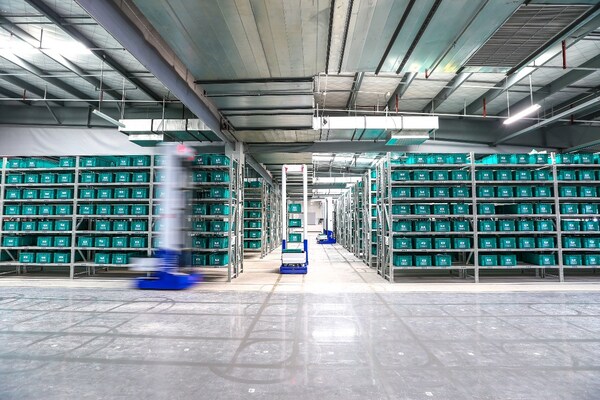
Inside Best Supply Chain’s digital and intelligent cloud warehouse, automated equipment operates efficiently among neatly arranged shelves, reflecting the smart operations of the flexible warehouse network and omni-channel single-inventory solution
Notably, Best Supply Chain has scaled the application of blockchain technology across the entire B2B transportation chain, paired with its self-developed TMS system, to achieve full-process traceability from outbound delivery, transit, and end-point to store receipt. Through facial recognition and real-time data notarization, information is tamper-proof, fundamentally resolving issues like false receipts and cumbersome reconciliation. A leading outdoor equipment brand has achieved 100% paperless operations through this, completely eliminating paper receipts and significantly improving reconciliation efficiency. This technology was granted a national invention patent in 2023 and is fully deployed across key client operations, ensuring honest transactions while promoting green supply chain principles.
Digital Foundation: Omni-Channel Single Inventory, Breaking Down Inventory Data Silos
With increasing channel fragmentation in 2026, footwear and apparel brands commonly face pain points such as inventory buildup, channel conflicts, and data silos. In response, Best Supply Chain has developed an omni-channel single-inventory solution, setting an industry benchmark. By integrating online and offline inventory and achieving omni-channel inventory visibility, it enables strong control over the entire supply chain process. This capability relies on Best’s self-developed digital and intelligent system, which features a three-tier collaborative architecture:
At the execution layer, it digitizes the entire process of basic operations like warehousing, transportation, and distribution, capturing goods flow data accurately in real time;
At the coordination layer, self-developed systems like OMS, WMS, and TMS are fully integrated, helping brands build a data middle platform for efficient collaboration across all links;
At the decision-making layer, based on massive data, it uses big data computing and AI algorithms to provide intelligent decision support for brand sales forecasting, warehouse network planning, and inventory planning.
This flexible capability has been validated in collaboration with a well-known domestic women’s fashion group. When the brand started its e-commerce operations in 2012, it faced a peak of 50,000 orders on Double 11’s first day, and Best Supply Chain achieved “zero warehouse overflow, zero delays.” Subsequently, as the brand expanded its sub-brands and SKU count multiplied, Best Supply Chain helped it integrate online and offline inventory for unified omni-channel fulfillment: consumers ordering online could have goods shipped from nearby stores, and offline stockouts could be resolved through cross-warehouse transfers for next-day delivery, with all omni-channel orders managed under a unified inventory system, turning inventory from a sunk cost into efficiently circulating profit.
Rapid Reverse Logistics: Compressing Processing Cycles to Recover Profits Lost to High Return Rates
High return rates are a persistent pain point in the footwear and apparel industry, with clothing return rates often exceeding 40% during promotional periods. Traditional return processing cycles can take over two days, causing goods to miss their golden sales window and forcing price cuts for clearance, leading to significant profit loss.
To address this challenge, Best Supply Chain has developed a rapid reverse logistics service. Using specialized reverse warehouses and AI-driven decision algorithms, it enables quick redistribution of returns, compressing the entire processing cycle to under 12 hours. After quality inspection, returned goods can be directly matched with pending orders and shipped out again within 4 hours. Taking World Cup fan jersey returns as an example, goods entering the warehouse quickly go through the full process of registration, quality inspection, ironing, disinfection, packaging, and shelving, forming an efficient closed-loop management system that maximizes the sales value of goods and reduces inventory depreciation losses. The system provides full visibility into each step of the return process, issuing real-time alerts for efficiency lags, shifting reverse logistics from experience-based operations to algorithm-driven management, helping brands recover “lost profits.”
Digital Leadership: Competing for the Future Through Efficiency, Empowering Global Brand Growth
In the future, competition in the footwear and apparel industry will fundamentally be a contest of supply chain efficiency.
Best Supply Chain states that it will continue to iterate its digital and intelligent capabilities, leveraging big data and AI technology to drive logistics from passive execution to proactive forecasting.
Facing market volatility and consumption upgrades, Best Supply Chain remains at the forefront of the industry, using digital certainty to address demand uncertainty, helping Chinese footwear and apparel brands elevate their position in the global value chain, achieve high-quality growth, and ensure that every consumer passion receives precise and efficient responses.