

GuangzhouMay 31, 2026 /PRNewswire/ — On May 29, the “CGMA University Development Forum,” hosted by AICPA & CIMA, the Association of International Certified Professional Accountants, was grandly held at Guangdong University of Foreign Studies (GDUFS). Experts and scholars from dozens of partner universities across the country gathered to discuss the transformation direction of accounting and business education against the backdrop of digitalization and artificial intelligence. The forum also held a ceremony to commemorate the 10th anniversary of the establishment of the GDUFS CGMA Directional Class.
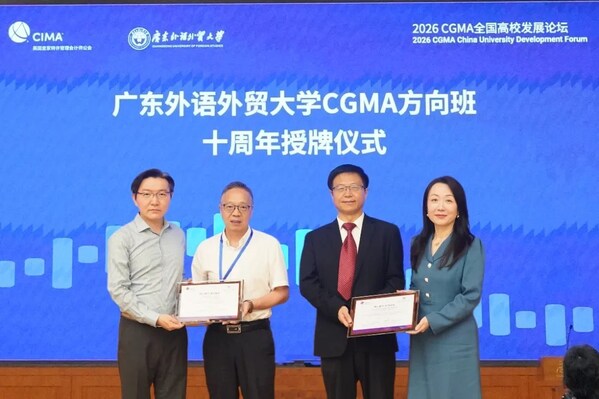
Li Ying, President of AICPA & CIMA North Asia, pointed out at the forum that traditional accounting talent cultivation faces significant challenges. She proposed three key directions: “Digital Leadership, Embracing Change, and Building Bridges,” emphasizing that CIMA will collaborate with universities to integrate international perspectives, digital thinking, AI applications, and management accounting cases into curricula, placing students at the forefront of digital transformation. The forum also held a ceremony commemorating the 10th anniversary of the GDUFS CGMA Directional Class. Li Ying highly praised GDUFS for turning the concept of international accounting talent cultivation into a nationally influential project, providing “GDUFS experience” for universities nationwide. She stated that education is a long relay race, and CIMA aspires to be the most industry-savvy, demand-responsive, and trustworthy strategic partner, working with universities to cultivate a new generation of accountants who can harness algorithms rather than be defined by them. Professor Hu Chunyu, Dean of the School of English for International Business at GDUFS, mentioned that GDUFS is a crucial base for international talent cultivation in South China. The School of English for International Business has always been committed to cultivating versatile business talents with international vision, national sentiment, and professional competence. Since partnering with AICPA & CIMA in 2016 to launch the CGMA Directional Class, both sides have worked together for a decade, cultivating nearly 500 outstanding graduates, many of whom have become pillars in the finance and economics field. This collaboration has witnessed mutual trust and win-win outcomes and has become a vivid practice of innovation in international finance and economics talent cultivation at Chinese universities. The forum brought together experts, scholars, and industry representatives from over 20 universities nationwide to build consensus, deepen collaboration, and jointly explore new paths for cultivating international finance and economics talents that align with China’s national conditions and the demands of the digital era.
Coinciding with the 10th anniversary of the GDUFS CGMA Directional Class partnership, the forum specially invited Wang Weichao, Vice Dean of the School of English for International Business, and Yu Pengyi, Vice Dean of the School of Accounting, to review the decade-long collaboration journey and look ahead to the future of talent cultivation in the digital intelligence era. At the same time, taking this opportunity to express gratitude to GDUFS for its long-standing support, a 10th-anniversary commemorative plaque ceremony was held on site.
Liang Ping, Director of AICPA & CIMA China Mainland Affairs, delivered a keynote speech titled “How Digital Thinking Reshapes Career Futures – Capability Reconstruction from a CGMA Perspective.” He pointed out that the digital wave is profoundly reshaping career development paths, and talents in the new era need to embrace a digital-era mindset, responding to change with greater openness and agility.
Liang Ping further emphasized that CIMA has always been forward-looking in anticipating industry trends. Years ago, it pioneered the launch of Digital Management Accounting (DMA) and established a systematic digital management accounting certification system to address the new demands for versatile, high-quality talents in the digital economy era.
Lei Yu, Member of the Standing Committee of the Party Committee and Vice President of Guangdong University of Finance and Economics, delivered a keynote speech on “Paths for Cultivating Finance and Economics Talents in the Digital Era,” systematically elaborating on the core logical framework of the digital business education ecosystem. He pointed out that efforts should start from building a new digital education ecosystem, pragmatically creating a “physical environment” for digital teaching, accelerating the deep integration of AI with economics and management disciplines, and comprehensively promoting the digital transformation and upgrading of education.
At the same time, Vice President Lei Yu emphasized that enhancing teachers’ digital literacy, deepening AI technology applications, dynamically updating course systems to keep pace with rapidly evolving technological changes, and promoting industry-education integration for collaborative talent cultivation are all key pathways to cultivating high-quality finance and economics talents that meet future demands.
At the forum, the following awards were presented to recognize partner universities for their excellence in CGMA education, innovation in practical teaching, and potential for cooperative development. The list of awardees at the CGMA Partner University Awards Ceremony is as follows:
CGMA University Education Excellence Award (in no particular order)
- Chongqing Technology and Business University
- Guangdong University of Foreign Studies, School of English for International Business
- Guangdong University of Foreign Studies, School of Accounting
- Jiangxi University of Finance and Economics
- Tianjin University of Finance and Economics
- Xiamen University
CGMA Teaching Innovation Practice Award (in no particular order)
- Chongqing University of Technology
- Dongbei University of Finance and Economics
- Xi’an International Studies University
- Shihezi University
- Hubei University of Economics
CGMA Cooperative Development Potential Award (in no particular order)
- East China Jiaotong University
- University of Jinan
- Beijing Union University
- Zhejiang University of Finance and Economics
- Shanghai Lixin University of Accounting and Finance
- Jincheng College of Nanjing University of Aeronautics and Astronautics
- Wuhan College
A fireside chat, moderated by Liang Ping, Director of AICPA & CIMA China Mainland Affairs, focused on “Educational Transformation of Management Accounting and Pathways for Cultivating Versatile Talents in the AI Era.” The dialogue guests included Zheng Dengjin, Vice Dean of the School of Accounting at Central University of Finance and Economics; Yi Yang, Vice Dean of the School of Accounting at Southwestern University of Finance and Economics; and Li Ziyang (CIMA member, CGMA Global Chartered Management Accountant), Director of the Academic Master’s and Doctoral Programs at the Business School of Sichuan University. Against the backdrop of accelerating digital and AI technology development, accounting education and the profession are undergoing systemic reshaping, driven by the continuous evolution of industrial structure and economic forms. The guests pointed out that while universities currently have the resources and foundation to advance digital curriculum construction, a key challenge during the accelerated transformation is how to uphold and reshape the core value of the accounting discipline. As students are exposed to more technical courses, some talent is shifting towards technology fields, highlighting new challenges for the attractiveness and development paths of the accounting discipline. The experts noted that as basic accounting functions are gradually replaced by technology, accounting talents should strengthen their data-based analysis and decision-making capabilities, using digital technology as a tool rather than an end goal, returning to and deepening the essence of the profession. At the same time, universities need to continuously promote interdisciplinary integration, break down traditional disciplinary boundaries, and build a talent cultivation system that integrates “finance, technology, business, and management” to support the new demands for versatile talents in the digital economy era.
Another roundtable dialogue, “Deepening Digital Management Accounting to Reshape the New Landscape of University Finance and Economics Education,” was moderated by Zhang Jianghua, Director of Emerging Markets for AICPA & CIMA China Mainland. The roundtable guests included Guo Guihang (CIMA member, CGMA Global Chartered Management Accountant), Vice President of South China Business College, Guangdong University of Foreign Studies; Xie Jincheng, Dean of the School of Accounting at Wuhan College; Lyu Minkang, Vice Dean of the School of Accounting at Zhongnan University of Economics and Law; Xiao Lijuan (CIMA member, CGMA Global Chartered Management Accountant), Deputy Director of the Financial Management Department at the School of Accounting, Jiangxi University of Finance and Economics; and Song Xinbei, Director of International Programs at the School of Accounting, Chongqing Technology and Business University. Zhang Jianghua systematically reviewed the deep collaborative achievements between various universities and CIMA over the years, covering key projects such as CIMA Directional Classes, the CGMA Global Business Challenge (GBC), and the “Academic Elite” program, demonstrating a continuously deepening path of collaborative talent cultivation. The guests unanimously agreed that the current transformation is not merely at the level of certificates or curriculum upgrades but represents a systemic reshaping of talent cultivation and educational models. By integrating foreign language skills with business and management accounting knowledge, and adding digital thinking, data analysis, and cross-cultural communication skills, the cultivation of future-oriented, versatile international business talents is being accelerated. Among these, “financial professionals who can use AI” has become a key manifestation of core competitiveness. In this context, management accounting capabilities are shifting from traditional accounting orientation towards value creation and decision support orientation, driving the automation and intelligent upgrade of financial functions, with greater emphasis on data-driven insight, problem-posing, and cross-business integration capabilities. Overall, management accounting is entering a critical development phase, with its core competency model focusing on “business understanding + data analysis + technology application (AI),” continuously propelling the accounting profession towards a higher-value decision support role.