

- IBI363 combined with chemotherapy as first-line treatment for PD-L1 negative or low-expression advanced non-small cell lung cancer (NSCLC) demonstrates excellent efficacy and a favorable safety profile;3→1.5 mg/kg dose group achieves an objective response rate (ORR) of 86.4%, confirmed objective response rate (cORR) of 81.8%, and disease control rate (DCR) of 100%
- Phase 2 of this PoC study is ongoing, with a head-to-head comparison against pembrolizumab combined with chemotherapy as first-line treatment for advanced NSCLC (PD-L1 all-comer population)
- Innovent Biologics and Takeda Pharmaceutical are jointly developing IBI363 globally (Takeda development code: TAK-928)
San Francisco, USA and Suzhou, ChinaJune 1, 2026 /PRNewswire/ — Innovent Biologics, Inc. (HKEX: 01801), a biopharmaceutical company dedicated to the research, development, manufacturing, and commercialization of innovative drugs for major diseases such as oncology, autoimmune diseases, metabolic and cardiovascular diseases, and ophthalmology, announced detailed preliminary data from a proof-of-concept (PoC) clinical study of the first-in-class PD-1/IL-2α-bias bispecific antibody fusion protein IBI363 (Takeda development code: TAK-928) combined with chemotherapy as first-line treatment for advanced NSCLC at the 2026 American Society of Clinical Oncology (ASCO) Annual Meeting.
This study is the first phase of a PoC clinical study evaluating IBI363 combined with platinum-based doublet chemotherapy (PDC) in patients with locally advanced or metastatic NSCLC who have not received prior systemic treatment. It aims to explore the safety, efficacy, and dose optimization strategy of IBI363 combined with chemotherapy as first-line treatment for NSCLC.
As of December 22, 2025, a total of 80 patients were enrolled, including 11 in the safety run-in phase and 69 in the dose optimization phase. The median follow-up time was 5.8 months (range: 0.9–9.5 months). The dose optimization phase enrolled NSCLC patients with PD-L1 TPS <50% (including TPS 1-49% and TPS <1%), who were randomly assigned in a 1:1:1 ratio to the following three dose groups. For a mechanistic analysis of the IBI363 dose optimization strategy, see the end of this document.
- 3→1.5 mg/kg dose group: Cycle 1: 3 mg/kg + PDC, followed by 1.5 mg/kg Q3W + PDC;
- 1.5 mg/kg dose group: 1.5 mg/kg Q3W + PDC throughout;
- 3 mg/kg dose group: 3 mg/kg Q3W + PDC throughout.
The median age of all subjects was 64 years, 88.8% were male, 81.3% had an ECOG performance status score of 1, and 66.3% had squamous NSCLC. Baseline characteristics were balanced and comparable across the three groups. In the dose optimization phase, 65.2% of subjects had PD-L1 TPS <1%, and 34.8% had TPS 1–49%.
IBI363 3→1.5 mg/kg dose group achieves ORR over 80%, demonstrating impressive efficacy in squamous and non-squamous subgroups, as well as PD-L1 negative and low-expression populations
Study results show thatIBI363 demonstrates excellent preliminary efficacy signals in first-line treatment of PD-L1 negative and low-expression NSCLC.In the 3→1.5 mg/kg dose group (n=22), the objective response rate (ORR) reached 86.4% (95% CI: 65.1–97.1), the confirmed objective response rate (cORR) was 81.8%, and the disease control rate (DCR) was 100%.
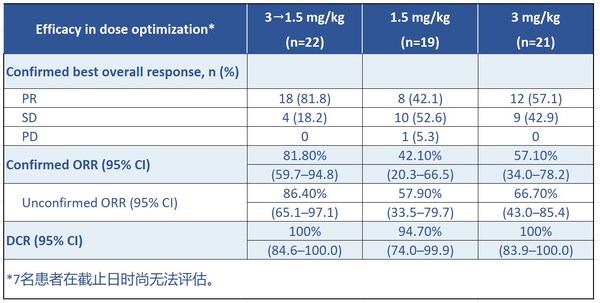
Furthermore, IBI363 demonstrated impressive efficacy in squamous and non-squamous subgroups, as well as PD-L1 negative and low-expression populations.
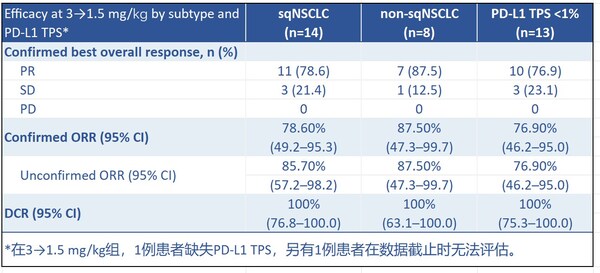
The impressive objective response rate shown by IBI363 combined with platinum-based doublet chemotherapy once again validates that IBI363, as a PD-1/IL-2α-bias bispecific antibody fusion protein, exerts potent anti-tumor effects regardless of PD-L1 expression status, corroborating the strong immune activation effect of IL-2.
Favorable safety profile supports continuous dosing and may translate into more durable efficacy benefits
In the 3→1.5 mg/kg dose group, the incidence of Grade ≥3 treatment-emergent adverse events (G3+ TEAEs) was 65.2%, demonstrating a favorable safety and tolerability profile, which may extend the first-line treatment duration for NSCLC and translate into durable efficacy benefits.
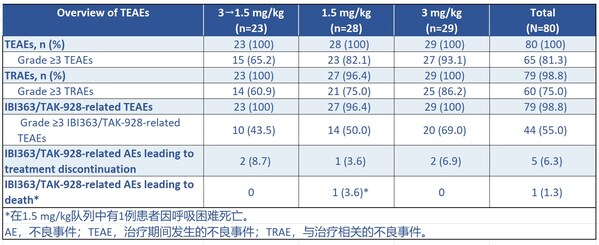
Grade ≥3 TEAEs occurring in ≥15% of all patients included: anemia (18.8%), neutropenia (42.5%), leukopenia (20.0%), and thrombocytopenia (17.5%).
Conclusions and Next Steps:
Based on a comprehensive assessment of overall safety, depth of efficacy, and durability, the 3→1.5 mg/kg dose is recommended for further study as the dose for IBI363 combined with chemotherapy in first-line treatment.Currently, Phase 2 of this PoC study, a randomized controlled trial comparing IBI363 3→1.5 mg/kg combined with chemotherapy versus pembrolizumab combined with chemotherapy as first-line treatment for advanced NSCLC (PD-L1 all-comer population), is ongoing.
Professor Yi-Long Wu from Guangdong Provincial People’s Hospital stated: “Currently, the standard first-line treatment for driver gene-negative advanced non-small cell lung cancer remains PD-1/PD-L1 antibodies combined with chemotherapy. With the emergence of next-generation immunotherapeutic agents, research into first-line treatment for non-small cell lung cancer has entered a new era. IBI363, as a first-in-class PD-1/IL-2α-bias bispecific fusion protein, has shown excellent preliminary clinical data when combined with chemotherapy as first-line treatment for non-small cell lung cancer. In PD-L1 negative and low-expression populations, the 3→1.5 mg/kg dose group demonstrated impressive objective response rates, also suggesting that IBI363 exerts potent immune activation and anti-tumor effects regardless of PD-L1 expression status. The adverse events were primarily hematologic toxicities commonly associated with chemotherapy, which are generally manageable, potentially enabling long first-line treatment cycles and translating into durable efficacy benefits. We look forward to more positive and sustained data updates from this study.”
Dr. Hui Zhou, Chief Medical Officer (Oncology) at Innovent Biologics, stated: “The design of IBI363 was precisely aimed at overcoming the bottlenecks of current immunotherapy. The research data presented at the 2026 American Society of Clinical Oncology (ASCO) Annual Meeting confirm that by designing a dosing strategy aligned with the immune mechanism—specifically the 3→1.5 mg/kg step-down regimen—we effectively harnessed the powerful advantages of IL-2 pathway activation, demonstrating impressive response rates in first-line treatment of PD-L1 low-expression and negative NSCLC. At the same time, the drug exhibits a favorable safety and tolerability profile that supports long-term administration, potentially yielding more durable efficacy benefits with extended follow-up. This result not only further validates the drug’s mechanism of action but also represents a significant milestone in the clinical translation of IBI363. We look forward to continued follow-up data from IBI363 in first-line NSCLC treatment and the accumulation of data from the ongoing Phase 2 randomized controlled PoC study, which will provide further robust evidence for the continued development of IBI363.”
Mechanistic Analysis of the IBI363 Dose Optimization Strategy
The dosing regimen of IBI363 has been precisely optimized to match the immune status and tumor microenvironment characteristics of patients at different treatment stages.
1) For patients with immunotherapy-resistant non-small cell lung cancer, the tumor microenvironment is generally in an immunosuppressive state, characterized by abundant regulatory T cell infiltration, M2-type tumor-associated macrophage polarization, and effector T cell exhaustion. For such patients, it is necessary to reactivate and continuously enhance the body’s anti-tumor immune capacity. Sustained high-intensity IL-2 signaling can awaken exhausted T cells and reverse the immunosuppressive effects induced by the tumor microenvironment.
- Updated PoC study data presented at this year’s ASCO Annual Meeting show that IBI363 3 mg/kg every three weeks as monotherapy can lead to long-term survival benefits. Currently, a global multicenter Phase III clinical trial (Marslight-11) is underway, which will conduct a head-to-head comparison of IBI363 3 mg/kg every three weeks monotherapy versus docetaxel.
2) Multiple studies have shown that in immunotherapy (IO)-naïve populations, the degree of immunosuppression in the tumor microenvironment is lower, allowing for an immune activation strategy of “igniting immunity and then maintaining stability.” Additionally, combination with chemotherapy can better facilitate antigen release and activate the immune system. Therefore, a strategy of using 3 mg/kg in the first cycle for immune priming is considered, to rapidly expand effector T cells, enhance T cell infiltration, and create an IO-sensitive immune microenvironment. Subsequently, 1.5 mg/kg Q3W is used for the maintenance phase, where a moderate dose can sustain the IO-sensitive tumor microenvironment, potentially extending the treatment cycle and further enhancing efficacy. Such dosing strategies are also common in the regimen design of other immunotherapies.
- Data from the dose optimization phase of the PoC study presented at this year’s ASCO Annual Meeting show that IBI363 3→1.5 mg/kg dose group combined with chemotherapy as first-line treatment for PD-L1 negative or low-expression advanced non-small cell lung cancer (NSCLC) demonstrates excellent efficacy and a favorable safety profile. Currently, Phase 2 of this PoC study, a randomized controlled trial comparing IBI363 3→1.5 mg/kg combined with chemotherapy versus pembrolizumab combined with chemotherapy as first-line treatment for advanced NSCLC (PD-L1 all-comer population), is ongoing.
About IBI363 (PD-1/IL-2α-bias Bispecific Fusion Protein)
IBI363 is a first-in-class PD-1/IL-2α-bias bispecific fusion protein independently developed by Innovent Biologics. It possesses dual functions of blocking the PD-1/PD-L1 pathway and activating the IL-2 pathway. The IL-2 arm of IBI363 has been engineered to retain its affinity for IL-2Rα while reducing its binding capacity to IL-2Rβ and IL-2Rγ, thereby reducing toxicity. The PD-1 binding arm enables simultaneous PD-1 blockade and selective IL-2 delivery. This differentiated strategy allows for more precise and effective targeting and activation of tumor-specific T cell subsets.
Currently, IBI363 is being evaluated in a series of clinical trials globally, including a global multi-regional Phase III trial in immunotherapy-resistant squamous non-small cell lung cancer and a pivotal Phase II study in untreated acral and mucosal melanoma in China. Additionally, multiple Phase Ib/II trials are ongoing to evaluate IBI363 in non-small cell lung cancer and colorectal cancer (including first-line and later-line treatments), as well as other tumor types. To date, IBI363 has received three Breakthrough Therapy Designations (BTD) from China’s NMPA and two Fast Track Designations (FTD) from the U.S. FDA.
In October 2025, Innovent Biologics and Takeda Pharmaceutical entered into a strategic collaboration. The parties will jointly develop IBI363 (Takeda development code: TAK-928) globally and co-commercialize it in the United States. Additionally, Innovent Biologics granted Takeda Pharmaceutical commercialization rights for IBI363 in regions outside of Greater China and the United States.
About Innovent Biologics
“Start with integrity, succeed through action.” Developing high-quality biologics that are affordable for the general public is Innovent Biologics’ mission and goal. Founded in 2011, Innovent is dedicated to the research, development, manufacturing, and commercialization of innovative drugs for major diseases such as oncology, autoimmune diseases, metabolic diseases, and ophthalmology, aiming to benefit more lives with our work. The company has 18 approved products on the market: Sintilimab Injection (Tyvyt®), Bevacizumab Injection (Byvasda®), Adalimumab Injection (Sulinuo®), Rituximab Injection (Dabohua®), Pemigatinib Tablets (Pemazyre®), Olverembatinib Tablets (Nerlynx®), Ramucirumab Injection (Cyramza®), Selpercatinib Capsules (Retevmo®), Equecabtagene Autoleucel Injection (Fucaso®), Tafolecimab Injection (Sibeprenlimab®), Fuzerisib Tablets (Dabote®), Pirtobrutinib Tablets (Jaypirca®), Taletrectinib Capsules (Dabole®), Lenvatinib Tablets (Aiyixin®), Teplizumab-mzwv Injection (Sibinmin®), Mazdutide Injection (Xinermei®), Pikunumab Injection (Xinmeiyue®), and Ipilimumab-nwyo Injection (Daboxin®). Currently, 5 new drug molecules are in Phase III or pivotal clinical studies, and an additional 14 new drug candidates have entered clinical research.
The company has established over 30 strategic collaborations with international partners such as Eli Lilly, Roche, Takeda, Pfizer, Sanofi, Incyte, and MD Anderson Cancer Center. While continuously innovating and developing its own drugs and pursuing its own growth, Innovent Biologics adheres to the people-centered development philosophy for economic construction. Over the years, it has always been guided by scientific conscience, adhered to a “patient-centered” approach, cared for patients and their families, and actively fulfilled its social responsibilities. The company has successively initiated and participated in multiple drug patient assistance programs, enabling more and more patients to benefit from advances in life sciences and to afford and access high-quality biologics. To date, Innovent Biologics’ patient assistance programs have benefited over 200,000 ordinary patients, with a total drug donation value of RMB 4 billion. Innovent Biologics hopes to work together with everyone to improve the development level of China’s biopharmaceutical industry, in order to meet the people’s need for accessible medication and their aspirations for a healthy life.
For more information, please visit the company website: www.innoventbio.com or the company’s LinkedIn page: www.linkedin.com/
Disclaimer:1.Innovent Biologics does not recommend the use of unapproved drugs/indications.
2.Ramucirumab Injection (Cyramza®), Selpercatinib Capsules (Retevmo®), and Pirtobrutinib Tablets (Jaypirca®) are developed by Eli Lilly.
Forward-Looking Statements
The information contained in this press release may contain certain forward-looking statements. These statements are inherently subject to significant risks and uncertainties. When using words such as “anticipate,” “believe,” “predict,” “expect,” “intend,” and other similar expressions, when related to the Company, the purpose is to indicate that they are forward-looking statements. The Company has no obligation to continually update these forward-looking statements.
These forward-looking statements are based on the current views, assumptions, expectations, estimates, forecasts, and understanding of future events by the Company’s management at the time they are made. These statements are not guarantees of future development and are subject to risks, uncertainties, and other factors, some of which are beyond the Company’s control and difficult to predict. Therefore, actual results may differ materially from the information contained in the forward-looking statements due to future changes and developments in our business, competitive environment, and political, economic, legal, and social conditions.