

ShanghaiJune 4, 2026 /PRNewswire/ — Recently, Wenzhou Medical University held a launch meeting for the National Science and Technology Major Project for Innovative Drug Research and Development (hereinafter referred to as the “Launch Meeting”), during which the initiation and progress of two major projects led by the university were reported. Jin Sai Pharmaceutical, as a participating unit in the major project titled “Creation and Clinical Research of Multi-Target Anti-Fibrosis Fusion Proteins and Antibody New Drugs,” was invited to attend the meeting.
The Launch Meeting brought together authoritative forces from multiple sectors. Attendees included Yu Zhenxing, Director of the Medical Division of the China National Center for Biotechnology Development; Academician Li Xiaokun, President of the China Medical Biotechnology Association and Chancellor of Wenzhou Medical University; Yuan Lin, former Director of Drug Safety at the National Medical Products Administration; Qiu Xueting, Director of the Zhejiang Provincial Medical Science, Technology, and Education Development Center; Academician Zhang Kang, Dean of the Advanced Institute for Eye Health and Diseases at Wenzhou Medical University and a European Academy of Sciences member; Professor Zeng Su, Qiushi Distinguished Professor at Zhejiang University; Wu Xifeng, Vice President of the Second Affiliated Hospital of Zhejiang University School of Medicine; and representatives from Jin Sai Pharmaceutical, among other government, academic, and industry figures, who delivered speeches at the project launch. The meeting was chaired by Lin Li, Vice President of Wenzhou Medical University. Project leaders Professor Wang Xiaojie and Professor Huang Zhifeng provided detailed introductions to the overall objectives, key technologies, and collaboration mechanisms of the projects.
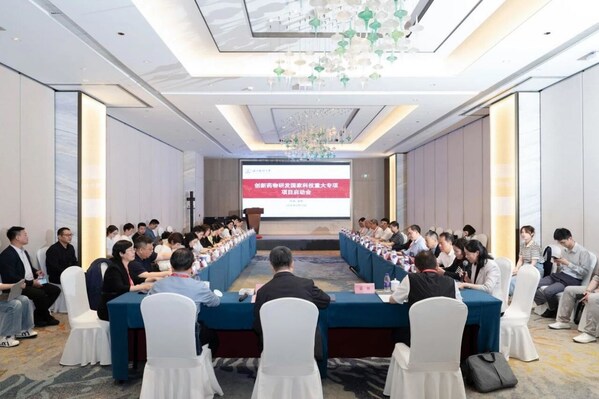
Launch Meeting of the National Science and Technology Major Project for Innovative Drug Research and Development
Wang Xiaojie, project leader of “Creation and Clinical Research of Multi-Target Anti-Fibrosis Fusion Proteins and Antibody New Drugs” and Deputy Director of the National Engineering Research Center for Cell Growth Factors and Protein Preparations at Wenzhou Medical University, elaborated on the project’s overall objectives, technical roadmap, and phased progress.
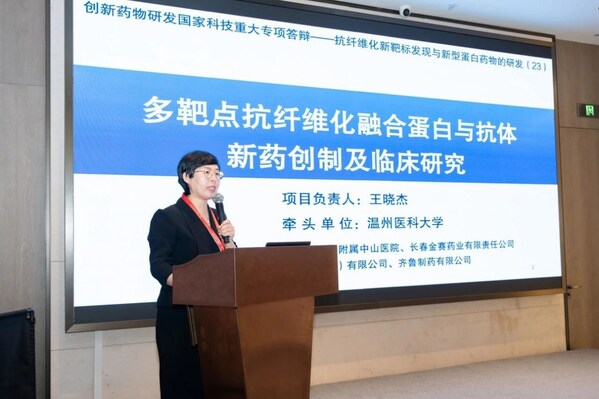
Wang Xiaojie, project leader of “Creation and Clinical Research of Multi-Target Anti-Fibrosis Fusion Proteins and Antibody New Drugs” and Deputy Director of the National Engineering Research Center for Cell Growth Factors and Protein Preparations at Wenzhou Medical University
Experts unanimously agreed that the two projects—”Creation and Clinical Research of Multi-Target Anti-Fibrosis Fusion Proteins and Antibody New Drugs” and “Development of Novel Cytokine-Based Biologics for Metabolic Diseases”—are original, pioneering, and industrially impactful. They are expected not only to fill gaps in related domestic fields but also to provide core support for the biomedical industry chain. The experts recommended strengthening the integration of real-world data with multimodal digital twin technology, utilizing AI to optimize target screening, structural modifications, and clinical trial design; focusing on in vivo processes and quality control studies for long-acting drugs; and exploring the expanded application of cytokines in chronic diseases such as cardiovascular conditions.
Yang Liu, Head of Health Affairs at Jin Sai Pharmaceutical, stated that the implementation of major projects is a key strategic measure to drive China’s pharmaceutical industry toward high-quality development and meet critical clinical needs. The role of enterprises as innovation entities has been strengthened, and the implementation of the projects has effectively promoted deep integration among government, industry, academia, research, and healthcare. Core entities such as administrative departments, technical experts, enterprises, universities, research institutes, and medical institutions have formed a collaborative network to tackle challenges together around shared goals.
While affirming the effectiveness of the projects’ implementation, the enterprise side also raised current practical challenges and policy expectations based on their experience.
“Enterprises hope for a more comprehensive, full-chain policy support system, striving for efficient coordination between the strategic layout of major projects and the supporting policies of various ministries. In particular, we look forward to more policy support in areas such as pricing of marketed drugs, determination of payment standards in national medical insurance negotiations, and hospital access for pharmaceuticals,” Yang Liu said.
Furthermore, on the day of the Launch Meeting, one of the products from the “Creation and Clinical Research of Multi-Target Anti-Fibrosis Fusion Proteins and Antibody New Drugs” project—the domestically developed first long-acting IL-1β monoclonal antibody, Vuxinchi Monoclonal Antibody (Jinbeixin®), independently developed by Jin Sai Pharmaceutical—received authoritative recognition as one of the “Top 10 Advances in China’s Medical Biotechnology in 2025.”[1] The “Top 10 Advances in China’s Medical Biotechnology in 2025” selection is co-hosted by the China Medical Biotechnology Association, the Journal of China Medical Biotechnology Co., Ltd., and Wenzhou Medical University. This annual selection has been successfully held for eleven consecutive years and is a benchmark event with high credibility and influence in the domestic medical biotechnology field.
Vuxinchi Monoclonal Antibody for injection was approved for market launch in June 2025. It is a novel, fully human anti-interleukin-1β (IL-1β) monoclonal antibody drug independently developed by Jin Sai Pharmaceutical, classified as a Class 1 new therapeutic biologic. Its dosing regimen of “one injection effective for six months” significantly improves patient treatment compliance, marking a new era for gout treatment in China, entering a “long-acting, precision anti-inflammatory” management phase with biologics.[2-3]