

BangkokJune 8, 2026 /PRNewswire/ — Researchers at Chulalongkorn University have developed a new “cocoa-based mineral nutritional supplement” that processes secondary cocoa raw materials and discarded cocoa shells into high-value-added livestock feed. This innovation, built on a circular economy model, helps farmers reduce breeding costs, improve livestock health, and effectively cut greenhouse gas emissions.
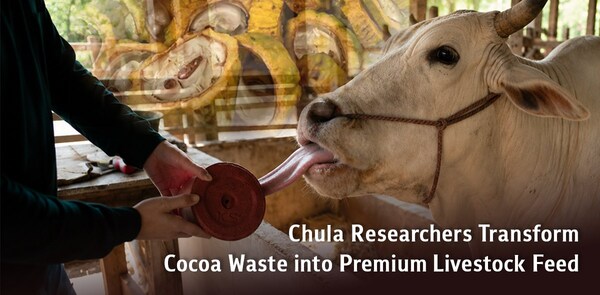
Chulalongkorn University researchers turn cocoa waste into premium livestock feed
This research is led by Dr. Tansiphorn Na Nan, Assistant Professor and Acting Deputy Dean for Research and Academic Services at the School of Integrated Agriculture, Chulalongkorn University, and Director of the Thailand Sustainable Cocoa Research and Development Innovation Center (ISTC) in Nan Province. Driven by worsening climate conditions, cocoa crop losses range from 80% to 90%, leaving farmers with large stocks of unsellable cocoa waste. Meanwhile, prolonged drought has steadily pushed up feed costs for the livestock industry—prompting this innovative solution.
The research team has developed two forms of nutritional supplement products: compressed “lick blocks” for small-scale farms, and a powder product suitable for large-scale feed blending production lines. In both product formulas, cocoa waste can account for up to 30% of the content, efficiently processing agricultural waste while creating additional income streams for cocoa growers.
Studies show that cocoa’s natural components, including flavonoids, polyphenols, theobromine, and tannins, offer significant health benefits for livestock. Notably, theobromine improves overall health in cattle, reduces inflammation, and enhances feed conversion efficiency. Field tests reveal that this feed supplement can reduce mastitis-related somatic cell counts in dairy cows by over 70% and boost milk fat content by up to 15%.
Results in beef cattle farming are equally striking. While ordinary beef cattle typically sell for only 20,000 to 30,000 Thai baht per head, feeding this nutritional supplement significantly improves meat quality, with some cattle reaching premium A3 and A4 grades and fetching prices exceeding 100,000 baht per head. Additionally, the tannins in cocoa inhibit methane-producing microbial activity in the rumen, cutting greenhouse gas emissions by up to 44% while redirecting more nutrients toward muscle and fat development, further enhancing marbling and meat quality.
Beyond cattle farming, this research has been progressively applied to poultry, goat, and shrimp aquaculture, adhering to the project’s guiding principle of “making the most of every cocoa bean.” This fully demonstrates how circular economy innovations can create sustainable value across various agricultural sectors.