

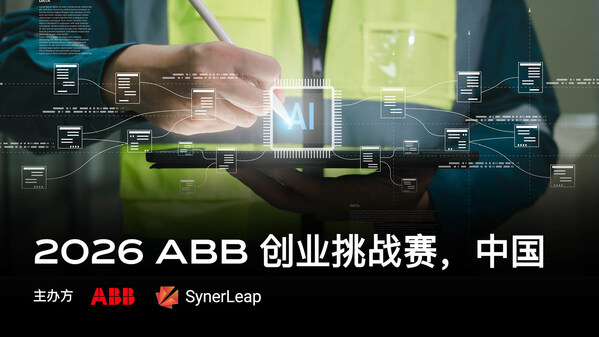
BeijingJune 9, 2026 /PRNewswire/ — Amid the wave of deep integration between artificial intelligence and industrial automation, an increasing number of enterprises are seeking intelligent approaches to break through engineering efficiency bottlenecks. On June 9, the 2026 ABB Startup Challenge officially kicked off, inviting Chinese startups to participate and jointly tackle technical challenges in the field of industrial automation.
Challenge Focus: Simplifying Automation Engineering and Maintenance
Currently, the engineering and commissioning of automation systems remain complex, error-prone, and time-consuming tasks, with system troubleshooting posing a major challenge. Such work requires engineers to have deep product expertise. To address this, ABB’s Motion Control business unit has launched a challenge titled “AI Solutions: Making Automation Engineering and Maintenance Simpler” for Chinese startups (click here to learn about the challenge details and registration method), aiming to leverage AI technology to lower the barrier to using automation products, allowing customers to focus on machine innovation and optimized maintenance.
This challenge is open to Chinese startups, expecting participating companies to develop an AI-driven solution that can act as a “technical expert,” assisting engineers in efficiently completing tasks such as programming, commissioning, troubleshooting, and routine maintenance of automation systems. The solution must address at least one of the following scenarios or pain points in other typical industrial application settings.
Typical Application Scenario 1
Engineers at original equipment manufacturers (OEMs) are familiar with the equipment and application scenarios but may not be proficient in ABB automation products such as drives, servo systems, or PLCs. When carrying out equipment engineering and commissioning tasks (e.g., PLC programming, drive commissioning), they need to consult technical documentation, engage in trial-and-error testing, or even seek help from ABB’s technical team, a process that consumes significant time.
For this scenario, the AI solution should interact with engineers to clarify work objectives, interface with products to monitor real-time operational status, automatically provide commissioning steps, and even generate ready-to-use parameter configurations.
Typical Application Scenario 2
When equipment malfunctions, engineers at end-user companies need to quickly diagnose and resolve issues. However, due to their limited in-depth understanding of the ABB automation products built into the equipment, relying solely on fault codes and alarm information makes it difficult to complete troubleshooting.
For this scenario, the AI solution should communicate with engineers to understand the fault symptoms, interface with products to obtain fault information and operational status, support reading auxiliary materials such as images and videos, and then generate on-site troubleshooting steps or even provide directly feasible solutions.
Additionally, the solution must consider the following requirements:
- Be adaptable to different ABB automation products;
- In addition to integrating ABB’s technical expertise, be capable of learning and incorporating the customer’s own technical knowledge and hands-on experience;
- Go beyond standard manuals and formal documents to learn and organize unstructured, fragmented knowledge and experience;
- Possess continuous iteration capabilities to constantly learn and improve understanding of ABB products and customer equipment;
- Ensure information security and support local deployment.
At the same time, we also look forward to innovative ideas from startups to enhance the solution’s applicability in industrial scenarios, focusing on overcoming the following issues:
- How to adapt AI solutions to the characteristics of industrial application scenarios (e.g., limited data volume, low data quality)?
- How to achieve efficient training so that the AI solution reaches the professional level of a senior technical expert?
- How to minimize the resources required to run the AI solution?
Generous Rewards Await You
The winners of this challenge will receive:
- 200,000 RMB: To collaborate with ABB China Motion Control business unit in developing a minimum viable product (MVP) that can be offered to ABB customers;
- SynerLeap Membership: ABB’s open innovation platform, helping startups grow and gain visibility among ABB, partners, and customers. Membership benefits include:
- Networking opportunities with ABB, partners, and startups
- Guidance on how to collaborate with ABB and tailored introductions to ABB experts and scientists
- Exploration of pilot projects and proof-of-concept (PoC) opportunities funded by ABB’s R&D and business units
- Participation in events and workshops organized by SynerLeap, ABB, and partners
Challenge Schedule:
|
June 9 – July 3 |
Registration Period |
|
September 14 – September 23 |
10-Day Challenge |
|
October 9 |
Feedback Session |
|
October 27 – 29 |
Finals (Location: Nanjing) |
|
Through Q2 2027 |
Collaboration Phase |
|
2027 |
Market Entry Phase |
For Chinese Startups, Act Now
This challenge is open to Chinese startups, with a registration deadline of July 3. If your team is exploring the intersection of AI and industrial automation, here you will find real application scenarios, professional technical resources, and the opportunity to bring products to market together with ABB.
From idea to product, from lab to market — ABB looks forward to joining hands with Chinese startup teams to put innovative technology into practice in industrial automation.
Register now! (Click here to learn about the challenge details and registration method)