

ChengduJune 11, 2026 /PRNewswire/ — Today, the clinical research results of JWK002 injection, an AAV gene therapy drug independently developed by Chengdu Jinweike Biotechnology Co., Ltd. for the treatment of X-Linked Retinoschisis (XLRS), were officially published as an original article in the internationally renowned top medical journal The New England Journal of Medicine (NEJM). As one of the oldest and most academically influential comprehensive medical journals globally, The New England Journal of Medicine is renowned for its rigorous peer review system and distinct orientation toward clinical translational value, long leading the frontier of international clinical medical research.
This marks the first XLRS gene therapy clinical data ever published in NEJM worldwide, signifying that this hereditary retinal disease has officially entered the era of precision gene replacement therapy. It also represents a breakthrough for China’s original First-in-Class ophthalmic gene therapy, transitioning from concept validation to clinical benefit validation, bringing new hope of “one treatment, long-term efficacy” to patients with hereditary retinal diseases worldwide.

X-Linked Retinoschisis is an X-linked recessive genetic disease caused by mutations in the RS1 gene. Patients typically experience progressive vision loss, retinoschisis (separation of retinal layers), macular schisis, macular holes, and retinal detachment during childhood or adolescence, ultimately leading to legal blindness. The global incidence rate is approximately 1/5,000 to 1/25,000, with an estimated hundreds of thousands of patients worldwide. Currently, there are no approved drugs globally; only symptomatic support or surgical management of complications is available, unable to address the fundamental genetic defect. Chengdu Jinweike Biotechnology innovatively employs a self-complementary recombinant adeno-associated virus serotype 8 (scAAV8) vector, carrying a sequence-optimized human RS1 gene and a photoreceptor-specific promoter, precisely achieving specific expression of the RS1 gene in photoreceptor cells. Preclinical studies have shown that subretinal injection of JWK002 injection (scAAV8-hRS1) can improve retinal structure and function in XLRS mouse models and demonstrates good safety in rhesus monkeys, laying a solid foundation for subsequent clinical trials.
This clinical study enrolled 12 subjects at West China Hospital of Sichuan University. During the 52-week clinical trial follow-up period, in terms of safety, all subjects showed good ocular and systemic tolerability, with no Grade 3 or higher adverse events, no drug-related adverse events, and no ocular inflammatory reactions observed. Structurally, patients’ retinoschisis cavities closed, and retinal structure returned to normal (as shown in the figure). Central retinal thickness (CRT) results showed that the average CRT of treated eyes at week 52 decreased by (437.7 ± 153.4) μm from baseline. Functionally, at week 52 post-treatment, the best corrected visual acuity (BCVA) of treated eyes in 12 patients improved by an average of (10.8 ± 4.9) letters. Throughout the follow-up period, patients’ visual function maintained stable growth overall. The results of this study indicate that subretinal injection of JWK002 is safe in XLRS patients and can improve retinal structure and function, laying a solid foundation for subsequent clinical development. Currently, all patients for the Phase II clinical trial of the JWK002 project have been enrolled.
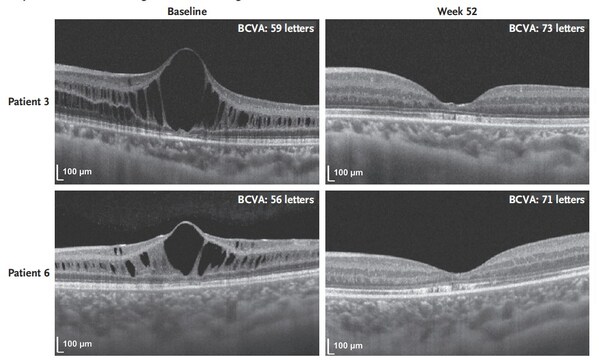
Figure: Representative macular OCT images of two patients at baseline and week 52 post-treatment. The top right corner shows BCVA letter count.
This study was co-authored by Professor Lu Fang from the Department of Ophthalmology, West China Hospital of Sichuan University, Researcher Yang Yang from Chengdu Jinweike Biotechnology, Academician Wei Yuquan, and Professor Zhang Kang from the Eye Hospital of Wenzhou Medical University as corresponding authors, with Dr. Liang Licong and Dr. She Kaiqin from the Department of Ophthalmology, West China Hospital of Sichuan University as co-first authors.
Chengdu Jinweike Biotechnology
Chengdu Jinweike Biotechnology, founded by Academician Wei Yuquan and Researcher Yang Yang, is located in the SanYi Innovation Center in Wenjiang District, Chengdu. The company is a biotechnology firm dedicated to the development of AAV gene therapy drugs for ophthalmic diseases, neuromuscular diseases, and genetic metabolic diseases. Currently, multiple AAV gene therapy products in its pipeline have entered clinical research stages.
Chengdu Jinweike Biotechnology has established a 3,000-square-meter R&D and production base integrating AAV gene drug R&D, pilot-scale preparation, and quality control. It has formed a highly integrated and comprehensive “technology chain” for AAV gene therapy, with its gene therapy drug R&D capabilities and AAV preparation technology at a leading domestic level. Jinweike’s independently developed “two-plasmid packaging system” significantly enhances AAV vector packaging efficiency while substantially reducing production costs, establishing a core advantage for the clinical translation and future commercialization of AAV gene therapy drugs. The company’s AAV gene therapy products have been used in clinical studies involving over 200 patients, demonstrating excellent safety and efficacy data.
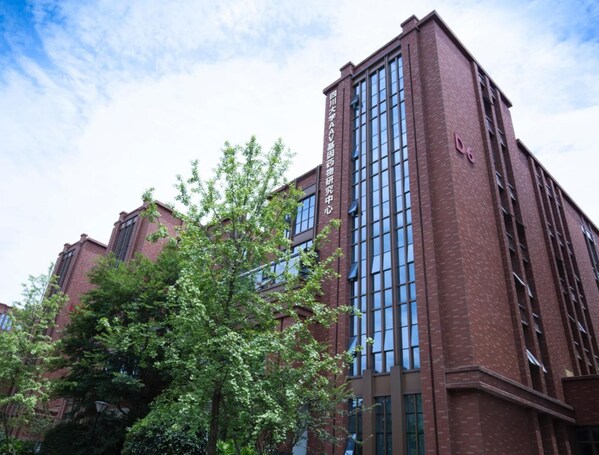
The core management team of Chengdu Jinweike Biotechnology comes from renowned domestic and international pharmaceutical companies, research institutions, and universities. The core technical team’s background covers AAV vector design, pilot-scale production, quality research, and medical clinical aspects, endowing Jinweike with an integrated operational level from the source design of gene therapy products to large-scale pilot preparation and medical and clinical research.
Chengdu Jinweike Biotechnology will leverage its strong technology platform, collaborate with leading domestic and international partners, integrate resources, and achieve the accessibility of AAV gene therapy drugs, striving to benefit a broader patient population more rapidly.