

 |
Pavia, ItalyJune 21, 2026 /PRNewswire/ — The National Center for Oncological Hadrontherapy (CNAO) today became the first stop of Pope Leo XIV’s pastoral visit to Pavia. The Pope’s choice to begin his visit at this center underscores his firm commitment to fostering a deep dialogue between the advancement of science and the alleviation of human suffering.
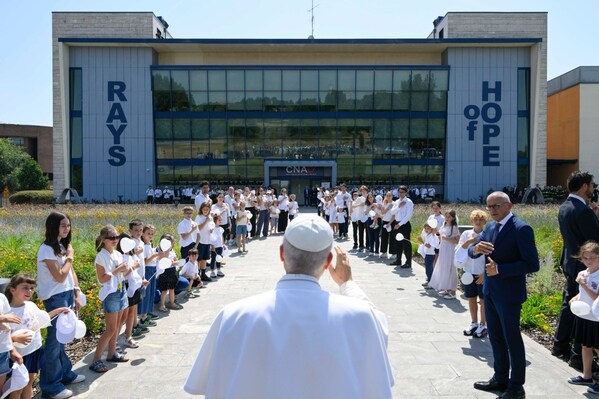
Pope Leo XIV visiting the National Center for Oncological Hadrontherapy (CNAO) in Pavia – Italy
CNAO Chairman Gianluca Vago and General Manager Sandro Rossi welcomed His Holiness and introduced him to the center’s unique capabilities. CNAO is a unique institution in Italy and one of the very few in the world capable of performing hadrontherapy using both protons and carbon ions. The technological core of the facility is its synchrotron—a subatomic particle accelerator that generates ultra-precise particle beams used to treat complex, inoperable tumors that are resistant to radiotherapy. This cutting-edge technology can precisely target and destroy diseased cells while maximizing the protection of surrounding healthy tissue, thereby significantly improving patient survival rates and quality of life.
Furthermore, CNAO is expanding its treatment capabilities, aiming to become a leading international particle therapy center in the application of new ion beams. Research with helium ions is already underway, and oxygen and neon ions will be introduced in the future. The center will also integrate the Leo Cancer Care upright patient positioning and imaging system into its treatment workflow. Treatments using a dedicated Hitachi proton accelerator with a rotating gantry, as well as a BNCT system for metastatic diseases equipped with an electrostatic accelerator produced by TAE Life Science, are set to begin soon. With the introduction of these new technologies, CNAO will become one of the most technologically advanced centers in the world.
To date, over six thousand people have benefited from these life-saving treatments, including approximately three hundred children and adolescents.
During the visit, the Pope engaged with the CNAO Board of Directors, a collaborative body bringing together multiple universities, clinical institutions, and research centers from across the country. The Pope also warmly greeted the center’s two hundred employees. These doctors, physicists, engineers, and researchers work tirelessly to provide treatment and care for oncology patients using advanced technologies.
The most touching moment of the day was the private meeting between the Pope and a delegation of pediatric patients undergoing treatment. The children and their families shared a warm and emotional time with the Pope, receiving his caring embrace.
CNAO Chairman Gianluca Vago stated: “The visit of Pope Leo XIV is an honor for us and a moment of extraordinary human value. In his encyclical Magnifica Humanitas, the Pope emphasizes that science must always uphold the centrality of the human person and direct technology toward the common good. In an era of global tensions, CNAO witnesses every day how the astonishing power of atoms can be used for healing rather than destruction. The particle beams we use to fight disease symbolize ‘rays of hope,’ and we participate in and support the International Atomic Energy Agency (IAEA) project bearing that name. The Pope’s embrace of the children reminds us once again that scientific research fulfills its truest mission only when it walks hand in hand with listening, care, and hope.”