

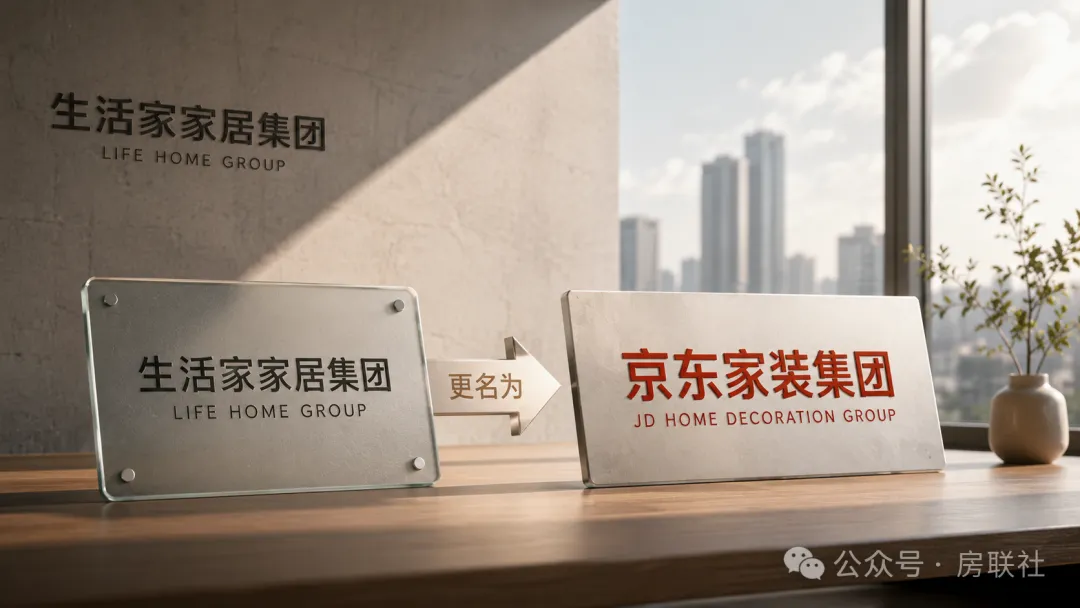
On June 23, 2026, a business registration change on Tianyancha sent shockwaves through the home renovation industry: Sichuan Shenghuojia Home Furnishing Group Co., Ltd. officially changed its name to “JD Home Furnishing Group Co., Ltd.”.
This comes exactly one year after JD.com’s acquisition of Shenghuojia Home Furnishing’s equity was approved by the State Administration for Market Regulation. The shift from “Shenghuojia” to “JD Home Furnishing” is not merely a simple brand swap; it signifies that JD.com’s deep integration into the trillion-yuan home furnishing landscape has moved from “behind the scenes” to “center stage.”
One is an internet giant, the other a veteran chain renovation company with 15 years of offline experience. After a year of磨合, this partnership has finally shown its hand. Why is JD.com in such a rush to “brand” Shenghuojia? And what will this mean for ordinary consumers and the overall industry landscape? This article will dissect the details for you, interpreting the ambitions and challenges behind this name change.
The Acquisition Story: From Approval to “Branding” in One Year
Let’s rewind to 2025. On June 4 of that year, the Second Division of Antimonopoly Enforcement under the State Administration for Market Regulation issued a notice unconditionally approving the equity acquisition of Sichuan Shenghuojia Home Furnishing Group Co., Ltd. by Beijing JD Century Trade Co., Ltd. One month later, the business registration change was completed, with JD.com achieving absolute control, holding approximately 66.6% of the shares.
The acquiring entity, “Beijing JD Century Trade Co., Ltd.,” is the core business vehicle of the JD Group, wholly owned by JD.com Hong Kong International Co., Ltd. The target, “Shenghuojia Home Furnishing,” founded in 2010, is a whole-home renovation company with a direct-sales network in over 20 core cities nationwide, having served more than 200,000 middle-class families.
From the equity change to the brand rename, JD.com took one year. This was not a delay but a deliberate process of digestion and absorption. Shenghuojia’s founder, Bai Jie, a former teacher, led the company from building materials agency to digital-intelligent whole-home renovation. Its offline delivery capabilities and localized construction teams are precisely the “heavy assets” that JD.com most lacked and craved. Now, this force is officially under JD.com’s banner.
Strategic Intent: Breaking the Bottleneck of “Online Traffic + Offline Delivery”
Why did JD.com insist on changing “Shenghuojia’s” name to “JD Home Furnishing”? Behind this lies a profound reflection after repeated failures by internet giants in the home renovation space.
Over the past decade, Alibaba, Tencent, and Baidu have all ventured into home renovation with platform models, but almost all have stumbled. Home renovation has never been a traffic-driven business. Online platforms can help you find designers and recommend renovation companies, but they can’t manage a bag of cement or a pipe on the construction site. The uncontrollable quality of delivery is the industry’s biggest pain point.
JD.com’s solution: Since the light approach doesn’t work, go for the heaviest.
By fully controlling Shenghuojia, JD.com directly acquired a direct-service network covering over 20 cities nationwide, more than 2,000 designers, and mature construction teams. This name change is about fully “JD-ifying” this offline capability—users select products and designs online via JD.com, and then receive delivery from JD.com’s own construction teams offline, creating a closed loop with no outsourcing or subcontracting.
JD Group CEO Xu Ran once proposed moving the renovation industry from the “assembled machine era” to the “branded machine era.” This means that in the future, when you place an order with JD Home Furnishing, you’ll receive a standardized service with clear specifications, uniform standards, transparent pricing, and after-sales support, much like buying a branded computer. Renaming Shenghuojia to “JD Home Furnishing” is the final brand-level implementation of this “branded machine” strategy.
Ambitions and Challenges of the Heavy-Asset Model
After the name change, JD Home Furnishing’s ambitions become clearer. According to public information, JD Home Furnishing has built a closed-loop chain covering product selection, design, and construction:
- Supply Chain: Over 500 professional sourcing agents directly procure from 14 countries globally;
- Construction: Directly manages over 5,200 skilled workers across ten trades;
- Design: JoyAI large model collaborates with over 1,000 full-time designers;
- Offline Layout: Fully integrated into JD MALL, with plans to cover 30 cities nationwide by 2026, targeting a GMV of over 30 billion yuan in the next three years.
However, the heavy-asset model is not a panacea. The highly personalized nature of renovation services and regional differences inherently conflict with JD.com’s standardized retail logic. Replicating uniform construction standards across different cities like Beijing, Shanghai, and Chengdu, while also accommodating local user preferences and habits, comes with extremely high management costs. If the massive upfront investment fails to quickly achieve economies of scale, it risks falling into a dilemma of “high costs and difficulty in turning a profit.”
Industry Shift: The 5 Trillion Yuan Market Enters the “Branded Machine Era”
This name change occurs at a time of intense industry restructuring. China’s home renovation and furnishing market has surpassed 5 trillion yuan, with existing home renovations becoming the main driver. However, this market has long been plagued by the “big industry, small players” problem, with consumers suffering from opaque information and unreliable quality.
Now, internet giants are placing their bets: Alibaba has launched “Tmall Renovation Bao,” Ant Group offers fund custody, and Kuaishou has also entered the fray. But most players still follow a light platform logic, with only JD.com betting on a “self-operated heavy delivery” model.
Shenghuojia’s rename to JD Home Furnishing sends a clear signal: JD.com is no longer content to be a “platform bridge” in the renovation industry; it is stepping in to become the “general contractor.” Will this force the entire industry to move away from the rough “assembled machine” era and truly usher in a standardized, transparent “branded machine era”? We will wait and see.
Conclusion
From launching its home furnishing channel in 2011, to investing in Shangpin Zhaipei in 2021, to controlling Shenghuojia in 2025 and completing the brand rename in 2026—JD.com has spent 15 years transitioning from an observer to a player.
The name “Shenghuojia” has become history, and the banner of “JD Home Furnishing” has been formally raised. On the trillion-yuan home renovation table, a new player armed with an internet gene and a heavy-asset armor has shown all its cards. Now, the question is whether the delivery on construction sites will live up to the brand’s reputation.