

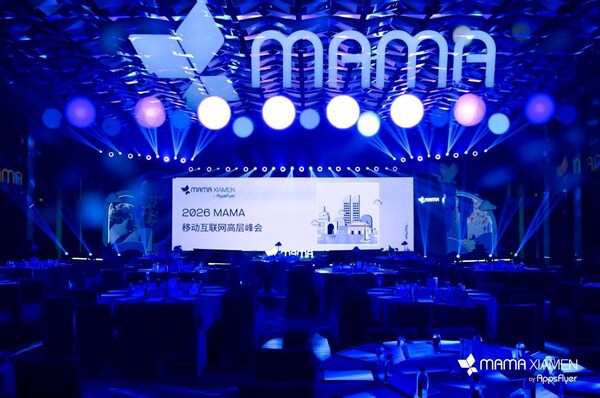
BeijingJune 22, 2026 /PRNewswire/ — AppsFlyer, the global marketing measurement and experience management platform, successfully hosted the 2026 MAMA Mobile Internet Executive Summit (hereinafter referred to as 2026 MAMA) in Xiamen. The summit brought together over 100 elite professionals from the mobile internet industry, including top CXOs and marketing decision-makers from sectors such as gaming, fintech, social networking, and intelligent marketing. In-depth discussions were held on topics including AI-driven changes in mobile marketing, the global expansion of Chinese brands, and new paradigms for growth.
Insights Converge: Five Guests Discuss New Growth Logic in the AI Era
During the keynote session of 2026 MAMA, five distinguished guests from academia and the mobile internet sector delivered in-depth analyses on topics such as restarting growth in the AI era, the irreplaceable core value of humans, Agentic Thinking reshaping corporate futures, and practices of AI-native organizations.
Dr. Wang Wei, General Manager of AppsFlyer Greater China, in his speech titled “Intelligence Arrives, Growth Restarts: New Directions in the AI Era,” predicted that 2026 is likely to be the first year AI transitions from “answering questions” to “completing tasks.” Citing insights from the AI Ascent Summit earlier this year, he noted that large language models have reached human-level intelligence. He emphasized that once such models are integrated with internal corporate data, organizational context, and tool-calling capabilities, they become essentially indistinguishable from a human employee sitting at a computer. He stressed that the more AI is implemented, the more critical data becomes. When model capabilities converge, the real difference between enterprises lies not in the models themselves but in the quality of context the models access. An agent operating on flawed data can amplify losses exponentially at machine speed. Additionally, Dr. Wang officially released the AppsFlyer “2026 China App Overseas Marketing Trends Report” at the summit.
Economist Xue Zhaofeng, in his speech “8 Reasons Humans Won’t Be Replaced by AI,” began with economist Bastiat’s metaphor: light is the welfare humans seek, while making candles is merely a means. He argued that the essence of technological revolution is the successive removal of “toil,” and that humans ultimately compete with other humans, not tools. He identified eight irreplaceable human impulses and fundamental needs: connection and belonging, curiosity and learning, complex experiences, imagery and storytelling, morality and sentiment, creation and achievement, health and physical sensation, and life’s meaning. He pointed out that AI can simulate responses but cannot provide the recognition of being valued by another equally fragile being. True breakthroughs in scientific history often lie not in solving final problems but in first posing the right questions—this “taste for problems” is uniquely human and structurally unattainable by AI. He concluded: “Machines are becoming more like humans, and humans finally have the time to be human.”
Steve Hoffman, Chairman and CEO of Founders Space, in his speech “The AI-Native Era: How Agentic Thinking Reshapes Corporate Futures,” noted that AI is comprehensively penetrating business areas like marketing, sales, customer service, and software development, driving dual restructuring of efficiency and business models. He proposed that companies formulate AI strategies by addressing three core questions: Why now? What impact will it have? How to proceed? Citing real corporate cases, he highlighted a Chinese food company that successfully drove organizational AI transformation by appointing an AI Champion, hosting regular internal sharing sessions, and tying AI adoption rates to KPIs. Conversely, other companies failed due to prematurely removing human oversight or failing to align AI tools with business goals. In his view, the dividing line between success and failure lies not in the tools themselves but in whether companies genuinely change their work methods. His core insight: “We are no longer task executors but system architects. Our new job is to define goals and let AI achieve them.”
Fu Qiang, Head of Growth Technology at Moonshot AI, shared the organizational secrets behind Kimi’s super-linear growth in his speech “Speed is Key: AI-Native Organizations and Growth.” He argued that today’s bottleneck for “speed” is no longer technical costs in product and R&D but organization, people, and decision-making itself. He distinguished between true and false AI-native approaches: many companies require employees to self-report AI usage efficiency and include it in KPIs, which is a false AI-native approach. True AI-native means treating AI employees as equal peers to human employees and incorporating AI into organizational structure from the outset.
Maya Kahane, Product Director at AppsFlyer, delivered a speech titled “Data as Foundation, AI as Power: AppsFlyer Product Vision and Roadmap.” She noted that marketers spend a significant amount of time weekly on manual, repetitive tasks, depleting productivity before any strategic decisions are made. AppsFlyer is building a three-tier capability system: a data foundation centered on trusted dashboards, an AI product matrix currently available for use, and a product roadmap toward autonomous marketing.
Dialogue and Debate: The Battle Over Measurement Infrastructure in the Signal Economy
During 2026 MAMA, high-level dialogues were exceptionally engaging, covering pain points in AI implementation, social product innovation, and core issues of the signal economy, presenting a summit of intellectual clash and practical wisdom.
In a fireside chat titled “AI Arrives with High Hopes, Where Should It Go Next?” Ronen Mense, President and Managing Director of AppsFlyer Asia Pacific; Ziv Peled, Chief AI and Customer Officer at AppsFlyer; and Qi Zilong, CMO of Hong Kong Fuliao, engaged in deep conversation. The trio revealed an industry truth: the underwhelming results of AI implementation in enterprises stem not from the tools themselves but from the foundation on which the tools operate. Ziv Peled highlighted the key difference between signals and data—signals are raw inputs, while data is the story told by aggregated signals; poor signals produce poor data, ultimately leading to wrong decisions. Qi Zilong confirmed this from dual perspectives as both a platform insider and an advertiser: fragmented signals across channels cause AI to confidently make erroneous optimizations within isolated information silos. The trio agreed that we are entering the “signal economy” era—whoever controls the most trustworthy and diverse signals controls their AI and their growth. Ronen concluded: 2026 will be the year when CMOs who upgrade measurement systems from reporting tools to strategic infrastructure truly “get it.”
Practical Breakdown of Gaming and Fintech Tracks
2026 MAMA featured a special growth flash session titled “New Forces in Modern Marketing: Cross-Industry Full-Chain Growth Practical Breakdown,” where multiple guests shared hands-on industry experiences.
Xue Jian, Vice President of Sales at AppsFlyer Greater China, first highlighted a common industry dilemma: “I don’t lack data; what I lack is growth intelligence that can guide investment decisions using data.” He systematically explained AppsFlyer’s upgrade logic from MMP to a modern marketing cloud—shifting the core question from “How many installs did this channel bring?” to “Which channel brought users still contributing revenue three months later?” He emphasized that growth formulas differ by industry, and generic solutions cannot solve industry-specific problems.
Li Bincen, Senior Director of User Growth at Tencent IEGG, presented “Growth Flywheel Under AI: Tencent Reshapes New Paradigms for Gaming Overseas Growth with AI Agents.” She outlined the three-stage evolution of overseas game publishing—from human-driven to AI-assisted to agent-autonomous—and identified a key blind spot: agents provided by platforms aim to maximize platform revenue, not advertisers’ long-term value. A platform’s own agent will never recommend allocating budget to other platforms. To address this, Tencent built a private UA Agent, using the MCP protocol to unify multi-channel investment, and coordinated with full-chain agents (creative, ASO, data analysis) via the A2A protocol, forming a positive flywheel of “growth → data → optimization → growth.” Her conclusion: true competitiveness in the agent era lies in evolving from “operator” to “commander.”
In a dialogue titled “From Traffic to Value: Building Attribution and High-Quality Growth Engines for Fintech Overseas Expansion,” Wan Yunfei, Head of Strategic and Key Accounts at AppsFlyer Greater China, and Gao Ying, CMO of Baigong, shared insights on high-quality growth for Chinese fintech companies going global. They discussed advantages in domestic expansion, migration of growth methodologies, localization adjustments, attribution return strategies, differences in customer acquisition across markets, and practical applications of AppsFlyer. They explored AI’s implementation paths and future opportunities in fintech overseas investment management. Gao Ying noted that the core of fintech overseas implementation lies in adapting to local compliance policies and culture. She emphasized that user growth is not a trade-off between “quantity” and “quality”—quantity is the baseline, but on that basis, companies must deepen user value exploration and enable growth teams to make more precise expressions in customer acquisition, so investment algorithms can truly find high-value users who complete first loans and retain for repeat borrowing. Wan Yunfei added that data capability is the foundation of fintech overseas growth systems—only by feeding correct conversion signals back to investment algorithms can AI truly optimize for business-relevant outcomes, rather than stopping at the false north star metric of installs.
As the main venue of this summit concluded, Susie Ma, Senior Marketing Director at AppsFlyer Greater China, delivered closing remarks. She noted that from economic perspectives to Silicon Valley venture capital, from long-term AI trends to frontline practices in gaming, social, entertainment, and fintech, every session had different angles but pointed to the same thing: AI is no longer just a trend; it is entering real corporate operations, specific growth processes, and decisions every team must face. “In the AI era, growth will not belong only to those who use tools first. True advantage comes from those who build data, measurement, and decision-making systems earlier and faster turn these capabilities into something the organization can truly use.”
Closed-Door Deep Discussions: Six Roundtables Collide with Industry’s Real Confusions and Consensus
During the summit, six closed-door roundtable discussions were held in two parallel sessions, covering areas such as mobile and casual games, intelligent marketing overseas, fintech compliance growth, mid-to-hardcore game overseas monetization, social entertainment, and enterprise AI implementation. Senior executives engaged in deep exchanges on core issues across different tracks, drawing on their rich experience and overseas insights. They formed consensus on topics like AI technology application, growth path selection, data metric restructuring, and user value mining, providing practical references for mobile internet industry growth innovation in the new cycle, with AI as a lever.
Glory Unveiled: The 4th MAMA Awards Honors Overseas Pioneers
During the summit, AppsFlyer successfully hosted the VIP Exclusive Dinner and the 4th MAMA Awards Ceremony. The evaluation comprehensively considered brand influence, market performance, technology application, and global layout, among other indicators. Five awards were established: Marketing Strength Award, Marketing Growth Award, Marketing Layout Award, Deep Operations Award, and AI Marketing Pioneer Award. Each award selected five winning companies, totaling 25 honored enterprises.
AppsFlyer consistently upholds principles of fairness and neutrality, using the awards platform to encourage continuous innovation and consolidation of advantages, fostering a more dynamic and sustainable competitive ecosystem in the industry.
As AppsFlyer’s flagship global brand event, MAMA Mobile Internet Executive Summit continues to create high-quality, high-value exchange platforms for Chinese mobile enterprises, promoting mutual development and future creation among ecosystem partners amid technological change and global challenges.