

~Collaboration with Nippon Steel and Nittetsu Shoji to Achieve Higher Value Addition~
TokyoApril 30, 2026 /PRNewswire/ — Asahi Kasei Corporation (Headquarters: Chiyoda-ku, Tokyo; Representative Director and President: Kojiro Kudo; hereinafter “Asahi Kasei”) announced that it has established a recycling mechanism in collaboration with Nippon Steel Corporation (hereinafter “Nippon Steel”) and Nittetsu Shoji Co., Ltd. (hereinafter “Nittetsu Shoji”) to recover pure titanium scrap[1] generated during the manufacturing of salt electrolysis cells as pure titanium raw material.
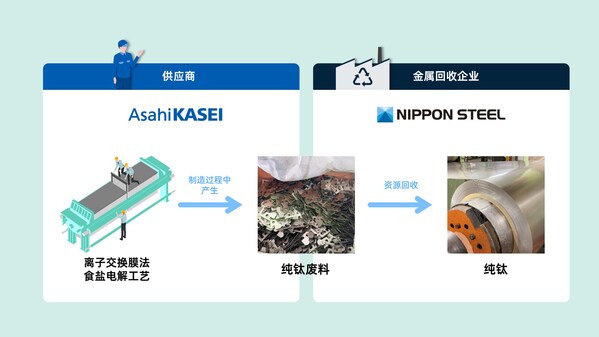
Recycling mechanism for pure titanium resource recovery
Salt electrolysis cells used to produce chlorine gas and caustic soda are internally divided into an anode chamber, where chlorine gas is generated, and a cathode chamber, where caustic soda is produced. Since the anode chamber, which generates highly corrosive chlorine gas, requires high corrosion resistance, it is made of pure titanium, a material with excellent corrosion resistance.
Pure titanium offers the best workability among various titanium products, but it is also a material that demands extremely strict purity management. Therefore, when using titanium scrap as remelting raw material, very rigorous quality control and pretreatment are necessary to prevent contamination from other materials or impurities. In particular, titanium scrap generated during the manufacturing of titanium processed products has been difficult to recycle as pure titanium due to challenges in ensuring traceability and quality management, and has primarily been used in open-loop recycling[2] as an additive material for steel, among other applications.
To address these challenges, Asahi Kasei has collaborated with Nippon Steel, which supplies pure titanium for salt electrolysis cells, and Nittetsu Shoji to establish a recycling mechanism (hereinafter “this mechanism”) that remelts and recovers a portion of pure titanium scrap as pure titanium material.
Under this mechanism, pure titanium scrap generated by Asahi Kasei during the manufacturing of salt electrolysis cells at its plant in Nobeoka, Miyazaki Prefecture, is sorted according to specifications under a system that leverages digital technology to ensure traceability. The sorted scrap is entirely collected by Nittetsu Shoji and processed into a state suitable for use as raw material in the remelting process. Subsequently, a portion of the sorted and processed scrap is returned to Nippon Steel for use as raw material in the pure titanium remelting process.
Yoshinori Sumi, General Manager of the Ion Exchange Membrane Division, Asahi Kasei, commented:
“The ability to establish a mechanism for sustainable resource recycling in the future is the result of a shared commitment to sustainability and a long-term partnership among all parties. As an initiative contributing to the sustainability of the entire chlor-alkali industry, we will continue to collaborate with our partners to advance manufacturing with foresight.”
Takeshi Terai, Senior Manager and General Manager of the Titanium Business Division, Nippon Steel, commented:
“The realization of this mechanism combines Nippon Steel’s industrial pure titanium remelting technology development using electron beam melting furnaces with Asahi Kasei’s titanium scrap management system accumulated over many years in salt electrolysis cell manufacturing. This is supported by a shared commitment to sustainability and an ongoing partnership focused on advancing resource recycling.”
Manabu Akimoto, Executive Officer, Nittetsu Shoji, commented:
“In this collaboration, by undertaking the collection, processing, and delivery of pure titanium scrap generated during the manufacturing of salt electrolysis equipment, we have taken a new step toward achieving a decarbonized and circular society. Going forward, our company will continue to leverage its long-standing experience and track record in distribution and as a trading company to ensure the smooth operation of this mechanism and maximize its added value.”
Moving forward, Asahi Kasei will further deepen its collaboration with Nippon Steel and Nittetsu Shoji to increase the recycling rate of pure titanium. Additionally, it will link with existing initiatives such as the closed-loop recycling of precious metals[3] announced in April 2025 to further promote the recovery of other metal materials used in salt electrolysis cells, contributing to the sustainability of the entire chlor-alkali industry.
[1] Pure titanium scrap: Processing offcuts and post-use waste of titanium products with a purity of no less than 99.4%
[2] Types of recycling (Japan Iron and Steel Federation website):
https://www.jisf.or.jp/business/lca/recycle/index.html
[3] April 2025 news (Asahi Kasei website):
Asahi Kasei Salt Electrolysis Business Website
https://chlor-alkali.asahi-kasei.co.jp/cn/