

Huzhou, ChinaMay 10, 2026 /PRNewswire/ — On May 9, Hangzhou Dehong Technology Co., Ltd. officially unveiled the world’s first industrial demonstration line for directly producing lactic acid from straw. This achievement transforms common agricultural straw waste into high-value bio-based biodegradable materials, helping to reduce reliance on petrochemical resources, save grain, mitigate “white pollution,” and support the nation’s “dual carbon” goals.

Scene from the unveiling ceremony of Dehong Technology’s world-first industrial demonstration line for directly producing lactic acid from straw
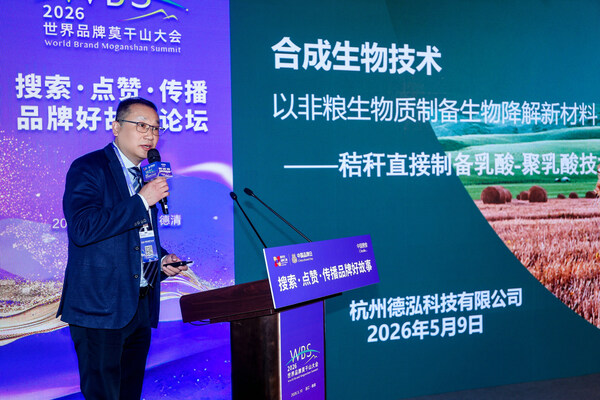
Wang Jian, Council Member of the China Biotech Fermentation Industry Association and Deputy General Manager of Hangzhou Dehong Technology Co., Ltd., delivers a speech
Wang Jian, Council Member of the China Biotech Fermentation Industry Association and Deputy General Manager of Dehong Technology, stated at the “Search, Like, and Spread Good Brand Stories” forum hosted by China Search that the new multifunctional bacterial strain developed by Dehong Technology enriches China’s microbial strain resource library for lactic acid production. The innovative advanced production process provides an efficient and feasible solution for the off-field resource utilization of solid waste like straw-based lignocellulose from industrial and agricultural sources. Looking ahead, the company plans to build on this thousand-ton demonstration line by establishing industrial bases in Hainan, Guangxi, Shandong, Xinjiang, Sichuan, and other regions, leveraging local straw resource advantages to create zero-carbon, non-grain bio-based material industrial parks integrating raw materials, production, deep processing, and application, thereby advancing the development of the non-grain bio-manufacturing industry.
The “Search, Like, and Spread Good Brand Stories” forum, held in Deqing County, Huzhou City, Zhejiang Province, was part of the 2026 World Brand Moganshan Conference series. Industry insiders invited to attend unanimously agreed that the technology contributed by Dehong Technology spans three fields: low-carbon environmental protection, new materials, and biosynthesis. It is not only internationally leading but also accessible to ordinary households through various products at relatively low prices. Yao Xianping, a top expert in Zhejiang Province, Director of the Zhejiang Provincial Bio-based Fully Degradable and Nanomaterials Innovation Center, and President of the Hangzhou Chemical Research Institute, stated that the “15th Five-Year Plan” clearly proposes promoting bio-manufacturing as a new economic growth point. The achievement released by Dehong Technology represents a major breakthrough in bio-manufacturing technology, which will drive the upgrade and iteration of production technologies across the entire industrial chain. Mao Jianwei, a professor at Zhejiang University of Science and Technology and Director of the Zhejiang Provincial Agricultural Bio-biochemical Manufacturing Collaborative Innovation Center, noted that this technological achievement by Dehong Technology has enormous application potential. Upstream, it promotes the improvement of straw collection, storage, and transportation systems, enhancing agricultural efficiency and increasing farmers’ income; downstream, it provides stable, low-cost environmentally friendly raw materials for degradable product manufacturers, fostering coordinated development of upstream and downstream enterprises. The project is expected to drive the formation of a non-grain bio-based material industrial cluster in Zhejiang and across the country, enabling the straw resource utilization industry to support regional green, high-quality development.
In November 2025, Dehong Technology’s “New Technology for Direct Fermentation of Lignocellulose into L-Lactic Acid Using Extremely Thermophilic Anaerobic Bacteria and a Thousand-Ton Annual Demonstration Line” passed a technical achievement appraisal organized by the China Light Industry Federation and was registered as a Zhejiang Provincial Science and Technology Achievement, with its key technology reaching internationally leading levels. Unlike traditional technologies that require grain crops like corn and potatoes to produce lactic acid, Dehong Technology, after eight years of research and development, developed a new production bacterial strain, overcoming the technical bottleneck of efficient straw conversion. This ensures that the environmentally friendly materials produced through bio-manufacturing do not compete with people for grain or land for food, fundamentally avoiding food security risks.
Data from the Ministry of Agriculture and Rural Affairs shows that China’s crop straw output is increasing year by year, currently reaching 867 million tons, with a collectible amount of 733 million tons. In the past, low straw utilization rates led to air pollution from burning. Leveraging Dehong Technology’s innovative technology, this waste straw can be directly converted into lactic acid, the core raw material for producing fully degradable plastic—polylactic acid (PLA)—truly turning waste into treasure and helping reduce dependence on fossil resources like petroleum.
According to reports, traditional straw-to-lactic acid technology requires the addition of exogenous cellulase enzymes to first break down straw into sugars before fermentation. Dehong Technology’s innovation lies in the bacterial strain’s self-production of cellulase enzymes, directly converting cellulose and hemicellulose in straw into lactic acid, combining the saccharification and fermentation processes into one. This achievement stems from foreign scientists’ discovery and cultivation of a unique microorganism—extremely thermophilic anaerobic bacteria—in extreme wild environments years ago. In 2017, Dehong Technology introduced this experimental bacterial strain, accelerating the strain selection, process technology development, and industrialization transformation, leading to the construction and successful operation of the world’s first thousand-ton straw-to-lactic acid production line. Thus, straw-to-lactic acid production has shifted from a “two-step” to a “one-step” process, opening up the entire “straw-lactic acid-PLA” production chain with significant efficiency and cost advantages. Additionally, PLA materials made from straw can degrade into carbon dioxide and water under industrial composting conditions, returning to the natural cycle and avoiding the “white pollution” caused by plastic products, achieving sustainable, renewable, green, and low-carbon circular development.