

Supports 65V wide input and 9A peak output, combining high efficiency, high integration, and flexible voltage regulation capabilities
ShanghaiJune 23, 2026 /PRNewswire/ — MPS (NASDAQ: MPWR) recently announced the launch of the high-efficiency synchronous step-down converter, the MP8887. This product supports a 4.5V to 65V wide input voltage range, a peak output current of up to 9A, and integrates an I2C digital interface, programmable frequency, and adjustable overcurrent protection. It is suitable for applications such as wireless charging, USB PD3.2 EPR (Extended Power Range), and high-power DC power supply, providing a power solution that combines efficiency, flexibility, and reliability for next-generation high-voltage, high-power systems.
In recent years, with the rapid development of USB PD EPR, high-power wireless charging, and high-voltage DC power supply systems, the demands on power management ICs in terminal devices have been continuously increasing. Especially in high-power-density applications, systems not only require higher input voltage tolerance and stronger output capability but also need more precise power management, lower heat generation, and more flexible dynamic regulation within limited space. In response to this trend, the MP8887, with its high current capability, high integration, and digital control features, offers a more efficient implementation for high-voltage, high-power power supply designs.
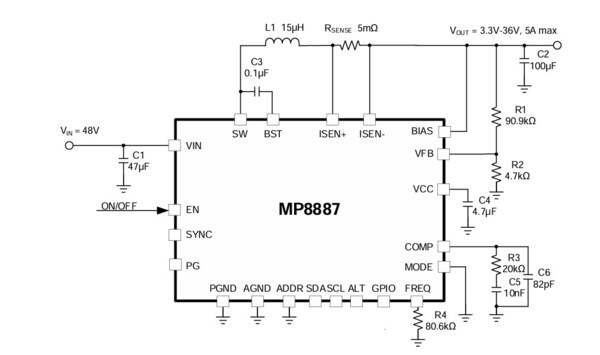
MP8887 Typical Application Schematic
High Current Capability Meets High-Power Application Demands
As the USB PD3.2 EPR specification boosts power delivery to 240W and wireless charging systems continue to upgrade to higher power levels, the demand for high current output capability in power systems has significantly increased. As a 65V/9A high-efficiency synchronous step-down converter designed for high-power scenarios, the MP8887 integrates two power MOSFETs, supports a maximum of four-phase parallel operation, delivers a single-device peak output current of 9A, and supports a 1V to 51V wide output voltage range. This covers various application needs, including wireless charging transmitter ends, USB PD EPR power supplies, high-power DC modules, and industrial equipment.
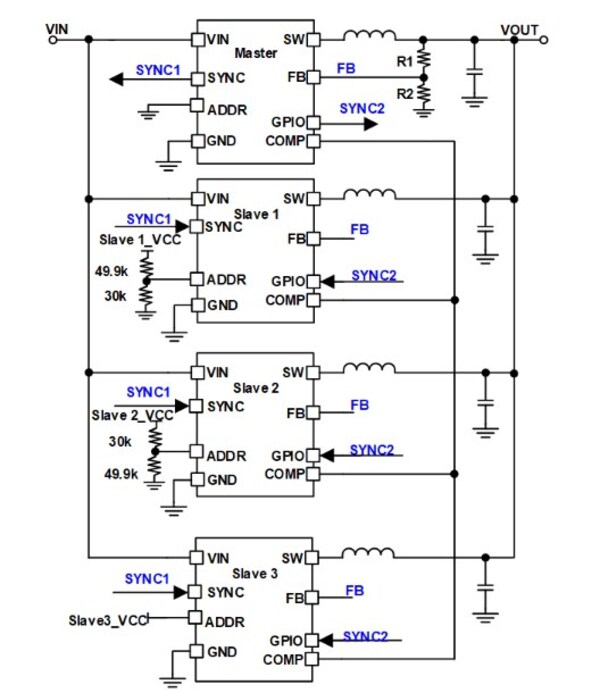
MP8887 Four-Phase Parallel Application Schematic
Additionally, the product supports a 4.5V to 65V wide input voltage range, with a maximum absolute voltage tolerance of 70V. It can be directly adapted to 24V, 36V, and 48V applications in commercial vehicles, consumer electronics, and industrial scenarios, reducing the need for additional front-end conversion circuits and helping to lower system complexity and overall BOM cost. For high-power supply platforms, higher input voltage tolerance and stronger output capability not only enhance system compatibility but also provide ample headroom for future higher-power designs.
Flexible Programmable Configuration Adapts to Diverse Application Platforms
As terminal device functions continue to grow more complex, the demand for dynamic power regulation capabilities in systems is also increasing. Traditional fixed-parameter power solutions often lack sufficient flexibility when dealing with multi-protocol, multi-mode applications. To meet the differentiated power management needs of various system platforms, the MP8887 supports an I2C interface, allowing flexible configuration of output voltage, output current limits, and protection parameters. Compared to traditional fixed-parameter solutions, this design significantly enhances system adaptability. For example, in USB PD3.2 EPR applications, the output can be dynamically adjusted according to different power levels; in wireless charging systems, power supply performance can be optimized based on different load conditions.
Furthermore, the MP8887 supports a configurable switching frequency from 200kHz to 600kHz, features external clock synchronization, and includes Frequency Spread Spectrum (FSS) functionality to help further optimize EMI performance and overall efficiency. The product also supports 100% duty cycle operation, maintaining stable output even when the input-to-output voltage difference is small, further improving application adaptability.
High Integration and Compact Package Balance Performance and Space Requirements
Beyond higher performance, miniaturization is a key development trend for current high-power devices. For wireless charging equipment, docking stations, power modules, and industrial portable devices, limited PCB space often requires power solutions to deliver higher power output within a smaller footprint. The MP8887 adopts a compact 4mm × 5mm QFN package, providing high-voltage, high-current output capability while effectively saving PCB area, helping customers achieve higher power density designs.
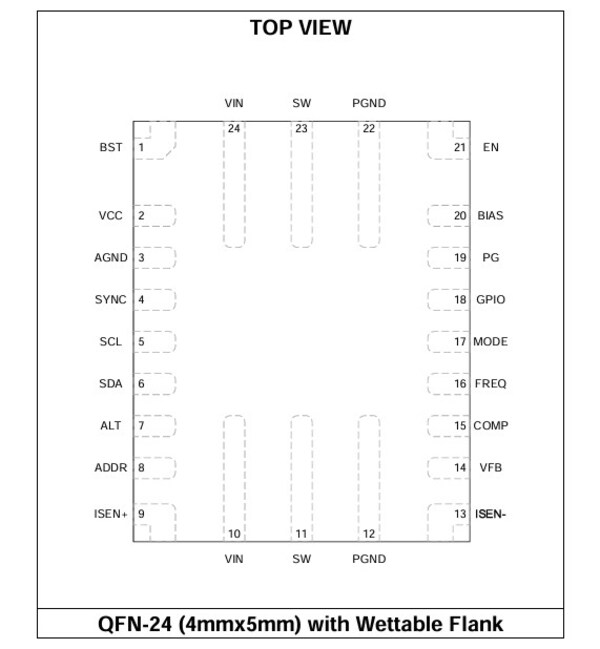
MP8887 Package Reference Diagram
High-Efficiency Design Meets High-Power System Requirements
In high-power applications, efficiency and thermal performance directly impact product reliability and overall design complexity. Especially in wireless charging, fast charger adapters, and compact industrial devices, limited space often makes it difficult to accommodate complex heat dissipation structures, so the power system must minimize power loss and heat generation. The MP8887 employs a high-efficiency synchronous step-down architecture, achieving an efficiency of up to 97.67% under 36V input and 5A load conditions, effectively reducing power loss and thermal dissipation.
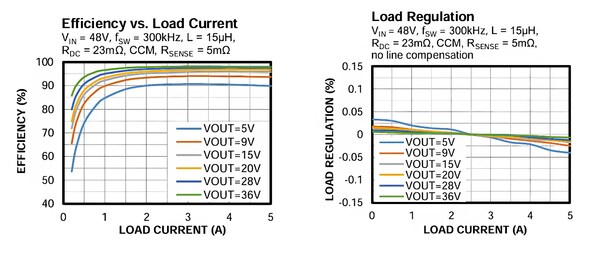
MP8887 Efficiency vs. Load Curve
At the same time, the MP8887 achieves the full power range of USB-PD3.2 EPR with a single converter and also features excellent thermal performance, helping to reduce system heat dissipation stress and improve long-term operational stability. Under 36V/5A output conditions, the Tcase is only 94.2°C; at an operating frequency of 200kHz, the Tcase temperature can drop to 80°C. This characteristic not only helps reduce the need for heat sink components in the system design but also further enhances overall power density, making it more suitable for high-performance, miniaturized terminal devices.
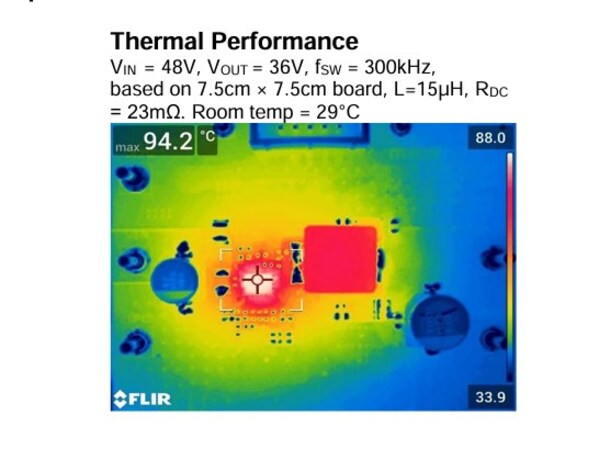
MP8887 Thermal Performance Test Diagram
Additionally, for high-voltage, high-power application environments, the MP8887 integrates multiple protection mechanisms, including Overvoltage Protection (OVP), Overcurrent Protection (OCP), and Overtemperature Protection (OTP), effectively handling abnormal conditions in complex operating environments and enhancing long-term system reliability.
MP8887 Series Product Specifications Overview
- 4.5V to 65V wide input voltage (VIN) range, 70V maximum absolute voltage
- 1V to 51V wide output voltage (VOUT) range
- 0V to 2.047V feedback (FB) reference voltage range, 0.5mV step size
- Peak output current (IOUT) up to 9A
- Efficiency up to 97.67% under 36V/5A load conditions
- Low quiescent current (IQ) of 180µA with I2C operation disabled
- Configurable peak/valley current limits
- ±5% output constant current (CC) limit accuracy
- Automatic Advanced Asynchronous Modulation (AAM)/Pulse Width Modulation (PWM) mode, and FPWM mode with Frequency Spread Spectrum (FSS)
- Configurable switching frequency (fSW) from 200kHz to 600kHz, supporting external clock synchronization
- Supports VCC bias supply function to improve efficiency
- Configurable line drop compensation
- Configurable output discharge current
- Overvoltage Protection (OVP), Overcurrent Protection (OCP), Overtemperature Protection (OTP), and interrupt
- Power Good (PG) indication
- Available in a side-solderable QFN-24 (4mmx5mm) package
Product Purchase and Technical Support
If you are interested in the MP8887, MPS can provide rich technical resources, including product datasheets and evaluation demo boards. Additionally, for other solution requirements, you are welcome to visit the MPS website to inquire about more product details.
About MPS
Monolithic Power Systems, Inc. (MPS) is a globally leading semiconductor company focused on chip-based high-performance power solutions. MPS’s mission is to reduce energy and material consumption to improve the quality of life in all aspects. Founded in 1997 by CEO Michael Hsing, the company has three core strengths: deep system-level knowledge, outstanding and professional semiconductor design capabilities, and proprietary semiconductor processes, system integration technologies, and innovation capabilities. These combined strengths enable MPS to provide customers with reliable, compact, and monolithic integrated solutions, making their products more energy-efficient and cost-effective, while also delivering sustained returns to our shareholders. For more information about MPS, please visit www.monolithicpower.cn or local offices.