

Reston, VirginiaMay 7, 2026 /PRNewswire/ — Against the backdrop of artificial intelligence technology profoundly reshaping the global job market, Chinese business students abroad are undergoing a repositioning of their professional skills. Based on the “2026 Prospective Students Survey Report” recently released by the Graduate Management Admission Council (GMAC), an analysis of data from a sample of prospective candidates in the Greater China region reveals a noteworthy trend: Facing the uncertainty brought by technology, Chinese applicants of different age groups generally place greater emphasis on “skills” when choosing their majors, aiming to alleviate anxiety caused by technological change. However, at the same time, their core demands for business education remain unchanged, still highly focused on a “soft power moat” represented by strategic thinking and problem-solving.
“Business Analytics” Becomes a Cross-Age Hotspot, Hardcore Data Skills as a Stepping Stone
As global enterprises undergo digital transformation, business education is transitioning from purely theoretical frameworks to deep integration with industries. GMAC’s insights show that the “Master of Business Analytics,” an interdisciplinary field highly combining data science and business logic, has become the most sought-after program. According to GMAC’s 2025 “Application Trends Report,” among Chinese prospective candidates, all business master’s programs reported in the study, except for the Master of Business Analytics, experienced growth in application numbers from both international and domestic applicants, indicating that business education remains highly attractive to Chinese prospective candidates.
Among mature professionals aged 25 to 30 with some work experience, up to 54% of respondents ranked the Master of Business Analytics as their top choice among business programs, surpassing the traditional full-time MBA (44%). Even among the younger group aged 22 and under, the Master of Business Analytics (38%) firmly held the second position, trailing only the traditionally preferred Master of Finance (52%). This data suggests that regardless of whether applicants are at the beginning or development stage of their careers, acquiring solid data analysis and technical application skills is seen as a necessary “stepping stone” to cope with the current challenging employment environment and industry reshuffling.
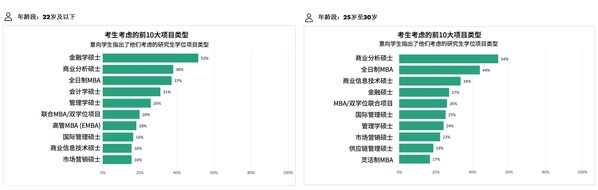
Top 10 Graduate Degree Program Types Considered by Business Applicants
Precisely anticipating this industry trend, GMAC, as the organizer of the GMAT business school entrance exam, has proactively introduced a “Data Insights” section in the new GMAT exam. This core change not only helps prospective applicants build a solid foundation in data analysis and business decision-making before formal enrollment but also enables them to demonstrate their data literacy and hardcore capabilities intuitively and compellingly to top global business schools when competing for admission to interdisciplinary fields like business analytics.
Beware of “Technological Determinism”: Higher-Order Cognitive Abilities Remain the Core Premium of Business Education
However, the pursuit of hardcore majors by Chinese business applicants is not a blind “technological determinism.” The survey reveals a seemingly contradictory yet highly logical phenomenon: When asked about the “skills most desired to develop at business school,” “quantitative/data analysis skills” ranked only in the middle among younger groups (53%) and fell to the bottom among the 25-30 age group (38%).
In contrast, both groups overwhelmingly ranked “problem-solving” and “strategic thinking” as the top two priorities. Among the 25-30 age group, the proportions expecting to enhance these two skills were as high as 65% and 63%, respectively. This indicates that Chinese applicants maintain a high degree of realistic clarity: They view data analysis as a foundational tool, while the true premium of business school lies in teaching how to use this data to make strategic decisions.
This demand aligns closely with feedback from the employer market. The GMAC “Global Employer Recruitment Survey Report” points out that both employers and prospective applicants consider strategic thinking and problem-solving abilities as key skills, while employers place greater emphasis on initiative, adaptability, and interpersonal skills such as emotional intelligence. This means that in an era where AI can rapidly process massive amounts of data, human higher-order cognitive abilities are the irreplaceable workplace moat.
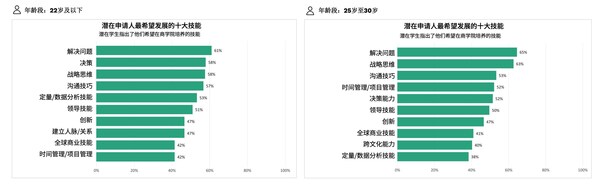
Top 10 Skills Prospective Applicants Most Want to Develop at Business School
Pragmatic Embrace of AI: Rejecting Theoretical Gimmicks, Different Demands Across Groups
Artificial intelligence is no longer an add-on to business education but an essential component of the curriculum. Regardless of the degree type preferred by prospective applicants, AI has become a core curriculum requirement. The survey shows that half of global applicants report that using AI tools is already part of their core learning at business school, a proportion that has risen significantly from 17% in 2022 (the year ChatGPT was launched), 40% in 2023, 46% in 2024, to the current 50%.
In the Greater China region, applicants of different ages have put forward more targeted and pragmatic demands regarding “how to learn AI.” The younger group (aged 22 and under) most hopes that business schools will offer courses “exploring how AI can assist in formulating business strategies (60%).” They focus more on the macro-level impact of technology, aiming to build a foundational understanding for coping with future business changes. For the 25-30 age group facing real workplace pressures, their demands are more micro and practical: up to 61% of respondents require “integrating AI into the curriculum, providing hands-on experience through business simulations and practical applications,” while another 55% emphasize using AI for personalized learning. This sends a clear signal to global business schools: Chinese students demand that schools deeply integrate cutting-edge tools into specific business case simulations.
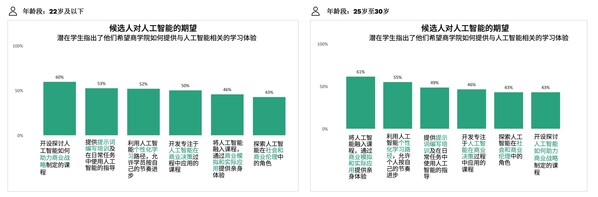
Candidates’ Expectations for AI-Related Learning Experiences
Ms. Joy Jones, CEO of GMAC, stated: “We are seeing more and more business candidates no longer viewing graduate business education as a ‘restart’ for their careers, but rather as a targeted investment in specific skills, regional opportunities, and return on investment.”
From the “2026 GMAC Prospective Students Survey Report,” it is evident that in the face of technological waves, business applicants in Greater China are demonstrating high adaptability and strategic vision. They gain entry qualifications by choosing competitive programs while clearly focusing their learning on strategic decision-making and problem-solving abilities that are not easily replaced by AI. For top global business schools, only by breaking disciplinary boundaries and achieving deep integration of cutting-edge technology with comprehensive management skills can they gain an advantage in competing for high-quality students in the Greater China region and promote the high-quality development of international business education.