

- Scientists from Peking University and Tsinghua University awarded “Bayer Chair Professor,” “Bayer Researcher,” and other honors
- To date, over 230 Chinese scientists have received related awards and funding
BeijingApril 23, 2026 /PRNewswire/ — Recently, Bayer, together with Peking University and Tsinghua University, announced the 2025 Bayer China Research Collaboration Awards, including several key honors such as the “Bayer Chair Professor,” “Bayer Researcher,” “Bayer Research Translation Fund,” and “Bayer Postdoctoral Fellow.” As an integral part of Bayer’s long-term strategic partnership with China’s top universities, these awards aim to recognize and fund outstanding scholars who have made significant contributions in fields such as life sciences, clinical medicine, and drug development. They continuously promote exchanges and collaboration between the pharmaceutical industry and academia, accelerate the translation of basic research into new drug development, and ensure that innovative achievements benefit patients as early as possible.
This year, Professor Wang Cunyu from the Peking University Institute of Advanced Clinical Medicine and Professor Yu Li from the School of Life Sciences at Tsinghua University were honored as “Bayer Chair Professors.” Additionally, selected by a joint steering committee composed of Bayer experts and senior scholars from these two top Chinese institutions, a total of nine scientists from Peking University and Tsinghua University received the “Bayer Researcher” award. Associate Researcher Liu Huiqin from the School of Pharmaceutical Sciences at Tsinghua University, Associate Professor Pan Deng from the School of Basic Medical Sciences, and Assistant Professor Wang Qiang from the School of Life Sciences were awarded the “Bayer Research Translation Fund” to support their research projects. Furthermore, three outstanding young scholars from Peking University received the “Bayer Postdoctoral Fellow” award.
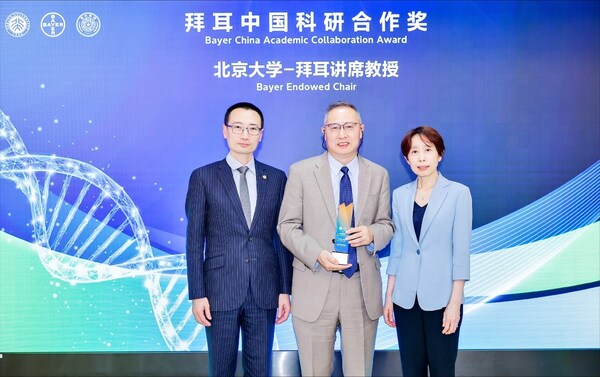
Wang Wei, Vice President of Bayer’s Pharmaceuticals Division and Head of China Medical Affairs, and Professor Chen Xuemei, Dean of the School of Life Sciences at Peking University, present the 2025 “Bayer Chair Professor” award to Professor Wang Cunyu from the Peking University Institute of Advanced Clinical Medicine
As a member of the joint steering committee, Dr. Anastasia Hager, Senior Vice President of Global R&D and Head of Drug Discovery Science at Bayer’s Pharmaceuticals Division, stated: “I extend my heartfelt congratulations to all the scientists honored with the 2025 Bayer China Research Collaboration Awards. Your relentless exploration and outstanding achievements not only continuously expand the boundaries of science but also elevate China’s research and innovation capabilities to new heights! Your contributions inject critical momentum into the global pharmaceutical industry, inspiring us to push boundaries and drive transformative progress. At Bayer, we believe in the transformative power of science to reshape the future of healthcare. Our long-term collaboration with Peking University and Tsinghua University is not just about sharing knowledge but also a commitment to jointly creating a better future. We look forward to deepening our cooperation, expanding its dimensions, and accelerating the translation of breakthrough innovations into new therapies, bringing greater health benefits to patients worldwide. As we look to the future, we are also co-creating it.”
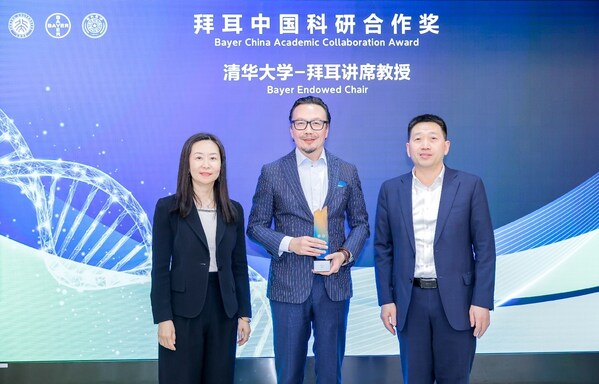
Li Qi, Vice President of Bayer’s Pharmaceuticals Division, Head of the International R&D Beijing Center, and Head of China Regulatory Science and Registration Affairs, and Professor Shi Songhai, Dean of the School of Life Sciences at Tsinghua University, present the 2025 “Bayer Chair Professor” award to Professor Yu Li from the School of Life Sciences at Tsinghua University
As a key component of its long-term commitment in China, Bayer places high importance on and continuously supports local research collaborations, vigorously backing China’s original innovation and new drug development translation. It established long-term strategic research partnerships with Tsinghua University in 2009 and Peking University in 2014, respectively, not only pioneering research collaborations between multinational pharmaceutical companies and local Chinese academic institutions but also setting a model for the coordinated development and innovative cooperation of “industry-academia-research.”
Professor Shi Songhai, an academician of the Chinese Academy of Sciences, Dean of the School of Life Sciences at Tsinghua University, member of the Bayer-Tsinghua University Joint Steering Committee (JSC), and recipient of the 2022 “Bayer Chair Professor” award, said: “On behalf of Tsinghua University, I extend my sincere congratulations to the award-winning scholars and express my respect to Bayer and researchers in the biomedical field. This honor is a high recognition of your long-term dedication and outstanding achievements in biomedical innovation. Talent is the primary resource for innovation and the fundamental support for high-level technological self-reliance. The research collaboration awards and funding platforms established by Bayer have continuously supported leading academic talents and young research backbone in their dedicated exploration and pursuit of excellence, providing crucial assistance for talent development and original innovation in the life sciences field. As a long-term and important strategic partner, Tsinghua University and Bayer have achieved efficient collaboration and fruitful results in talent cultivation, research innovation, and technology translation. Looking ahead, both parties will continue to focus on the frontiers of life and health, support top innovative talents, solve major challenges in life sciences, and serve people’s health and contribute to the progress of human science with high-quality innovative achievements.”
Professor Chen Xuemei, a member of the Bayer-Peking University Joint Steering Committee, recipient of the 2022 “Bayer Chair Professor” award, and Dean of the School of Life Sciences at Peking University, stated: “Over the past decade, Peking University and Bayer have worked hand in hand, achieving remarkable results in talent cultivation, academic exchange, and research innovation. The two parties have continuously deepened cooperation in cutting-edge biomedical fields, covering areas such as new drug target discovery, structural biology, radiopharmaceuticals, and novel therapeutic technologies. With the collaborative participation of multiple schools related to life sciences at Peking University and close cooperation with Bayer’s research team, progress has been made in key scientific questions and translational research. At the same time, both parties place high importance on talent development, establishing programs such as the ‘Bayer Chair Professor,’ ‘Bayer Researcher,’ and ‘Bayer Postdoctoral Fellow,’ which have become important components of the collaboration, effectively promoting the growth of young talents and the construction of an academic innovation ecosystem. Looking to the future, both parties will further deepen cooperation in key areas such as new target discovery, disease mechanism research, novel therapeutic modalities, and artificial intelligence applications, continuously advancing cutting-edge technological innovation, promoting the translation of research achievements, and making greater contributions to improving human health.”
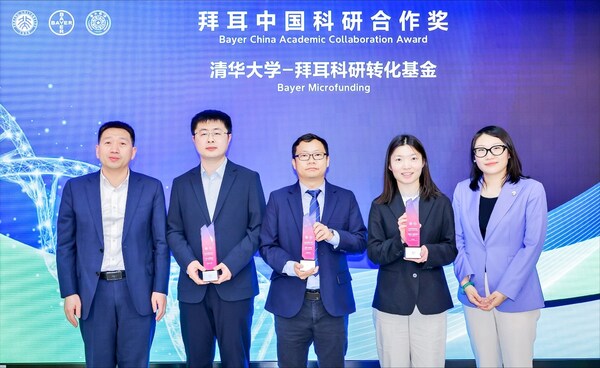
Dr. Huang Danjie, Vice President of Bayer’s Pharmaceuticals Division and Head of the China Collaboration Innovation Center, and Professor Shi Songhai, Dean of the School of Life Sciences at Tsinghua University, present the 2025 “Bayer Research Translation Fund”
To date, over 230 top Chinese scientists and young scholars have received awards such as the “Bayer Chair Professor” and “Bayer Researcher.” In addition to establishing the China Research Collaboration Awards, the research collaborations between Bayer and these two institutions have also yielded fruitful results. As of now, over 110 research projects have been initiated, covering areas including the discovery and structural analysis of new targets, studies on disease pathogenesis and drug mechanisms, drug screening, efficacy evaluation, exploration of novel molecular forms of drugs, new chemical synthesis methods, and innovative formulations, spanning multiple disease areas such as oncology and cardiovascular diseases.