

 |
ShanghaiJune 4, 2026 /PRNewswire/ — On June 3, the 17th (2026) International Photovoltaic and Smart Energy Conference & Exhibition (SNEC) opened at the National Exhibition and Convention Center in Shanghai. LONGi, following the launch of its “Full-Stack LONGi ONE” solar-storage integration strategy, presented for the first time a comprehensive display of its implementation pathway and core products. It systematically proposed a deliverable, verifiable, and responsibility-closed-loop solution aimed at driving the industry from a multi-supplier patchwork model toward native integration.
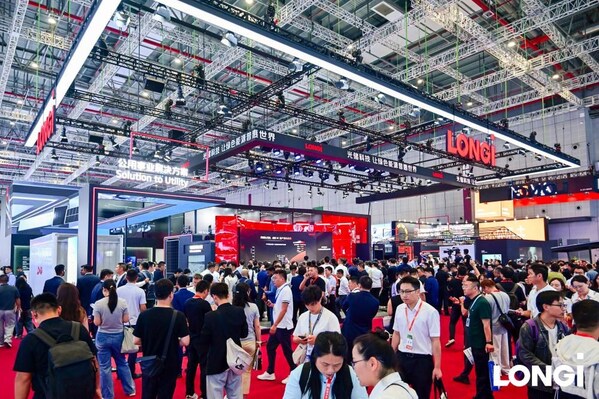
SNEC LONGi Booth
From Heterogeneous Patchwork to Native Integration
In the era of solar-storage integration, addressing the pain points of “patchwork” systems—efficiency bottlenecks, safety risks, and blurred responsibilities—is the starting point of LONGi’s energy storage design. Although solar-storage integration has become a definitive technological pathway, long-standing structural contradictions remain unresolved: photovoltaic and energy storage systems often come from different suppliers, relying on heterogeneous communication protocols for interconnection, leading to issues such as cumulative losses, inefficient joint debugging, and blurred responsibility boundaries. Customers not only suffer efficiency losses on a technical level but also bear hidden costs arising from the lack of system integration.
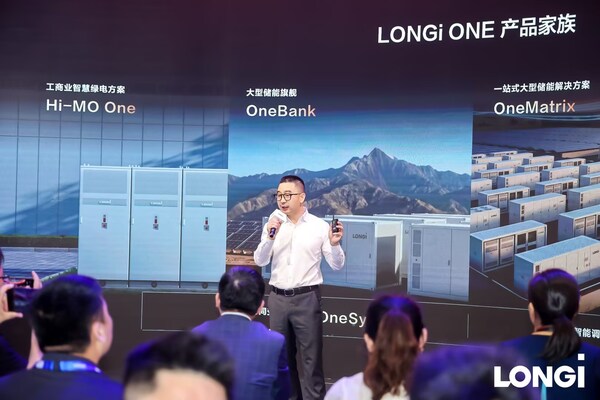
Special Event at LONGi Booth
On the first day of the exhibition, LONGi unveiled a series of solutions for GWh-scale power stations and industrial-commercial districts, systematically elaborating on the “Full-Stack LONGi” technological pathway. Its core is not about making partial optimizations to existing architectures but rather restructuring the solar-storage coordination mechanism from the ground up—achieving native integration from high-efficiency BC photovoltaic technology to the full 5S system (BMS, iCCS, EMS, TMS, PCS) of energy storage, fundamentally breaking the silo effect between solar and storage systems.
From the GWh-scale large power station solutions OneBank 2.0 and OneMatrix 2.0, to the smart green electricity solution Hi-MO One for industrial-commercial applications, to the off-grid and microgrid storage flagship OneNexus, as well as the domain-wide coordinated conversion core OneSync and the cloud-based intelligent dispatch platform OneOS, Full-Stack LONGi builds a product matrix covering all scenarios on a unified technology foundation. This enables solar-storage systems to operate as a cohesive whole, providing customers with complete solutions from centralized power stations to distributed parks. Ending the patchwork era means customers no longer need to coordinate multiple suppliers themselves or bear the hidden costs of system fragmentation.
Quantifiable System-Level Gains
Based on internal test data from LONGi’s full-stack self-developed platform, the OneBank 2.0 and OneMatrix 2.0 systems for GWh-scale power stations achieve a round-trip efficiency (RTE) of 93%, approximately 4 percentage points higher than the average of comparable discrete solutions. Over the full lifecycle, this means each kilowatt-hour of solar energy can be more efficiently converted into billable power assets.
Additionally, leveraging innovative cluster-level management technology, the system enables independent charging and discharging of battery clusters with precise control, effectively avoiding inter-cluster circulating currents and the “barrel effect.” Tests show an 8% increase in the full-lifecycle power generation of the energy storage system, significantly enhancing project lifecycle returns. In patchwork systems, battery clusters lack coordinated management, but full-stack self-development allows each cluster to reach its full potential.
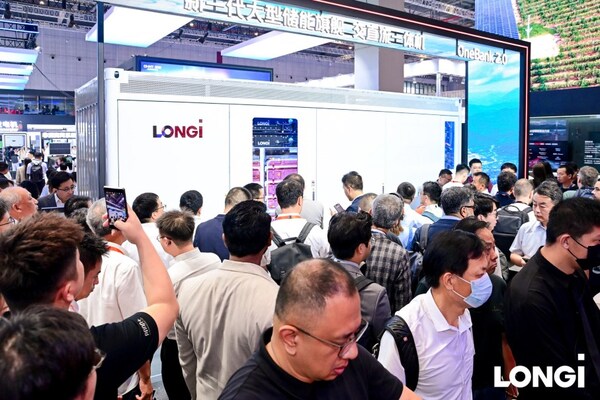
OneBank 2.0
In typical industrial-commercial or large power station models, the 93% system round-trip efficiency and 8% power generation improvement create synergistic gains: higher round-trip efficiency reduces energy loss during each charge-discharge cycle, while the available capacity released by cluster-level management directly increases total discharge over the full lifecycle. Combined, the overall project return on investment improves by 2 to 4 percentage points compared to traditional discrete solutions. This gain is particularly significant in high-frequency dispatch scenarios—efficiency advantages accumulate with each cycle, ultimately translating into quantifiable asset returns.
The reliability leap brought by the full-stack self-developed system supports a 99% system uptime rate. For owners who position energy storage as critical infrastructure, the certainty represented by high uptime is a key prerequisite for predictable asset returns and undiminished investment value. Addressing common issues in the patchwork model, such as responsibility disputes over faults and downtime losses, Full-Stack LONGi responds systematically with a single responsible entity and full-lifecycle service.
For industrial-commercial scenarios, Hi-MO One is equipped with the OneOS system, featuring a 1+N modular expansion design that supports flexible configuration from 2 to 24 hours, along with fault self-isolation and expansion self-connection capabilities. This ensures that industrial-commercial users at the distribution network periphery also receive system-level guarantees of solar-storage integration. From large power stations to industrial-commercial parks, LONGi is redefining the competitive benchmark for solar-storage integration: the industry should focus not on peak parameters of individual devices but on the system-level revenue growth of native systems over their full lifecycle.
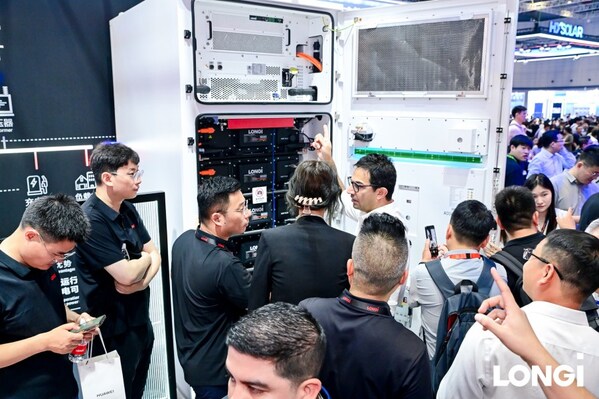
Hi-MO One
“2830 Plan”: Physical Support for a Global Solar-Storage Service Network
The advantages of the full-stack self-developed architecture are not only reflected in the energy conversion process but also permeate the entire project lifecycle. LONGi positions its service system as a core pillar of the solar-storage integration strategy, leveraging its photovoltaic marketing and service network across 120 countries to continuously advance the “2830 Plan.” This involves building 30 full-capability local service centers in major global solar-storage integrated markets, establishing a solid physical foundation for global solar-storage services.
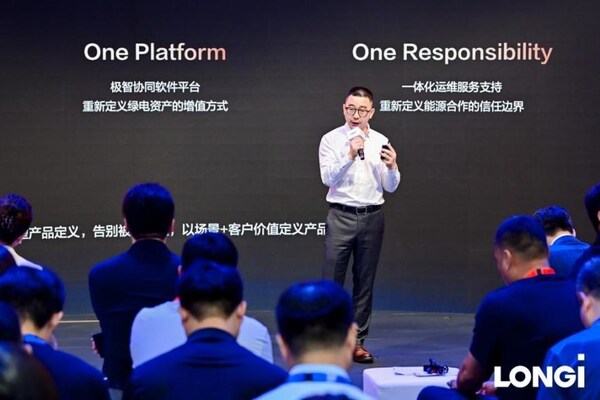
Special Event at LONGi Booth
These full-capability local service centers will comprehensively cover the entire value chain of solar-storage power stations, from preliminary planning and solution design to full-process delivery and implementation, and full-lifecycle operation management. Regardless of the customer’s time zone or language, they can receive localized rapid response and professional support—no longer lagging remote coordination, but proactive local assurance; no longer fragmented passive responses, but full-chain solution delivery.
Leveraging this service network, LONGi systematically extends the experience and capabilities accumulated in past project delivery phases to every key node of the project lifecycle. Services have evolved from a single delivery action to a systematic commitment running through the entire project. Customers receive not only highly reliable solar-storage equipment but also a professional service support system that is accessible and deeply trustworthy at any time.
Returning Solar-Storage to Its Systemic Essence
At SNEC 2026, LONGi presented a systematic solution with “Full-Stack LONGi ONE”: from native integration technology to single-responsibility-entity service, from a full-stack self-developed product matrix to a full-lifecycle assurance system.
The competition in solar-storage integration will ultimately move beyond equipment stacking and responsibility shifting, toward a fundamental contest of system-level capabilities and long-term asset value. Making solar energy a stable, adjustable “sunlight generator”—LONGi is gradually turning this into reality.