

ShanghaiMay 26, 2026 /PRNewswire/ — From May 20 to 22, 2026, the 21st Probiotics and Health Symposium, hosted by the Chinese Institute of Food Science and Technology, was successfully held in Ningbo. The conference, grounded in the current era, focused on cutting-edge technology and industrial practices, gathering wisdom from various sectors to explore new development pathways, thereby building consensus and injecting momentum into the high-quality development of the probiotics industry.
Concurrently, the “Consumer Classroom” event, hosted by the Chinese Institute of Food Science and Technology and supported by Yakult (China) Investment Co., Ltd., commenced as scheduled. Centered on the theme “Finding Joy in Busy Times, Balancing with Probiotics,” experts in the probiotics field delivered engaging and professional science communication on gut health, attracting over a hundred industry experts and students and faculty from Ningbo University.
Scene from the Consumer Classroom at the 21st Probiotics and Health Symposium
Addressing Regional Health Challenges with Scientific Evidence
Rooted in scientific evidence, the probiotics industry continues systematic scientific exploration globally, driving innovation in the field of gut health. The annual Probiotics and Health Symposium serves as a key academic platform for presenting cutting-edge findings and aggregating industry wisdom.
In a symposium report on May 21, Hideyuki Shibata, Chief Researcher at the Yakult Central Institute for Microbiological Research, delivered a keynote speech titled “Empowering Health Development with Probiotics, Addressing Health Challenges through Scientific Research.” He shared the latest research findings on Lacticaseibacillus paracasei strain Shirota (LcS) and explored pathways to tackle health challenges through scientific innovation.
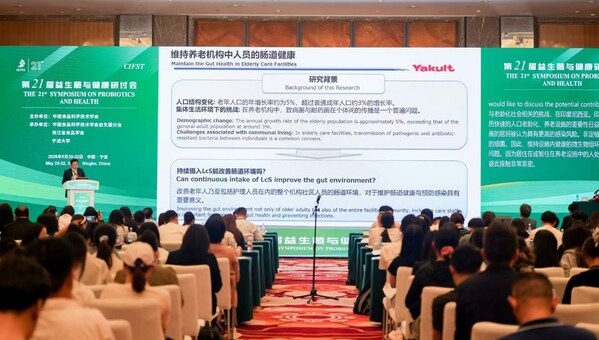
Hideyuki Shibata, Chief Researcher at the Yakult Central Institute for Microbiological Research, shares research findings
Researcher Shibata noted that different regions in Asia face distinct health challenges: for instance, in aging societies, maintaining gut health and controlling the spread of pathogenic bacteria are critical; in hot and humid climates, aflatoxin contamination poses food safety and health risks. In response, Yakult has conducted multiple trials based on the LcS strain, rigorously validating the health benefits of lactic acid bacteria through scientific evidence.
The report presented a randomized controlled trial conducted by Yakult’s research team over six months in a nursing home in Indonesia. The trial included 56 subjects consuming LcS fermented milk and 54 in a placebo group. Results showed that continuous intake of LcS significantly increased the abundance of beneficial bacteria such as Bifidobacterium, reduced levels of opportunistic pathogens like Enterococcus and antibiotic-resistant bacteria-related flora, and increased fecal butyric acid content, fostering a more anti-inflammatory gut environment. This has significant public health value in reducing the risk of infection transmission within nursing facilities.
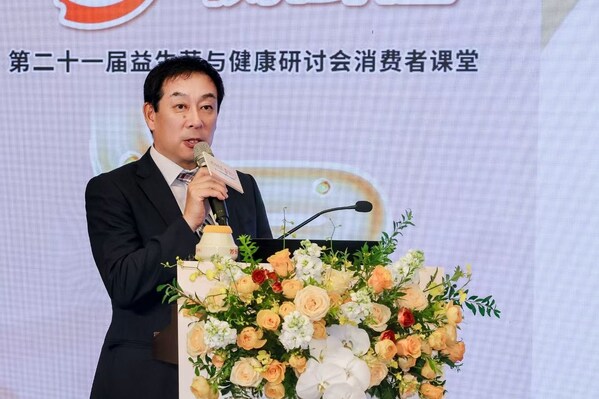
Hideyuki Shibata, Chief Researcher at the Yakult Central Institute for Microbiological Research, speaks at the Consumer Classroom
The report also shared findings on aflatoxin exposure, common in warm, humid regions like Malaysia. Results indicated that LcS effectively reduced urinary aflatoxin levels and maintained low levels of related serum biomarkers, confirming that LcS helps reduce aflatoxin exposure in the human body.
Additionally, Yakult set up an exhibition booth at the symposium, integrating scientific displays and interactive exchanges to visually present LcS research outcomes.
Translating Research into Public Science Education to Boost Scientific Literacy
Communicating authoritative scientific consensus in the probiotics field to the public and enhancing scientific literacy is a key task for industry development. For years, Yakult has adhered to the principle of “benefiting the public through science,” using diverse formats like the “Consumer Classroom” to deliver scientific, authoritative knowledge on gut health and probiotics to consumers.
This Consumer Classroom specially invited Professor Gao Jie from the College of Food Science and Technology at Hebei Agricultural University to deliver a talk titled “Probiotic Health Interventions: From Universal Regulation to Precision Control.” Professor Gao has conducted research on novel probiotics based on gut microbiota characteristics of specific Chinese populations. In her presentation, she noted that probiotic interventions are evolving from universal regulation to precision and personalization. In the future, more targeted probiotic solutions will be developed based on population gut microbiota profiles, lifestyles, and health needs, to better safeguard national health.
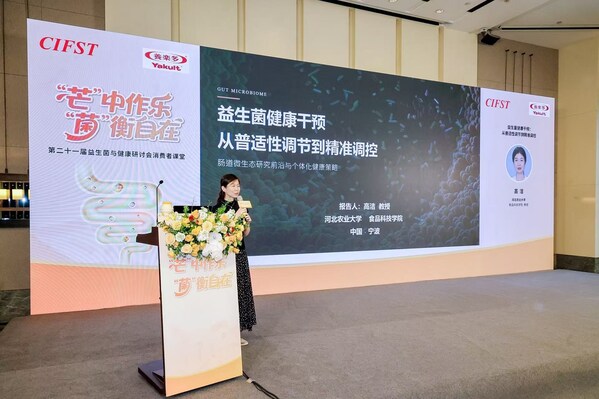
Professor Gao Jie from Hebei Agricultural University delivers a speech at the Consumer Classroom
Researcher Shibata, in a talk titled “Focusing on Probiotics and Health from a Scientific Evidence-Based Perspective,” once again explained the scientific evidence system for the LcS strain in an accessible manner. He stated that scientific research rooted in social issues can create practical solutions for public health problems, and Yakult will continue to conduct research related to social issues, striving to promote public health and well-being based on scientific evidence.
The long-term development of the probiotics industry relies on the dual support of scientific exploration and science communication. While pursuing scientific research, Yakult continues to advance probiotic science education, building bridges between academic exchange and public communication. In the future, Yakult will continue to collaborate with domestic research institutions, deepen industry-academia-research partnerships, safeguard public gut health, and contribute to the construction of a Healthy China.