

—— Field observations on stable wheat production and harvest security in Yancheng, Jiangsu
Yancheng, ChinaApril 28, 2026 /PRNewswire/ — In April, the northern Jiangsu plain sees wheat waves rising and ears swaying on stalks. Entering the 10,000-mu seed breeding base of Fangqiang Farm in Yancheng City, Jiangsu Province, stretches of wheat fields extend endlessly, with ears gradually emerging and flowering in an orderly and balanced growth pattern. Along the ridges, agricultural experts and technicians inspect seedling conditions field by field and check for diseases, laying a solid foundation for ensuring a stable supply of high-quality seed sources and supporting stable summer grain production and harvest security.
As an agricultural researcher who has long worked deeply in the middle and lower reaches of the Yangtze River wheat region, while also serving as a deputy to the National People’s Congress, Gao Derong, a researcher at the Wheat Research Laboratory of the Lixiahe Agricultural Research Institute in Jiangsu, stated frankly after inspecting seedling conditions in the fields: “This year, Yancheng’s wheat has been affected by a warm winter and persistent rainy weather this spring, resulting in overly large populations and a higher risk of Fusarium head blight epidemics, posing significant challenges to stable wheat production.” Having深耕 wheat breeding for over 30 years and successfully developing more than 40 Yangmai series varieties, he emphasized based on his own research practice that under unusual climatic conditions, the stress resistance of varieties is fundamental. Only by screening and promoting excellent varieties with tolerance to late sowing, disease resistance, and strong stress tolerance, combined with scientifically matched cultivation and management techniques, can production bottlenecks be broken, the impact of adverse weather be minimized, stable wheat production and increased efficiency be ensured, and the bottom line of summer grain harvest be secured.
First Hurdle: Overcoming Late Sowing Adversity – Laying the Foundation with Good Varieties to Tackle Tight Crop Rotation and Weak Seedlings
The middle and lower reaches of the Yangtze River wheat region, as China’s largest rice-wheat rotation area, accounts for over 80% of the national rotation area, and the connection between rice and wheat stubble is inherently tight. Coupled with continuous rainy weather during last autumn’s sowing, which further delayed the wheat sowing period, seedling conditions in some Yancheng wheat fields showed a polarized trend, with both overgrown and late-sown weak seedlings coexisting. Uneven field seedling growth subjected wheat yield improvement to multiple tests, making late-sowing adversity the first major challenge for wheat production.
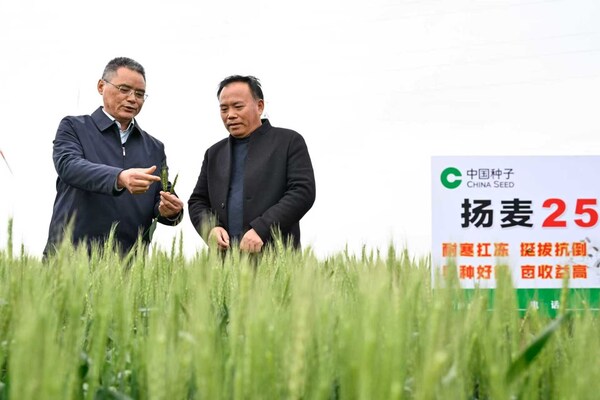
At the breeding base of Fangqiang Farm in Yancheng City, researcher Gao Derong (left) from the Lixiahe Agricultural Research Institute in Jiangsu checks the growth of Yangmai 25 in the field with farm staff.
At the Fangqiang Farm breeding base, nearly 10,000 mu of Yangmai 25, despite delayed sowing, still showed stable growth and a promising harvest scene. Li Jing, head of the Jiangsu branch of Sinochem Seed Co., Ltd. under Syngenta Group China, explained that in rice-wheat rotation areas, whether a variety can adapt to tight crop rotations and delayed sowing conditions is a key consideration for its promotion and application. As a high-quality variety with outstanding tolerance to late sowing and stable yield, Yangmai 25 features strong tillering ability, late-sowing tolerance, and good yield stability, making it a leading local variety for addressing late-sowing challenges.
Behind good varieties lies the result of synergistic efforts between research and industry. Since 2016, Sinochem Seed has continuously deepened cooperation with the Lixiahe Agricultural Research Institute in Jiangsu, focusing on the breeding, transformation, and promotion of excellent wheat varieties, gradually forming a full-chain system of “research breeding + enterprise demonstration + seed breeding base.” Research institutes provide variety breeding and technical support, enterprises screen and promote varieties based on regional needs, and cooperative production units like Fangqiang Farm strictly oversee key links such as large-scale breeding, growth period management, and water and fertilizer management, ensuring a stable supply of high-quality seed sources and accelerating the transition of “good varieties” from research results to large-scale field application.
On this basis, Sinochem Seed further took the lead in building a “Southern and Northern Joint Trial System for the Yellow-Huaihe Wheat Region,” bringing together 31 superior research institutions and enterprises from the north and south to systematically conduct variety trials and collaborative innovation, accelerating the breeding, approval, and promotion of excellent varieties. This system has approved 30 varieties and promoted them over an area exceeding 50 million mu, cultivating high-yield, high-quality varieties such as Zhengmai 9134 and Zhoumai 33, thereby solidifying the variety foundation for increasing wheat yield per unit area.
Currently, varieties like Yangmai 25 and Yangmai 39 have been widely promoted in the middle and lower reaches of the Yangtze River wheat region. Trial data shows that even when sown 30 days late, Yangmai 25 can still yield 639.3 kg per mu; Yangmai 39 has significant advantages in disease resistance and quality, providing diverse options for different planting conditions. During this year’s spring farming season, Sinochem Seed continues to deliver good varieties and good methods to growers through activities like spring management expert tours, demonstration displays, and field observations. “I’ve been growing Yangmai 25 for 8 years, and its performance has been consistently stable. When faced with tight crop rotations and late sowing, this variety is the most reassuring,” said Wang Sheng, a large-scale grower in Dafeng District, Yancheng City, who plants over 1,300 mu of Yangmai 25. For years, his yield has remained stable at over 1,200 jin per mu, with a maximum yield of 1,400 jin per mu. Good varieties serve as the “ballast stone” for stable production of late-sown wheat, continuously helping farmers stabilize grain production and increase income, providing solid support for strengthening regional food security and promoting high-quality development of the wheat industry.
Jiang Yekui, Executive Director and Party Secretary of Sinochem Seed, stated that the company will continue to explore new enterprise-research cooperation models, accelerate the transformation of research results, and truly transform the enterprise-research cooperation model from a project consortium into an enterprise-research consortium, bridging the last mile from the laboratory to the market, and stimulating yield and efficiency increases through good varieties and good methods.
Second Hurdle: Tackling Fusarium Head Blight Control – Precision Plant Protection to Guard Yield and Quality Bottom Lines
Having overcome the late-sowing adversity hurdle, Fusarium head blight (FHB) becomes another “gate” that Yancheng wheat must directly face. According to forecasts from the Ministry of Agriculture and Rural Affairs, the occurrence level of wheat FHB in the middle and lower reaches of the Yangtze River wheat region this year is rated 4-5, with a national estimated affected area of about 140 million mu. For Yancheng, with above-average rainfall in mid-to-late April, the overlap of rain and heat conditions with the flowering period creates an extremely tight control window, making it a top priority for local wheat control.
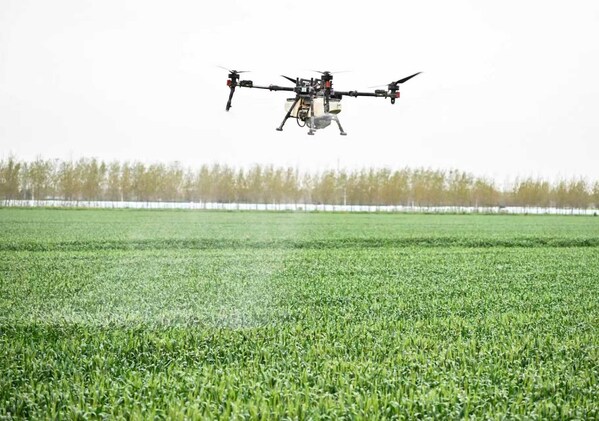
At the breeding base of Fangqiang Farm in Yancheng City, plant protection drones spray Syngenta’s “Maitian®” for aerial control operations.
“Fusarium head blight is preventable but not curable. In the Yancheng area, the early flowering stage of wheat often overlaps with the rainy season, making it more susceptible to FHB. Once the critical timing is missed, excessive toxin levels could waste a season’s hard work for farmers,” explained Ying Jinfeng, plant protection technology lead for Central and East China at Syngenta Group China. Syngenta’s “Maitian®” FHB control solution, leveraging its efficient, lasting, and stable technical advantages, can significantly improve grain filling color, effectively reduce the number of diseased grains and DON toxin content, and enhance wheat quality and yield. Precisely tailored to Yancheng’s rainy and concentrated flowering period control scenarios, it has become one of the important local choices for controlling FHB.
At the Jinfu Grain Planting Family Farm in Wulie Town, Dongtai City, Yancheng, 1,300 mu of wheat are currently in their flowering stage. On the tall, emerged wheat ears, tiny white wheat flowers the size of sesame seeds hang from the tips of tender green grains. Large-scale grower Sun Jinping seized the break between rains to conduct drone aerial control operations using the Syngenta “Maitian®” control plan. “I’ve been using this plan for several years, and the results have been consistently stable. Not only has FHB been effectively controlled, but the wheat grains are fuller and the quality is more stable. When selling the grain, I can get a better price than ordinary wheat. In recent years, I’ve felt more confident growing wheat,” Sun Jinping said.
Sun Jinping’s experience is a microcosm of the Yancheng wheat region. During this year’s spring farming season, Syngenta’s business teams went deep into key wheat areas including Central China, East China’s river basins, and the Huaihe River basin, conducting over 1,000 field巡回 guidance sessions and organizing approximately 600 on-site technical training sessions, covering over 28,000 large-scale growers. Technicians refined medication plans, application timing, and aerial control parameters field by field based on different sowing dates and seedling conditions, combined with the characteristics of the “Maitian®” plan, ensuring even adhesion of the liquid to wheat ears for scientific and precise control.
Currently, the “Maitian®” plan is applied on approximately 1 million mu in Yancheng (local wheat planting area is about 6.4 million mu). Multi-point surveys show that the average FHB ear rate in fields using this plan is controlled at 5%-10%, a reduction of 20%-25% compared to fields with farmer self-control, demonstrating significant control effectiveness. Moreover, “Maitian®” has lasting efficacy and can delay the senescence of wheat leaves, helping wheat extend the time for dry matter accumulation, significantly increasing thousand-grain weight and quality.
From Yancheng to the whole country, the “Maitian®” FHB control plan has been widely applied in high-risk areas such as the middle and lower reaches of the Yangtze River, the Jianghuai region, and southern Huang-Huai region, with a cumulative application area exceeding 40 million mu. In typical demonstration areas, the plan has achieved outstanding results, with an average wheat yield increase of about 10%-20%, effectively curbing the spread of FHB and ensuring wheat quality safety.
From precise operations on a single field to a control network covering major production areas, Syngenta is using a combined model of “technical solutions + frontline services” to precisely solve the problem of wheat FHB control, building a professional defense line for stable summer grain production and harvest security in Yancheng and nationwide, safeguarding the yield and quality of every inch of wheat field.
Final Hurdle: Securing Yield and Income Increase – Empowering with Fine Field Management to Deliver Stable Production and Efficiency Gains
Having overcome the late-sowing adversity hurdle and withstood the critical pressure of FHB control, a bountiful harvest is not yet guaranteed. For the Yancheng wheat region, which has a high proportion of late-sown fields this year, how to use a professional comprehensive agricultural technical service system to meticulously manage fields and convert the hard-won stable production foundation into tangible yields becomes the key final step in spring farming production.

At the Dongtai MAP Technology Service Center under Syngenta Group China’s Sinochem Agriculture, agronomists use a smart agriculture system to view and analyze wheat growth conditions in demonstration fields.
Building on the Central Document No. 1’s requirement to leverage the role of modern comprehensive agricultural service centers, Sinochem Agriculture MAP actively participates. As an important local force for agricultural socialized services, its Dongtai Technology Service Center relies on shared supporting facilities such as seedling nurseries, rice processing lines, and agricultural machinery stations to solve problems like “fragmentation,” “uneconomical” aspects, and “missing key links” in agricultural socialized services, making it more convenient for farmers to access full-chain agricultural socialized services covering pre-production, in-production, and post-production. This year, the center integrates resources including technology, equipment, and personnel to precisely match production needs, providing precise field management guidance and personalized service plans for late-sown wheat fields, promoting a shift in spring farming production from “going it alone” to “organized collaboration.”
In recent years, Jiangsu has closely followed the requirement to “establish a convenient and efficient agricultural socialized service system,” serving the overall situation of food security. Based on the agricultural production needs of different industries, links, and entities, it has comprehensively and multi-levelly promoted the construction of an agricultural socialized service system. Various types of agricultural socialized service entities have flourished, reaching 72,000. At the same time, Jiangsu has thoroughly implemented the national six-department “Guiding Opinions on Strengthening the Construction of Modern Comprehensive Agricultural Service Centers,” closely combining with Jiangsu’s actual conditions, adhering to the combination of public welfare and marketization, taking counties as units and planning as guidance, relying on existing service forces and resources to promote the construction of a batch of regional comprehensive agricultural service centers. Currently, 168 centers have been initiated in 30 comprehensively advancing counties.
“Agricultural service enterprises have high professional levels and strong comprehensive service capabilities, making them an important force in carrying out agricultural socialized services. We will promote various entities to continuously standardize service standards and improve service quality, leading and driving small farmers to save costs, increase efficiency, and boost income, promoting the healthy and orderly development of the industry,” said Lv Ting, Deputy Director of the Rural Cooperative Economic Guidance Division of the Jiangsu Provincial Department of Agriculture and Rural Affairs.
“The most prominent difficulties in local wheat later-stage management this year are mainly concentrated on the significantly higher risks of FHB and lodging compared to previous years,” introduced Ge Lin, an agronomist at the Dongtai MAP Technology Service Center. Multiple rainfall events in mid-to-late April highly coincided with the wheat heading and flowering period, with high temperature and humidity significantly increasing the risk of FHB outbreaks. Additionally, affected by the “warm winter + early spring warmth + rainy and humid” conditions, wheat populations were too large and stems were slender, making lodging risk higher than usual. In response to these challenges, the technical team focused on providing services around key links such as seedling monitoring, water and fertilizer management, pest and disease early warning, aerial control organization, and agricultural machinery scheduling, helping growers seize critical farming times and implement key measures in the fields.
Large-scale growers represented by Sun Jinping are achieving refined field management through the MAP comprehensive agricultural service system. Sun Jinping’s 1,300 mu of wheat planted this year faced problems such as weak seedlings, imbalanced population structure, and prominent lodging risks due to factors like late sowing and early spring rains. In response, MAP technicians conducted over ten one-on-one guidance sessions in the fields: guiding ditch clearing, soil moisture management, and balanced fertilizer application during the green-up period in late February to promote weak seedlings turning strong; implementing growth control and potassium fertilizer application during the jointing stage in mid-March to enhance lodging resistance. At the same time, relying on a digital platform, the technical team pushed “spraying calendars” and “fertilizer prescriptions” to growers, achieving precise and standardized farm management and ensuring the implementation of key farming times and measures. “In the past, spring management relied mainly on experience. Now, with MAP’s full-process technical guidance, fertilization is more scientific and management is more refined,” Sun Jinping said. “Sown at the end of last November, nearly three weeks later than the usual sowing date! Now the wheat growth has caught up with the early-sown fields, and the stems are sturdy. I am confident about this year’s harvest!”
To date, the Dongtai MAP Technology Service Center has served approximately 60,000 mu of farmland, including about 4,000 mu of Yangmai 25 and about 30,000 mu of contract farming, covering areas such as Wulie Town, Xinjie Town, Touzao Town, and Jianggang Town in Dongtai City. Focusing on subsequent key links like grain filling, harvesting, and drying, the center is proactively scheduling agricultural machinery and inspecting drying facilities to ensure timely harvesting in sunny weather and immediate drying after harvest, preventing ear germination and helping ensure every grain is stored. At the same time, to promptly connect crop rotations, MAP has organized the seedling nursery within the comprehensive service center to set up seedling production lines. In an instant, seed mixing, soil laying, sowing, and soil covering are completed. Trays filled with seeds are moved into greenhouses for incubation, and after 20 days, they will grow into strong seedlings, ready to start the next crop season.
Relying on a professional comprehensive agricultural service system, Sinochem Agriculture MAP continues to promote the implementation of wheat quality and yield improvement technologies nationwide. Focusing on key links such as seeds, nutrition, plant protection, and agricultural machinery, it has formed a full-process technical solution for wheat quality and yield improvement, which has been promoted and applied in major wheat-producing areas nationwide, effectively increasing per-unit yield and production efficiency. It practices the deployment of the Central Document No. 1 with concrete actions, helping to upgrade and improve the agricultural socialized service system in Jiangsu.
From good variety breeding to precision plant protection, from crop solutions to fine field management, Syngenta Group China, guided by technological innovation, promotes the deep integration of good varieties, good methods, and professional services, building a solid defense line for stable summer grain production and harvest security. It has forged an effective path for increasing grain production and farmer income under adverse climatic conditions such as late autumn sowing, providing a replicable and scalable “Yancheng practice” for stable production and efficiency gains in the middle and lower reaches of the Yangtze River wheat region.