

BeijingMay 8, 2026 /PRNewswire/ — Recently, JD.com, Ipsos, and Philips Water Health jointly released the “2026 Water Purification Industry Trend White Paper,” also referred to as the “2026 Chinese Household Water Consumption Leapfrog White Paper.” Based on an in-depth survey of 4,000 household consumers in China’s first- and second-tier cities, combined with e-commerce user data, the report indicates that Chinese households’ expectations for drinking water have evolved from “drinking clean water” to “drinking well, drinking conveniently, and drinking with style.” Water purification devices are undergoing a triple leap from “improvement-oriented optional consumer goods” to “standard features of quality living” and further to “leaders of premium lifestyles.”
Shift in Mindset: Safety Remains the Baseline, Quality Sees a Comprehensive Upgrade
Ten years ago, the question was, “Is this water clean?” Today, the inquiry is, “Can this water be used to make iced coffee?” The survey shows that beyond water cleanliness, consumers’ diverse demands for health benefits, taste, temperature, convenience, and even aesthetic design are stacking up layer by layer, forming a new decision-making framework. The role of water purifiers in households has fundamentally changed—they are no longer “functional tools” hidden in kitchen cabinets but have become “lifestyle carriers” extending into living rooms, studies, bedrooms, and even social settings. The industry is growing steadily, driven by both replacement demand and new market penetration, with high-end models emerging as the core engine for growth.
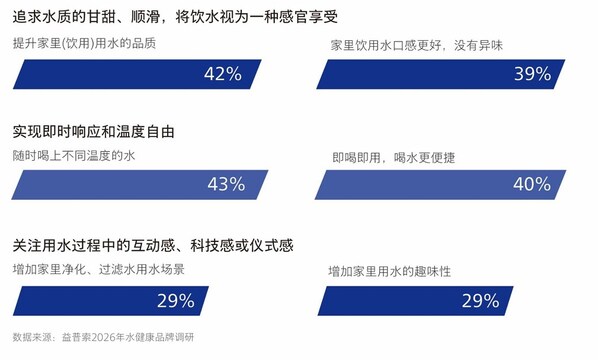
Shift in Scenarios: From a Corner of the Kitchen to a Whole-House Blueprint
As consumers begin to pursue “drinking healthily, conveniently, and enjoyably,” water consumption scenarios are rapidly expanding from a single point in the kitchen to the entire home. The white paper outlines six core water consumption scenarios: making iced beverages, morning wellness, working from home, catering to the elderly and children, family gatherings, and brewing and tasting—each with distinct time slots, primary spaces, core users, and value propositions. Users no longer need “one-size-fits-all” standalone devices but a set of water solutions that provide “just the right” support across different spaces.
Shift in Value: Four Consumer Groups and Five Major Trends
Through deep insights into lifestyles and water consumption behaviors, the white paper categorizes water purification device users into four typical groups: the Science-Based Parenting Faction (strictly controlling water quality and temperature), the Quality Lifestyle Enthusiasts (pursuing ritual and taste), the Lazy Homebodies (prioritizing one-button convenience), and the Refreshing Drinkers (seeking pure iced beverages with optimal taste).
Focusing on these four groups, the report identifies five major consumption trends: extending from single-point drinking to whole-house multi-scenario water use; diversifying from general products to those with specific taste and temperature functions; transforming iced beverage experiences from seasonal to year-round daily habits; upgrading devices from basic filtration to intelligent, visualized, and convenient features; and shifting purchase decisions from solely product-focused to encompassing full-cycle service experiences.
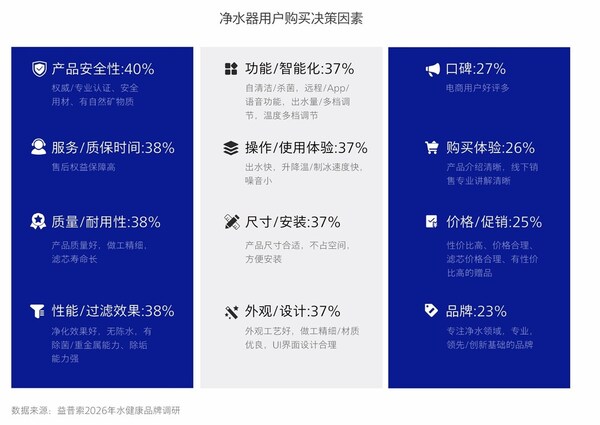
Currently, consumers purchasing water purifiers exhibit a notable trend toward rationalization and long-term value orientation. Multi-dimensional judgments around safety, professionalism, user experience, and cost are replacing blind brand loyalty. User demands for water purification products are climbing the value pyramid from “basic survival” to “health management,” “family socializing,” and “self-pleasure rituals,” with products evolving from functional tools into lifestyle carriers.
Shift in Devices: Temperature Control, Mineralization, and Ice-Making Become Key Upgrade Points
Changes in consumer demand are driving product capability upgrades. Temperature control, mineralization, and ice-making functions have become key industry focuses. Among these, multi-level temperature control has emerged as the primary driver for desktop water purifier replacement users, with 80% listing it as the top feature. Mineralization functions are gaining attention from more households, with 69% of replacement users including it as a must-have configuration. Meanwhile, ice-making functions are rapidly gaining popularity among young families in second-tier cities and female users in first-tier cities, with iced beverage consumption transitioning from a seasonal need to a daily lifestyle.
Shift in Brands: From Technical Specifications to Lifestyle
From “drinking a sip of clean water” to “covering the entire home with a quality lifestyle experience across all temperatures and scenarios,” user expectations for water purification have achieved a qualitative leap. This transformation brings three levels of profound insight for the industry and brands. At the product level, it shifts from “feature stacking” to “scenario integration.” At the service level, it upgrades from “post-sale response” to “full-cycle companionship.” At the communication level, it moves from “specification narratives” to “emotional resonance.”
JD.com, Ipsos, and Philips Water Health stated that this joint release aims to anchor consumer insights and drive the water purification industry from “specification competition” to “experience competition.” As material abundance becomes the norm, people’s focus shifts from functional parameters to emotional value. Only by understanding consumers’ implicit expectations in every specific moment can brands take the initiative in this transformation.
About the “2026 Water Purification Industry Trend White Paper”: This report was jointly released by JD.com, Ipsos, and Philips Water Health. It is based on Ipsos’ quantitative survey of 4,000 household consumers in China, combined with user data from the JD.com platform, providing a panoramic scan and future projections of consumption trends in China’s water purification industry.