

BeijingJune 25, 2026 /PRNewswire/ — Against the backdrop of “AI implementation” and “data reshaping,” modern marketing cloud platform AppsFlyer officially released the 2026 China App出海 Marketing Trends Report at the 2026 MAMA Mobile Internet Summit. Based on aggregated anonymous data from over 5,000 Chinese apps expanding overseas, the report systematically examines how Chinese apps are restructuring growth logic, optimizing budget structures, and achieving a strategic shift from “scale-driven” to “efficiency-driven” growth amid the wave of AI technology.
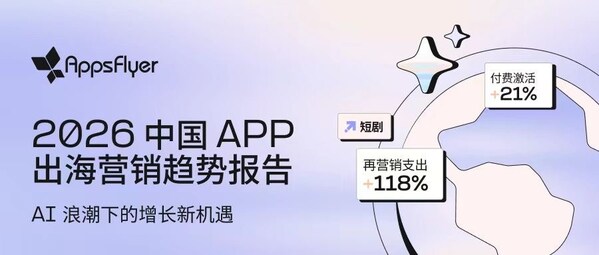
Report data shows that Chinese apps going global are shifting from pursuing scale in advertising to refined efficiency operations, with paid activation growth significantly outpacing ad spend growth. Meanwhile, short dramas and generative AI apps have emerged as the most dazzling growth tracks in this reporting period, reshaping the category landscape of Chinese apps expanding overseas.
Dr. Wang Wei, General Manager of AppsFlyer Greater China, stated at the summit: “2026 is likely to be the first year when AI transitions from ‘being able to answer questions’ to ‘being able to complete tasks.’ Mobile marketing, with its high data density, short feedback cycles, and measurable ROI, will become one of the earliest fields to be deeply transformed.”
Key insights from the report include:
Overall Growth Rebounds, Paid User Acquisition Remains Core Engine, but Efficiency Takes Priority Over Scale
In the first quarter of 2026, overall activations of Chinese apps going global grew 12.7% year-over-year, while paid activations grew 21.0%, indicating that new user acquisition remains the core of growth. Paid ad spend grew only 0.9% year-over-year, suggesting advertisers have shifted from expanding investment to improving efficiency. Meanwhile, retargeting ad spend surged 117.5% year-over-year, but conversions fell 5.1%, reflecting increased difficulty in re-engaging existing users. Going forward, the key to overseas growth is not just “faster user acquisition,” but leveraging AI to enhance audience identification, retargeting decisions, and conversion efficiency, forming a more efficient growth loop.
Non-Gaming Categories Rise Across the Board: Short Dramas Grow 225.6%, Generative AI Grows 155.5%
Non-gaming apps are replacing games as the main growth engine for Chinese apps going global. In Q1 2026, non-gaming app activations grew approximately 19% year-over-year, accounting for nearly 68% of total activations, while gaming apps’ share dropped from 35.5% to 32.0%. Short dramas and generative AI stood out particularly: short drama overall activations grew 225.6% year-over-year, paid activations grew 233%, and retargeting conversions grew 248%; generative AI overall activations grew 155.5% year-over-year, paid activations grew 207%, and AI-native apps are becoming a new growth track for overseas expansion.
Gaming Growth Divergence Intensifies, Casual Games Show Resilience
Gaming remains an important foundation for Chinese apps going global, but internal growth divergence is significant. Casual games performed strongly, with overall activations growing 20% year-over-year in Q1 2026 and paid activations growing 46%. In contrast, paid activations for hyper-casual games, mid-core games, and sports & racing games fell 25%, 18%, and 19% year-over-year, respectively, indicating greater pressure on traditional user acquisition-driven models.
Regional Market Stratification Intensifies: “Volume in Emerging Markets, Money in Mature Markets”
From a regional perspective, activations and ad spend show significant stratification. Southeast Asia and Latin America together contribute about 39% of overall activations (Southeast Asia 20.90%, Latin America 18.13%), serving as core regions for scale expansion; while North America and Western Europe account for nearly 68% of ad spend, with North America alone at 48.66%, making it the main battlefield for high-value user acquisition and monetization. The report recommends that companies going global establish a refined regional portfolio strategy: mature markets handle high-LTV user acquisition and brand building, while emerging markets focus on scale expansion and new category validation.
Revenue Path Divergence: IAP and IAA Find Their Places, Short Dramas Show Early Ad Monetization Potential
On the monetization front, revenue paths show clear stratification. IAP revenue is concentrated mainly in finance (41.33%), mid-core games (16.76%), casual games (13.15%), and social media (12.21%); IAA revenue is highly concentrated in gaming, with casual and hyper-casual games together contributing nearly 88%. Notably, short dramas have risen to third place in IAA revenue, accounting for about 7.31%, with ad monetization potential rapidly unlocking, potentially becoming a major IAA growth driver after gaming.
AI Drives Anti-Fraud Evolution, High-Value Categories Remain Risk Hotspots
The report shows that the overall fraud rate dropped from 10.20% in Q1 2025 to 4.89% in Q1 2026, a decline of more than half, with Android seeing a particularly notable decrease (from 9.60% to 4.68%); iOS fraud rates remain high at 16.83%, approximately 3.6 times that of Android, requiring ongoing attention. Bot traffic is the primary form of fraud on both platforms (accounting for over 82%), with finance (34.82%), social media (24.34%), and e-commerce (18.54%) being high-risk categories. As AI and automation technologies are used to simulate complex user behaviors, anti-fraud efforts similarly need to rely on AI to enhance anomaly detection, real-time blocking, and risk prediction capabilities.
Methodology
The 2026 China App出海 Marketing Trends Report is based on aggregated anonymous data from over 5,000 Chinese apps expanding overseas (each with at least 2,000 monthly conversions), covering January 2025 to March 2026. The total number of conversions tracked reached 19.8 billion (including organic activations, paid activations, and retargeting conversions), corresponding to $16.3 billion in paid ad spend. The report covers multiple verticals including gaming, e-commerce, finance, social media, short dramas, and generative AI, providing deep insights across dimensions such as paid user acquisition, retargeting, category structure, regional deployment, monetization paths, and fraud protection. All data is based on aggregated anonymous results, processed after standardization.
To view the full content of AppsFlyer’s 2026 China App出海 Marketing Trends Report, please visit or scan the QR code below: https://www.appsflyer-gcr.cn/resources/reports/mama-china-2026/