

 |
ShanghaiJune 9, 2026 /PRNewswire/ — Recently, MPS (Monolithic Power Systems, NASDAQ: MPWR) released its next-generation automotive-grade power management IC (PMIC) — the MPQ70340FS-AEC1. Developed based on the MPSafe™ functional safety development process, this product complies with the ISO 26262 ASIL-B hardware standard and is AEC-Q100 Grade 1 certified. Integrating three high-efficiency synchronous step-down converters and one low-noise LDO, the MPQ70340FS-AEC1 supports a maximum input voltage of 40V, offering a highly integrated and reliable power management solution for applications such as automotive cameras, driver monitoring systems (DMS), and in-cabin sensors.
With the rapid development of ADAS and intelligent cockpits, automotive perception systems demand higher camera counts, image quality, and real-time processing capabilities, posing challenges for traditional solutions. In next-generation in-vehicle vision systems, the integration of SoCs, MCUs, ISPs, and high-resolution CMOS image sensors is increasing. Alongside miniaturization requirements for structural space, modules often need to simultaneously provide multiple voltage rails such as 1.8V, 1.2V, 2.8V, and 3.3V, with strict requirements for startup sequencing, power supply ripple, EMI performance, and thermal design. Traditional discrete power supply solutions not only occupy significant PCB area but also involve complex system design and difficult EMI debugging. Highly integrated PMICs are gradually becoming a key trend in automotive camera power architectures. The MPQ70340FS-AEC1 is a high-performance automotive-grade PMIC designed for these trends, supporting battery-powered architectures and offering engineers flexible design options.
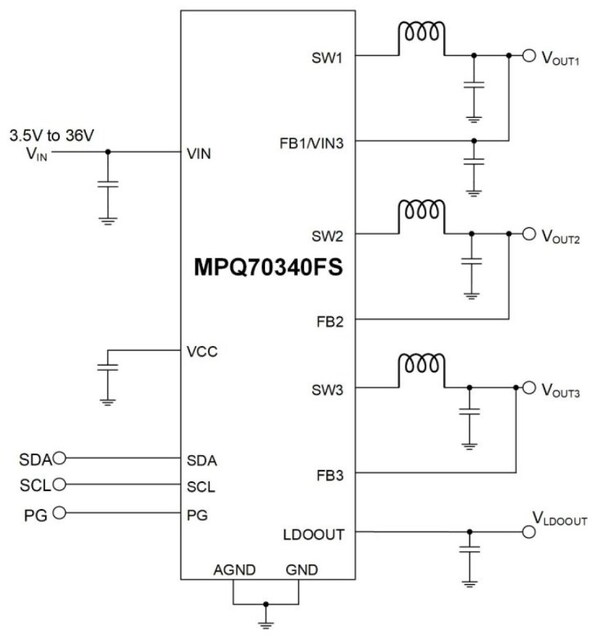
MPQ70340FS-AEC1 Typical Application Schematic
High-Efficiency Wide Input Architecture, Covering Multiple Automotive Power Supply Scenarios
Currently, automotive cameras have diverse power supply methods. DMS, OMS, and some in-cabin sensor systems are increasingly adopting 12V battery power from the vehicle, requiring the PMIC to adapt to complex conditions such as cold starts, battery fluctuations, and load dumps. Therefore, camera PMICs not only need a wide input range but also must maintain high conversion efficiency and good parameter performance under high input voltage conditions.
The MPQ70340FS-AEC1 supports a maximum input voltage of 40V, with two buck converters supporting an input range of 3.5V to 36V. The product uses a two-stage 36V step-down architecture, achieving higher efficiency under high input voltage conditions, especially suitable for low-voltage power rail needs like 1.8V CMOS image sensor I/O, reducing power consumption while optimizing thermal performance.
For the rapidly popularizing 8-megapixel or higher resolution cameras, the power consumption of image sensors and ISPs continues to increase, significantly raising thermal management pressure. By optimizing the power conversion path, the MPQ70340FS-AEC1 reduces system power consumption while improving module thermal performance, helping customers enhance long-term operational stability and reduce thermal design stress.
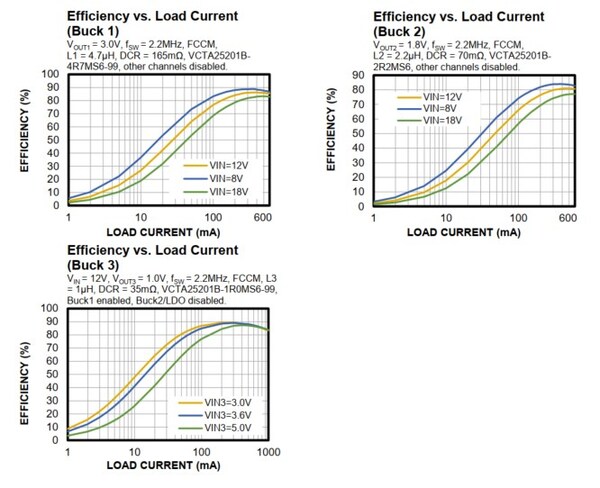
MPQ70340FS-AEC1 Efficiency vs. Load Curve
Low-Noise High-Frequency Design, Meeting Stringent Automotive EMC Requirements
In automotive vision systems, power supply noise directly affects the output quality of CMOS image sensors, subsequently impacting image recognition, object detection, and ADAS algorithm stability. Therefore, EMI performance has become a core indicator in camera PMIC design.
To address stringent automotive EMC/EMI requirements, the MPQ70340FS-AEC1 employs a MeshConnectTM Flip-Chip Package and symmetrical layout, reducing parasitic parameters while minimizing noise interference. The 2.2MHz fixed switching frequency reduces external inductor size and output voltage ripple, helping meet CISPR 25 Class 5 standards and supporting stable image link operation. Additionally, the device uses a constant-on-time (COT) control architecture with a phase-locked loop (PLL), enabling fast transient response under dynamic load changes, ensuring power supply stability while balancing overall EMI performance.
Highly Integrated Compact Solution, Optimizing Camera Module Space
As automotive intelligence advances, the number of cameras per vehicle has increased from early 4 units to 8, 12, or even more. Miniaturization and lightweight design of camera modules have become key trends in vehicle design. With increasingly limited module space, power system miniaturization is a design focus.
The MPQ70340FS-AEC1 uses a 2.5mm x 3.5mm QFN package, integrating three buck converters and one LDO within a limited PCB area, significantly reducing the number of external components and helping customers lower system size and BOM costs. For space-constrained applications such as surround-view, surround-view, electronic rearview mirrors, and in-cabin cameras, this product enhances module integration, simplifies board-level design, and frees up layout space for other critical components, especially suitable for space-limited electronic rearview mirrors, ultra-thin camera modules, and hidden in-cabin perception nodes.
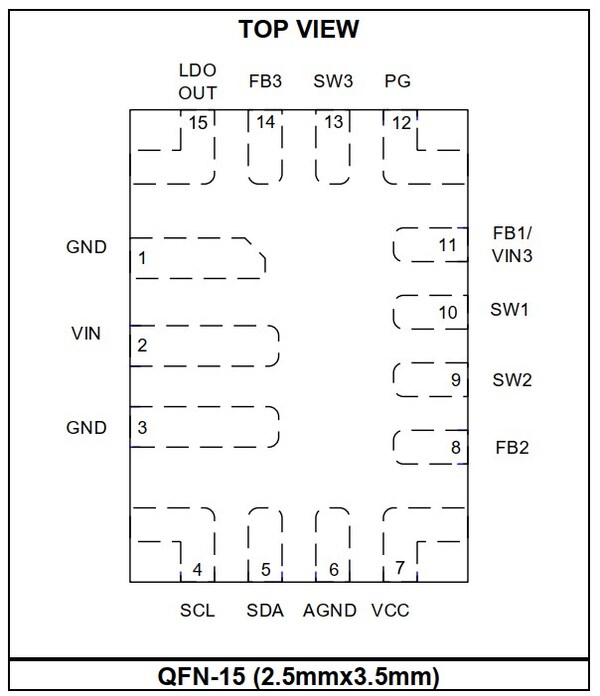
MPQ70340FS-AEC1 Package Diagram
High-Level Functional Safety Design, Supporting ASIL-B System Development
As ADAS evolves toward L2+ and L3 levels, cameras have become critical safety nodes in the vehicle perception chain, making the reliability and diagnostic capabilities of their power supply systems increasingly important. The MPQ70340FS-AEC1 complies with the ISO 26262 ASIL-B hardware standard and is developed based on the MPSafe™ functional safety process, helping customers accelerate system safety design and certification processes. Integrating multiple safety mechanisms such as analog built-in self-test (ABIST), diagnostic monitoring, window watchdog, and Power Good output, the MPQ70340FS-AEC1 also provides FMEDA and safety manual support, along with multiple protection features including undervoltage lockout, overcurrent protection, overvoltage protection, undervoltage protection, and overtemperature shutdown, further enhancing system operational reliability.
As automotive electronic architectures continue to evolve toward centralized computing and distributed perception, the number of in-vehicle cameras and sensor nodes will further increase. MPS will continue to leverage its high-performance analog and power management technologies to provide advanced automotive-grade solutions with efficiency, safety, and system integration advantages to global automotive customers.
Product Purchase and Technical Support
If you are interested in the above solution, MPS can provide you with rich technical resources such as the MPQ70340FS-AEC1 product datasheet and samples. Additionally, for other solution needs, you are welcome to visit for more product details.
About MPS
Monolithic Power Systems, Inc. (MPS) is a globally leading semiconductor company focused on chip-based high-performance power solutions. MPS’s mission is to reduce energy and material consumption to improve quality of life from all aspects. Founded in 1997 by CEO Michael Hsing, the company has three core strengths: deep system-level knowledge, outstanding and professional semiconductor design capabilities, and proprietary semiconductor processes, system integration technologies, and innovation capabilities. These combined strengths enable MPS to provide customers with reliable, compact, and monolithic integrated solutions, making their products more energy-efficient and economical, while also delivering sustained investment returns to our shareholders. For more information about MPS, please visit www.monolithicpower.cn or local offices.