

ShanghaiMay 29, 2026 /PRNewswire/ — In early May 2026, the 106th Annual Meeting of the American Association for Thoracic Surgery (AATS) was grandly held in Chicago, USA. The Head Nurse of the Nursing Department from our hospital presented the research poster titled “Evaluation of Changes in Neurocognitive Function after Thoracic Aortic Surgery” at the conference, engaging in academic dialogue with renowned thoracic and cardiac surgery experts from around the world, showcasing the research capabilities and professional excellence of our nursing staff in the field of perioperative cognitive management in cardiac and major vascular surgery.
Century-Old Premier Event, Building an International Academic Dialogue Platform
AATS, founded in the early 20th century (1917), is one of the oldest and most academically influential international events in the field of thoracic and cardiac surgery worldwide. After more than a century of development, the AATS annual meeting is renowned for its diverse formats, strong academic focus, innovative highlights, and the high caliber and academic standards of its participants. It is recognized as an international event in the field of cardiothoracic and vascular surgery, attracting thoracic and cardiac surgeons from around the globe to travel far and actively participate. Professor Sun Lizhong, Medical Director of our hospital, is also an AATS member.
This year’s conference focused on five major areas: Adult Cardiac Disease, Congenital Heart Disease, Perioperative Management, Structural Heart Disease, and Thoracic Surgery. Within the traditionally surgeon-dominated academic landscape of AATS, the poster presentation area provided a rare sharing platform for clinical nursing staff.
Focusing on Clinical Pain Points, Nursing Research Delves into Perioperative Cognitive Management
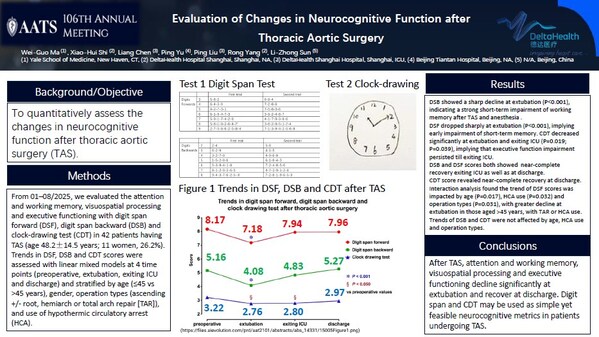
The head nurse’s poster primarily addressed changes in neurological function after thoracic aortic surgery, especially the more subtle and higher-incidence mild neurocognitive changes.
Its innovation lies in prospectively targeting the “acute critical period” of neurological changes during hospitalization, conducting longitudinal bedside assessments at four time points: preoperatively, post-extubation (in the ICU), upon transfer out of the ICU, and before discharge. Under the guidance of neurology experts, the study focused on cognitive domains susceptible to surgical impact, such as attention, working memory, visuospatial processing, and executive function.
The research, led by nurses who completed the full-cycle cognitive assessments, systematically mapped the dynamic evolution of neurocognitive impairment after thoracic aortic surgery for the first time, providing evidence-based support for early identification of high-risk patients and the development of personalized cognitive rehabilitation nursing plans.
International Exchange, Professional Achievements Highly Recognized by Domestic and Foreign Peers
During the poster presentation session, the head nurse introduced the research background, results, and findings entirely in English, engaging in discussions with clinical experts from institutions such as the Mayo Clinic, Cleveland Clinic, and Stanford University School of Medicine. She also had lively discussions with several domestic doctors (including from Fuwai Hospital, Anzhen Hospital, Shanghai Children’s Medical Center, and Wuhan Asia Heart Hospital) on the selection of neurological function assessments and cognitive tools.
Domestic and international peers showed strong interest in the nurse-led research and expressed intentions for future multicenter collaborations. A U.S. thoracic surgeon remarked: “In China, you perform many high-difficulty surgeries every day, creating excellent conditions for the growth of cardiac surgeons. Surgeons often focus on postoperative bleeding, infection, and anastomotic leaks, but may overlook whether patients can remember to take medications regularly, live safely, and recover at home—this is precisely one of the core elements of long-term success in aortic surgery. Your systematic management of postoperative details has given me much clinical inspiration.”
Originating from Clinical Practice, Grateful for Team Support Empowering Growth
After the meeting, the head nurse expressed: “Standing in front of the poster, I deeply felt the weight of team support. During the data collection process, my colleagues in the ward and ICU assisted and supported my work; without their help, I could not have done it alone. I am also very grateful to Director Ma Weiguo for his guidance on the research and data analysis. Without this support and effort, I would not be standing here.”
As a nurse, being able to present and share at a surgical conference like AATS is not only an honor but also a responsibility in multidisciplinary dialogue. In our hospital, patients undergo high-risk, high-trauma surgeries like thoracic aortic procedures every day. In the past, we focused more on drainage tubes/fluids, limb function, pain, and complications. But patients also need long-term care to build recovery confidence and improve quality of life.
AATS is not just a stage for surgeons; nursing staff can also offer scientific insights around core patient issues, because everything starts from the patient, and everything is for the patient’s true experience.
Nursing Advances Deeply, International Stage Amplifies China’s Nursing Voice
In recent years, our hospital’s Nursing Department has continuously promoted the integrated development of “clinical practice, teaching, research, and science popularization”, encouraging nursing leaders to participate in high-level academic exchanges both domestically and internationally. This AATS poster presentation not only recognizes individual research capabilities but also marks the entry of our hospital’s major vascular surgery nursing research onto the international exchange platform. Moving forward, the team plans to translate the poster research into clinical pathway tools and explore scientific collaborations with domestic and international centers, so that more postoperative patients not only “live well” but also “live clearly.”
Nursing has strength, and academia knows no boundaries. Our nursing staff will continue to base their work on clinical practice, delve into research, and amplify the “Chinese nursing voice” on the international academic stage.
On this Nurses’ Day, we sincerely wish every nursing worker a happy holiday!