

NingdeMay 7, 2026 /PRNewswire/ — On April 27, CATL and Hyperstrong signed a strategic cooperation agreement for sodium-ion batteries for energy storage in Ningde, Fujian. The two parties announced a three-year order cooperation for 60 GWh of sodium-ion batteries, marking a turning point for the industrialization of sodium-ion batteries.
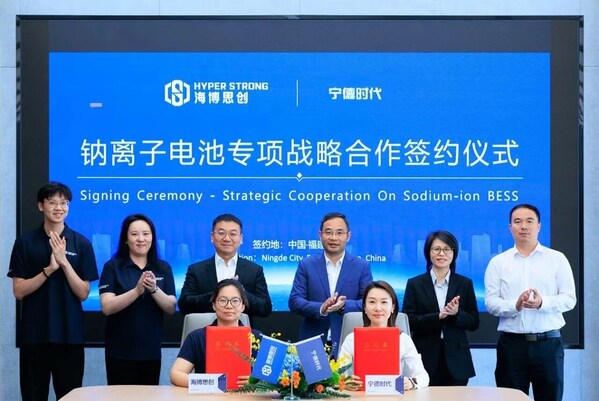
As CATL’s first strategic partner for sodium-ion batteries in energy storage, Hyperstrong will work closely with CATL in areas such as technology research and development, product application, and project implementation. On the same day, Li Yue, Vice President of CATL’s Zero-Carbon Energy Division for China, and Zhao Qing, Vice President of Hyperstrong, signed the agreement on behalf of their respective companies. Zheng Yelai, Co-President of CATL’s Market System and General Manager of the Zero-Carbon Energy Division, Xiao Lina, Executive President of CATL’s Zero-Carbon Energy Division, and Shu Peng, Co-Founder and Operating President of Hyperstrong, attended and witnessed the signing.
This cooperation signifies that CATL has overcome all challenges in the mass production of sodium-ion batteries and possesses the capability for large-scale delivery. It represents the largest sodium-ion battery order globally to date, ushering in a new phase of large-scale growth in the global sodium-ion battery industry.
CATL has significantly improved the energy density of sodium-ion batteries through morphology control and surface modification. In terms of manufacturing processes, the company has systematically resolved process issues in mass production, such as foaming in hard carbon production lines and moisture control, using core technologies like angstrom-level pore size adjustment, surface molecular water locking, and adaptive dynamic formation, ensuring consistency across large batches.
Sodium batteries exhibit strong adaptability to a wide temperature range, outstanding high-temperature cycle life, lower heat generation during operation, reduced cell expansion stress, and superior safety and stability. In mainstream long-duration energy storage applications, system integration can effectively simplify the overall architecture of energy storage systems, reduce auxiliary energy consumption, and enhance both operational efficiency and overall economic performance of power stations.
Additionally, CATL’s sodium-ion batteries for energy storage adopt a platform design with the same dimensions as lithium-ion batteries, ensuring high compatibility with existing industry chains. This effectively reduces adaptation costs and significantly shortens the time window from product development to deployment of storage stations.
The 60 GWh sodium-ion battery cooperation represents a major achievement for both parties. As sodium-ion batteries enter the stage of large-scale development, the two sides will continue to deepen collaboration, promote high-quality growth in the energy storage industry, and provide more resilient and diversified technical support for the global energy transition.