

GuangzhouApril 28, 2026 /PRNewswire/ — Popping two capsules to “protect the heart and brain” during late-night overtime, or taking one to “clear the pipes” after a heavy meal—fish oil has long been a health companion for office workers, night owls, and the elderly. Among them, rTG-type fish oil, with its high concentration of active ingredients and superior absorption rate compared to ordinary fish oil, is the mainstream product on the market.
However, the main component of fish oil, Omega-3, is prone to oxidative deterioration, leading to “stale” products and significantly reduced efficacy. For a long time, faced with a dazzling array of products on the market, consumers have been unable to accurately determine which product can “stay fresh” throughout its shelf life, urgently needing a clear “quality benchmark” to aid decision-making.
Recently, the China Nutrition and Health Food Association released the industry’s first group standard focusing on rTG fish oil, the “Classification Specification for Re-esterified Triglyceride (rTG) Fish Oil Soft Capsule Products.” The standard establishes a scientific and clear rTG fish oil quality classification system from two dimensions—”configuration” and “freshness”—providing a quality basis for consumers to select products and also promoting industrial upgrading and high-quality development.
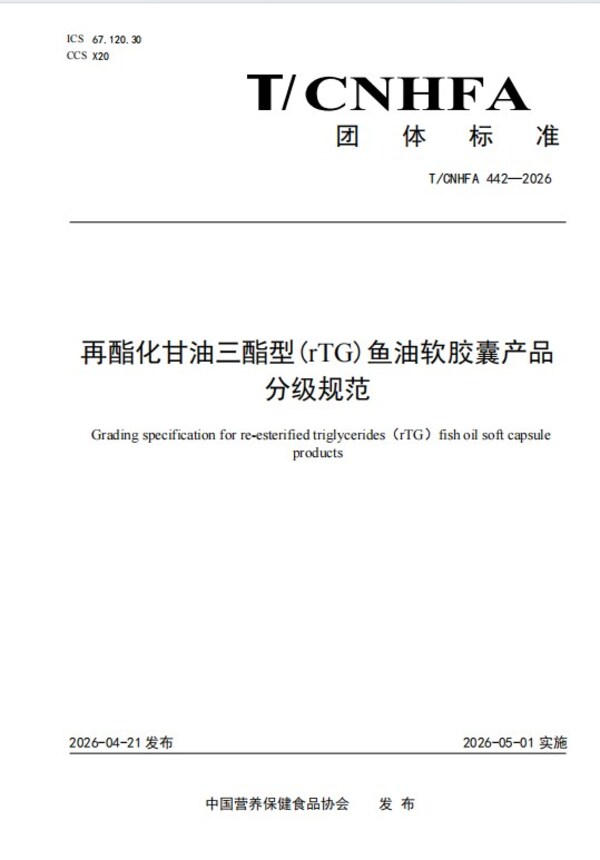
“Configuration” and “Freshness” Classification Addresses Fish Oil Selection Pain Points
Fish oil is rich in Omega-3s such as EPA and DHA, which have clear effects in aiding blood lipid reduction and protecting cardiovascular and cerebrovascular health. However, when the public selects fish oil, it is difficult to judge its freshness and active ingredient retention rate during the shelf life, as fish oil is easily oxidized.
The higher the proportion of triglycerides (TG) in fish oil molecules, the more stable the structure, the less prone to oxidation, and the better the product’s freshness is maintained. On the other hand, external conditions during fish oil production and distribution, such as temperature, humidity, and oxygen exposure, also affect the final freshness and quality of the product. Therefore, the standard establishes a quality classification evaluation system for rTG fish oil products from the two dimensions of “configuration” and “freshness,” providing a technical basis for solving the aforementioned selection dilemma.
In terms of configuration, the standard classifies products into three levels based on TG proportion: high-TG type, medium-TG type, and low-TG type, with higher proportions indicating stronger antioxidant capacity. In terms of freshness, three key indicators—acid value, peroxide value, and anisidine value—are used to measure the degree of oxidative rancidity of the product, with two grades designated: Grade 1 and Grade 2. Grade 1 freshness requires maximum retention of Omega-3 active ingredients. The cross-combination of these two dimensions forms a total of six product classification labels, such as “High rTG Type, Grade 1 Freshness” and “Medium rTG Type, Grade 2 Freshness.”
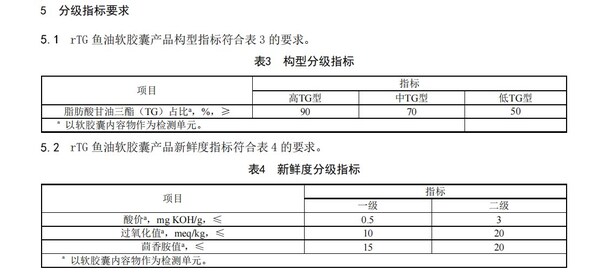
The standard also determines freshness classification by examining product stability, i.e., referencing test data at the end of the product’s shelf life or under accelerated oxidation conditions such as high temperature and high humidity, rather than relying solely on factory inspection reports. This approach helps guide companies to prioritize the freshness and quality of the product throughout its entire shelf life.
Multi-Party Collaboration to Build a Scientific Benchmark for Fish Oil Quality
The new group standard was released by the China Nutrition and Health Food Association, with the Yellow Sea Fisheries Research Institute of the Chinese Academy of Fishery Sciences, the R&D Professional Committee of the China Nutrition and Health Food Association, and By-Health taking the lead in drafting. It was completed over three years with participation from multiple authoritative institutions and well-known fish oil companies, including the China Institute of Quality Inspection and Testing, the United States Pharmacopeia China Regional Headquarters, and the Centre Testing International Group Co., Ltd.
To ensure the scientific rigor and authority of the standard, the drafting team surveyed a large number of domestic and international regulations and literature, referenced authoritative standards such as international pharmacopoeias and IFOS to develop and validate testing methods, and collected dozens of batches of raw materials and product samples for systematic actual testing. The basis for configuration classification was established by testing the TG proportion of 22 samples, and the limits for freshness indicators were determined by conducting stability studies on 26 commercially available samples and referencing long-term stability data from multiple products. Every indicator underwent repeated experiments and rigorous validation.
This standard fills the gap in rTG fish oil quality classification, providing a scientific reference for product development, process optimization, and quality control. It is conducive to regulating market order, guiding healthy competition in the industry, and promoting the development of the fish oil industry towards refinement and high quality.
As one of the leading units of the standard, By-Health integrated its accumulated full-chain product quality control experience into the standard-setting process, providing strong support for the scientific nature and operability of the standard. In the future, By-Health will continue to promote the upgrade of the standard system, refine product quality with higher standards, and safeguard public health with better quality.