Walmart E-Commerce Running Wild: 30-Minute Delivery Is Redefining American Retail
What is even more interesting is how rapidly Walmart is scaling its 30-minute delivery service.
By Chun Ge | Produced by "Ruiniu Finance"
If you only look at physical retail, Walmart’s recent days haven't been all that pretty.
In Q2 FY2026, Walmart US same-store sales grew by just 2.6%, marking the lowest rate in six years. Following the earnings release, the company's stock dropped roughly 9% at one point, wiping out over $80 billion in market value in a single day. Consumers are becoming more cautious, and traditional store operations are clearly under pressure.
However, another set of figures paints an entirely different picture.
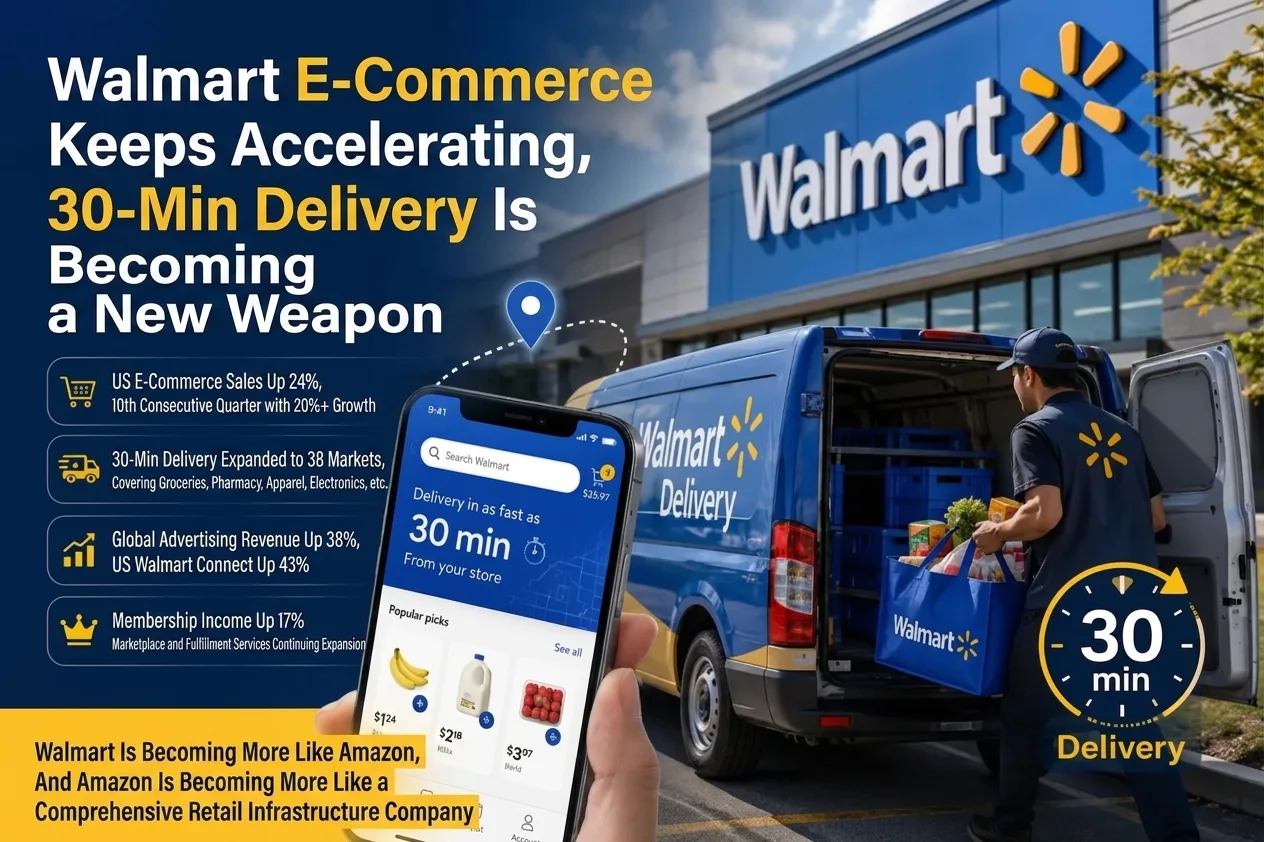
This quarter, Walmart US e-commerce sales surged 24% year-over-year, marking its 10th consecutive quarter of 20%+ growth; global e-commerce sales grew 23%. Meanwhile, store-fulfilled delivery jumped 40%, express delivery soared 48%, and about 70% of e-commerce orders were delivered same-day or faster.
What is even more interesting is how rapidly Walmart is scaling its 30-minute delivery service.
In May this year, the company announced the expansion of "30 minutes or faster" delivery to 33 US markets; by the latest quarter, coverage had expanded to 38 markets. Eligible items are no longer limited to groceries, but have broadened to prescription drugs, apparel, electronics, and various everyday general merchandise.
At the same time, Walmart's global advertising business grew 38%, with Walmart Connect in the US up 43%; membership income rose 17%, while Marketplace and fulfillment services continued their expansion.
When you put these numbers together, things get fascinating.
Walmart is looking more and more like Amazon, while Amazon is looking more and more like a comprehensive retail infrastructure provider.
In the past, Walmart represented "physical retail," whereas Amazon stood for "e-commerce."
Now, that distinction is becoming obsolete.
I. What’s Most Worth Watching About Walmart Isn’t Its 24% E-Commerce Growth
Walmart US e-commerce growing by over 20% for 10 consecutive quarters is certainly noteworthy.
However, what truly deserves attention is not the 24% figure itself, but why Walmart can still sustain such rapid growth.
Walmart is no longer a traditional retailer just getting its feet wet in e-commerce.
Its US e-commerce scale is already massive. In Q2, US e-commerce sales accounted for approximately 23% of total Walmart US sales. In other words, online operations are no longer just a "side hustle" next to physical stores—they are becoming a core pillar of the entire retail system.
More importantly, Walmart chose not to simply copy Amazon's playbook.
It didn't try to cram all merchandise into giant fulfillment centers and ship them out via national courier networks.
Walmart took another route:
Making the stores themselves the fulfillment centers.
This sounds simple, but it may be Walmart's single greatest e-commerce weapon today.
The US boasts a vast network of Walmart stores, which naturally double as local inventory hubs near consumers.
In the past, a store's value was "getting consumers to walk in and buy."
Now, it has gained another layer of value:
Consumers don't even need to visit—products can go directly from the store to their homes.
This transformation instantly turned Walmart’s decades-old physical assets into high-value infrastructure for the e-commerce era.
II. Walmart’s True "Fulfillment Centers" May Sit Right at Consumers' Doorsteps
This is the most critical point to understand about Walmart's e-commerce model.
Amazon's core advantage lies in its massive warehousing and logistics infrastructure. After a consumer places an order, products leave a large fulfillment center and travel through a logistics network to reach the home.
Walmart possesses a different kind of natural edge:
Its stores are already distributed right next to cities and local communities.
When consumers buy milk, medicine, laundry detergent, snacks, or even a piece of clothing, the core problem isn't "where to find the product," but rather:
Where is the inventory closest to the consumer?
If the inventory sits in a Walmart store just a few miles away, the delivery logic changes completely. Walmart can fulfill the order directly inside the store and send it out via local delivery networks.
As a result, Walmart is turning the traditional "last mile" into the "last few miles."
This explains why Walmart US store-fulfilled delivery grew by 40% this quarter.
Over recent years, Walmart has been aggressively automating its stores. Latest quarterly data shows that approximately 3,100 US stores feature varying degrees of automated freight capabilities, and more than half of e-commerce volume passes through automated facilities.
This means Walmart isn't merely building a simple shopping website.
It is converting its entire physical retail footprint into a giant distributed fulfillment system.
III. 30-Minute Delivery Isn't Just "Fast"—It Creates Entirely New Shopping Scenarios
When many people see 30-minute delivery, their initial reaction might be:
Isn't it just speeding up parcel delivery?
Not quite.
Shaving delivery times down from a day to a few hours reshapes logistics.
Shortening it further from a few hours to 30 minutes alters when consumers decide to buy.
Walmart has observed this shift firsthand.
The company noted that consumers using 30-minute delivery aren't just making emergency purchases—they are starting to use it for planned, everyday shopping as well.
What does this imply?
In the past, an American consumer who realized at night they were out of eggs might wait until tomorrow to buy them. Now, they might open the Walmart app immediately.
Previously, if a child suddenly needed an item for school, parents would drive to the store. Now, they can just order it online.
"Online shopping" used to mean sitting down to carefully browse a site. Now, it can become an instant consumer impulse:
Think of it, buy it; run out of it, get it delivered right away.
This is the true value of 30-minute delivery.
It doesn't just boost fulfillment efficiency; it transforms Walmart from a "shopping destination" into an on-demand utility infrastructure that can be tapped anytime.
In May this year, Walmart expanded 30-minute-or-faster delivery to 33 US markets, covering groceries, pharmacy products, and daily essentials. That footprint has continued to expand since.
Meanwhile, a similar trend is sweeping across the US retail industry.
Target, The Home Depot, Kroger, and others are accelerating hourly or even minute-level delivery options. Amazon is expanding its drone delivery network, aiming to bring 30-minute delivery to hundreds of US cities and towns.
Thus, 30-minute delivery is no longer just a standalone feature for Walmart.
It is fast becoming the new battleground for US retail.
IV. Where Walmart Truly Excels: Redefining the "Physical Store"
Over the past decade or so, traditional retailers feared one thing above all else: consumers shifting to online shopping.
Because online shopping poses a brutal question:
If consumers stop coming to stores, what happens to the stores?
Amazon's rise made this threat existential.
Yet the answer Walmart provides today is fascinating:
If consumers don't come to stores, let the stores serve consumers where they are.
Stores transformed from "places to shop" into "inventory nodes."
This represents a brilliant re-purposing of physical assets.
Walmart already possesses an abundance of stores, inventory, staff, and supply chain networks; it doesn't need to build an Amazon-style nationwide warehouse ecosystem from scratch.
What it needed to do was digitize these existing assets.
When an order arrives, the system calculates where the consumer is, where the inventory is, which store is closest, which driver can deliver fastest, and whether an item should ship from a store or a fulfillment center.
To the consumer, it looks like a simple "30-minute delivery" option in the Walmart App.
In reality, behind it sits a massive real-time engine of inventory, order processing, fulfillment, and local routing.
This is Walmart's true e-commerce moat.
V. More Notably: Walmart is Shifting from "Selling Goods" to "Monetizing Services"
If Walmart were only posting 24% e-commerce growth, the story wouldn't be quite so striking.
What is truly causing capital markets to re-evaluate Walmart is how it is changing its profit formula.
This quarter, Walmart's global advertising business surged 38%, with US Walmart Connect up 43%.
This is a critical development.
A core trait of the retail industry is that merchandise profit margins are notoriously thin. Walmart's long-standing reliance on low prices means it cannot rely on spiking product markups to drive earnings growth.
What is the solution?
Build high-margin revenue streams around consumer engagement.
Advertising is the biggest piece of that puzzle.
What consumers search for, buy, and express interest in daily on Walmart constitutes valuable commercial data.
Brands pay to rank higher in search results.
Suppliers pay for more precise consumer targeting.
Brands can purchase onsite ads, digital placements, as well as TV and streaming ad inventory.
Thus, Walmart isn't just selling goods anymore.
It is selling consumer attention.
Reports highlight that the high growth of Walmart Connect has become a key pillar supporting company profits—acting as an essential tool to offset margin pressures from low pricing and delivery investments.
This is the exact playbook Amazon ran before.
E-commerce is merely the entry point.
The real value lies in the advertising, membership, payments, logistics, cloud, and merchant services built around that e-commerce funnel.
Walmart is heading down that same path—except its starting line was the supermarket, not the web.
VI. Walmart is Building an "American On-Demand Retail Infrastructure"
Deconstructing Walmart’s business today reveals a company that looks less and less like a traditional supermarket chain.
It consists of at least six interconnected layers:
Merchandise: The traditional Walmart core, acquiring users through scale, low prices, and supply chain strength.
E-Commerce: Platforms where users buy via app or website.
Fulfillment: Stores, warehouses, automated facilities, and last-mile networks delivering goods to doorsteps.
Membership: Loyalty programs driving user retention while generating deep behavioral data. Global membership income grew 17% this quarter.
Marketplace & Fulfillment Services: Third-party merchants sell on Walmart's platform, driving revenue through marketplace fees and logistics. Nearly 50% of Marketplace volume now utilizes its fulfillment services.
Advertising: Brands paying for targeted consumer reach.
At this stage, Walmart has effectively built a closed loop:
Products → Users → E-Commerce → Delivery → Membership → Data → Advertising → Merchants → Fulfillment.
This is no longer just a retail operation.
It is evolving into a full-fledged retail infrastructure.
VII. An Interesting Shift: Walmart Looks More Like Amazon, and Amazon Looks More Like Walmart
Years ago, claiming Walmart was turning into Amazon would have sounded odd.
After all, their origins were polar opposites:
Walmart was the brick-and-mortar retail titan; Amazon was the internet pioneer.
One relied on stores; the other on a website.
One excelled at offline supply chains and physical scale; the other at digital tech and cloud computing.
Today, both companies are converging toward the middle.
Walmart is building e-commerce, third-party marketplaces, advertising, memberships, fulfillment networks, and AI capabilities.
Amazon is expanding its physical retail presence, grocery stores, pharmacies, local delivery, and 30-minute fulfillment. Amazon is also scaling its drone delivery network, targeting coverage across nearly 500 US cities and towns by late 2026.
Both giants are marching from opposite directions toward the same destination:
Whoever controls the end-to-end consumer shopping journey controls the profits.
Asking whether Walmart is a "brick-and-mortar retailer" or an "e-commerce company" is rapidly losing relevance.
It is both a physical retailer and an online marketplace; a logistics network and an advertising platform; a consumer destination and a merchant service provider.
And Amazon looks increasingly similar.
The Real Battle: Moving from "Who Sells More" to "Who Owns the Value Chain"
This is the key takeaway from Walmart’s latest earnings report.
On the surface, the quarter wasn't flawless. US same-store sales grew by just 2.6%, missing market expectations, while lower-income consumer spending remains constrained.
Yet, Walmart still raised its full-year sales and profit outlook.
Why?
Because the structural mechanics of retail are shifting.
In the past, evaluating a retail company meant looking at store sales growth.
That is no longer sufficient. Today, investors inspect:
How fast is e-commerce growing?
How fast is advertising growing?
How fast is membership income growing?
How fast are Marketplace and fulfillment services growing?
How much has delivery efficiency improved?
Can these segments deliver structurally higher margins?
Walmart is bridging the hardest-to-monetize part of retail (selling physical goods) with the most profitable elements of the digital era (traffic, data, advertising, memberships, and logistics services).
That is its true transformation.
30-minute delivery serves as the ultimate user-facing flagship experience for this entire system.
The consumer doesn't need to care how many automated warehouses Walmart operates or how it routes inventory. They only care about one thing:
I need a bottle of milk, a phone charger, or medicine right now—can Walmart deliver it in 30 minutes?
If the answer is yes, then decades of accumulated physical assets—stores, supply chains, inventory, and local routes—are instantly re-activated.
This is why Walmart’s e-commerce growth demands attention.
It isn't a traditional retailer frantically playing catch-up online; it is a physical giant turning its brick-and-mortar footprint into digital-age infrastructure.
Amazon is doing the exact same thing in reverse.
Eventually, the two may become nearly indistinguishable.
One moving from offline to online.
The other moving from online to offline.
Until the real differentiator is no longer "who is e-commerce and who is retail," but rather:
Who can deliver what the consumer wants faster, cheaper, and more efficiently—while monetizing goods, ads, memberships, logistics, and merchant services all at once.
That is the real war for the next era of retail.
And Walmart’s 30-minute delivery is merely the first visible surface signal of what lies beneath.
Discussion
Comments
Checking your account status