Meituan Steps Out of Loss Quagmire, Restructures Moat, AI Industry Faction
By Niu Er | Produced by “RuiNews Finance”On August 28, Meituan delivered its financial performance for the second quarter and first half of 2026.This time, the market finally recei
By Niu Er | Produced by “RuiNews Finance”
On August 28, Meituan delivered its financial performance for the second quarter and first half of 2026.
This time, the market finally received a relatively clear turning signal.
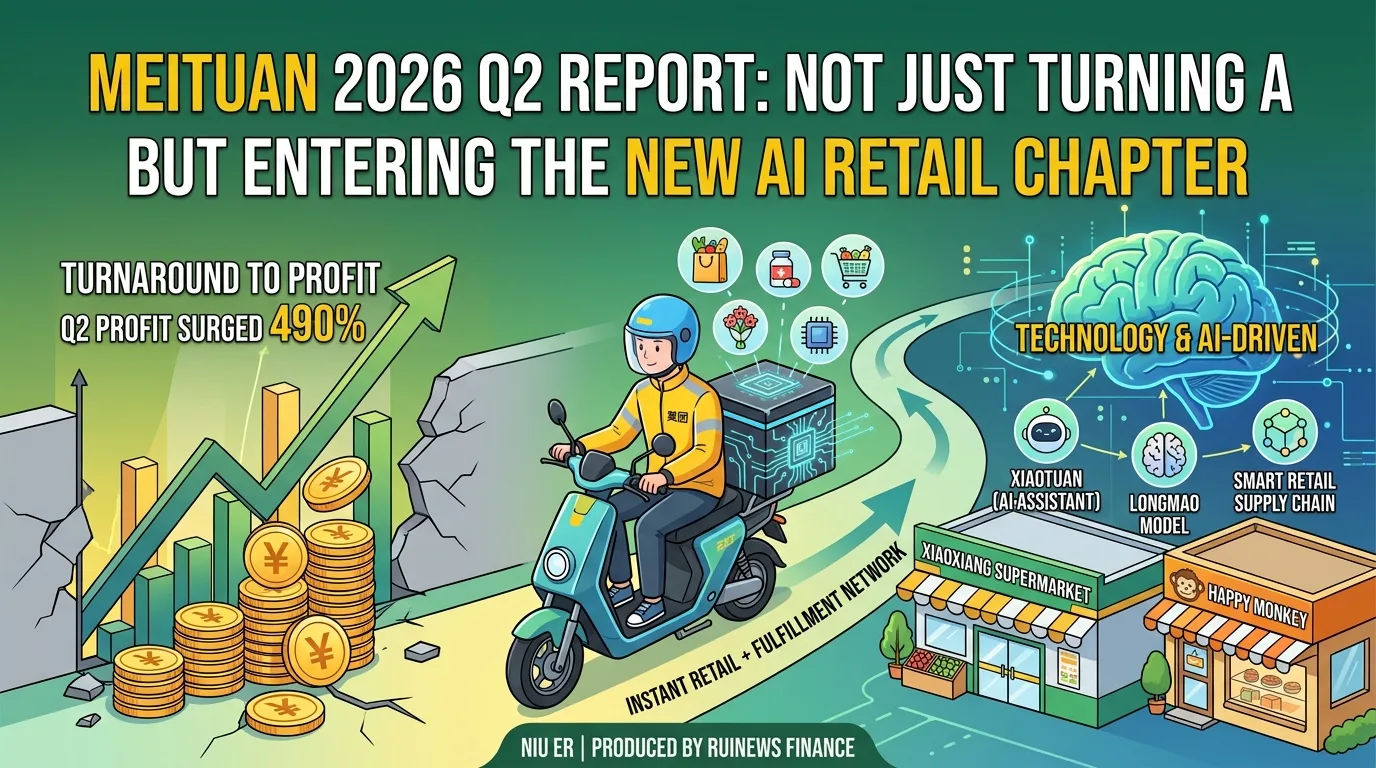
In the second quarter, Meituan achieved revenue of RMB 104.643 billion, representing a year-over-year increase of 14.4%. Profit for the period reached RMB 2.155 billion, surging 490% year-over-year, while adjusted net profit stood at RMB 2.524 billion, up 69% year-over-year. Compared with the net loss of RMB 6.83 billion in the first quarter of this year, Meituan has successfully returned to profitability.
Even more noteworthy is that Meituan’s earnings recovery was not driven by one-off gains. Core local commerce revenue reached RMB 71.5 billion, up 10.1% year-over-year, with operating profit reaching RMB 5.7 billion and operating margin rebounding to 7.9%. New initiatives revenue came in at RMB 33.1 billion, a year-over-year growth of 25%, while operating losses further narrowed to RMB 1.7 billion.
In other words, after undergoing an instant-retail price war for over a year, Meituan’s core business model is regaining its self-sustaining profitability.
However, if one simply interprets this earnings report as “Meituan survived the price war and profits are back,” it would still understate the fundamental shift taking place within the company.
What truly deserves close attention is Meituan’s transition from a local services platform reliant on traffic, delivery volume, and transaction scale into a commercial technology enterprise rooted in instant retail and powered by technology and AI as its new infrastructure.
Earnings Recover as Price War Dynamics Shift
Over the past year, Meituan’s primary challenge was not a lack of growth, but that growth was becoming increasingly expensive.
As players such as Alibaba’s Taobao Flash Sale (闪购) and JD Logistics/JD Delivery entered the instant retail and food delivery landscape, the once-stable competitive landscape was disrupted. Platforms competed for users, merchants, and riders through heavy subsidies, which directly inflated fulfillment and marketing costs across the industry.
Consequently, Meituan faced margin pressure over consecutive quarters throughout 2025.
By the first quarter of 2026, despite top-line revenue growth, the company posted an adjusted net loss of RMB 4.968 billion, with core local commerce recording an operating loss of RMB 2 billion.
Q2 marked a decisive turnaround.
As industry competition rationalized and Q2 coincided with the peak season for local lifestyle consumption, Meituan’s core local commerce segment returned to profitability. Official disclosures show that operating profit for core local commerce turned positive quarter-over-quarter, and the profitability of instant delivery operations improved significantly.
This signals a vital operational pivot:
The platform no longer needs to rely on endless subsidy increases to drive order volume.
From a business model perspective, this structural shift is far more important than earning a few billion RMB more in a single quarter.
Food delivery and instant retail are inherently scale-driven businesses. Higher order volumes increase the capacity utilization of delivery, merchant, and user networks. Once price wars subside, prior investments in infrastructure and network effects can once again translate into bottom-line profits.
As Reuters noted, Meituan’s profitability began to recover as competition in instant retail cooled.
Naturally, this does not mean competition has ended entirely. Meituan will still face ongoing competition from Alibaba, JD.com, and other platforms in instant retail. Therefore, Q2 is more accurately characterized as an inflection point in profitability rather than the conclusion of market competition.
Core Assets Extend Beyond Food Delivery
Deconstructing Meituan’s current operations reveals that the label “food delivery company” is increasingly inaccurate.
In Q2, core local commerce revenue reached RMB 71.5 billion, encompassing multiple business lines including food delivery, instant retail, in-store dining, and hotel & travel reservations.
An easily overlooked shift is Meituan’s continuous expansion of its instant delivery capabilities to broader product categories and consumption scenarios. Sales revenue from self-operated categories such as pharmaceuticals and liquor reached RMB 3.6 billion, representing a year-over-year increase of 78.9%.
This demonstrates that Meituan’s true core capability is not merely “delivering meals for restaurants”.
Instead, it is an instant fulfillment network that connects consumers, merchants, products, riders, warehousing, delivery, and consumption scenarios.
While this network historically served dining, it is now extending its reach to the broader retail industry.
This underscores why Meituan consistently emphasizes “Retail + Technology”. Food delivery represents merely the earliest and most mature application scenario of this underlying infrastructure.
In the future, whether a user purchases a bouquet of flowers, a box of medicine, a bottle of wine, or daily necessities, transactions can be fulfilled via the same instant delivery network. From this perspective, Meituan’s strategic ambition is to transform “30-minute delivery” into a universal commercial infrastructure.
Xiaoxiang Supermarket and Happy Monkey: Deepening Retail Capabilities
Another key shift lies in Meituan’s move upstream into product supply chains.
In Q2, new initiatives revenue grew 25% year-over-year to RMB 33.1 billion, while segment operating losses narrowed to RMB 1.7 billion. Within this segment, Xiaoxiang Supermarket expanded its operational footprint to 68 cities, while Happy Monkey expanded to 40 offline stores nationwide.
This is an important strategic indicator.
Historically, Meituan operated essentially as a platform connecting consumers and merchants. However, as instant retail and grocery retail mature, operating solely as a platform is no longer sufficient. Consumers ultimately buy products, not platform traffic. Whichever player controls merchandise supply, inventory, pricing, warehousing, and fulfillment will gain control over the end-to-end user experience.
Thus, Xiaoxiang Supermarket is not merely an additional retail brand; it represents Meituan’s direct effort to master product supply chains.
This marks a key differentiator between Meituan and traditional food delivery platforms: it is transitioning from “connecting merchants” to “managing products”.
Of course, this path entails heavier capital assets and operational complexity. Meituan must absorb costs associated with inventory management, shrinkage, warehousing, supply chains, and store operations. Consequently, whether Meituan can scale its retail operations into a long-term profit engine will require time to validate.
AI at Meituan: Beyond Chatbots
If operational changes are defined by “retailization,” the technological shift can be characterized as “AI-enablement”.
In Q2, Meituan’s R&D expenditure reached RMB 7.7 billion, up 22.5% year-over-year, accounting for 7.3% of total revenue.
This figure is notable. For a platform company operating at massive transaction volumes, investing tens of billions of RMB annually in R&D is not intended simply to introduce marginal AI features. Meituan is integrating AI directly into its core transaction workflow.
In June, Meituan launched LongCat 2.0. According to company disclosures, LongCat 2.0 is a trillion-parameter proprietary model trained and deployed on a fully domestic compute cluster.
Yet, beyond the “trillion-parameter” headline, the main point of interest is how Meituan intends to deploy it. The goal is not to build another general-purpose chatbot.
Meituan is constructing a three-tiered AI architecture:
1. Consumer Tier: The consumer-facing AI assistant “Xiaotuan” (小团) is evolving from “answering queries” to “executing tasks”. Upon receiving a request, it leverages real-time data to assist users with searching, ordering, hailing rides, and making reservations across local service scenarios. This reflects a core capability of AI Agents: completing tasks directly rather than merely providing instructions.
2. Merchant Tier: Meituan introduced the CatPaw all-scenario AI Agent platform, offering AI tools tailored for merchants across dining, beauty, and pet hospital sectors. Through CatPaw, Meituan aims to transform accumulated consumer insights, operational metrics, and domain knowledge into actionable merchant productivity tools.
3. Rider Tier: Meituan launched “Tuanbao” (团宝), an AI safety assistant offering features such as traffic light alerts, high-risk zone warnings, intelligent speed notifications, and reverse-riding detection.
Viewed together, Meituan’s AI strategy is clearly defined: enhancing transaction efficiency for consumers, operational efficiency for merchants, and fulfillment efficiency for riders.
This approach differs from internet firms that develop an AI product first and search for application scenarios later. Meituan’s competitive advantage lies in its existing volume of real-world commercial transactions.
“Xiaotuan” Could Redefine the Meituan App
Historically, entry points on internet platforms followed a linear path:
Open app → Search → Browse products → Compare prices → Place order.
With the introduction of AI Agents, that user journey may shift to:
State request → AI understands request → AI queries real-time supply → AI compares options → AI completes transaction.
This marks a significant product evolution.
For instance, instead of inputting structured parameters like “Sanlitun Beijing, 2 people, RMB 500 budget, 7 PM, Japanese cuisine,” a user might simply say:
“Find a quiet Japanese restaurant suitable for a date tonight, budget RMB 500, and book a table for me.”
If AI successfully executes search, evaluation, and reservation, the functional role of the Meituan App changes. It shifts from a simple local search portal to an active transaction agent for local services.
This explains why Meituan is developing proprietary foundation models and agents. If future consumer decisions are handled directly through third-party general AI, traditional app portals risk losing entry-point value. For Meituan, AI serves both as an operational efficiency tool and as a defense of its ecosystem gateway.
AI ROI: The Real Test Beyond Hype
A pragmatic perspective remains necessary. A quarterly R&D expenditure of RMB 7.7 billion does not imply that all funds are allocated exclusively to AI, nor can AI spending be automatically equated with future net income.
The ultimate value of AI must be validated through operational metrics, such as:
• Can “Xiaotuan” demonstrably improve order conversion rates?
• Can AI reduce customer support and merchant operational overhead?
• Does it optimize delivery routing and reduce rider accident rates?
• Can it unlock latent consumer demand?
If these metrics do not translate into transaction volume, user retention, or cost reduction, AI spending remains purely technical overhead.
Therefore, the critical benchmark for Meituan’s AI strategy is not parameter scale, but whether AI measurably optimizes local commerce operational efficiency. This distinguishes Meituan from pure-play AI research firms: while it possesses real transaction scenarios, it must prove that technology investments generate tangible commercial returns.
Internationalization Remains a Long-Term Play
Global expansion represents another growth axis for Meituan.
In Q2, new initiatives revenue grew 25%, with operating losses narrowing to RMB 1.7 billion—a segment that includes both grocery retail and international operations. Operational efficiency for Keeta continued to improve in Hong Kong SAR and Middle Eastern markets, while Meituan sustained expansion efforts in markets like Brazil.
Compared to domestic instant retail, overseas markets offer broader total addressable markets alongside heightened operational complexity. Consumer habits, labor costs, regulatory frameworks, and local competitive environments vary significantly by region.
Consequently, Meituan’s international footprint is best viewed as a long-term growth option rather than an immediate driver of near-term group profits.
Notably, narrowing losses in new initiatives signal a transition from capital-intensive user acquisition to a balanced focus on scale and operational efficiency. If international markets achieve sustainable profitability over time, they could form Meituan’s secondary growth curve.
Evolving from “Efficiency First” to Complex Ecosystem Governance
Beyond financial metrics, the earnings report reflects an increased focus on rider welfare, food safety, and overall ecosystem governance.
Effective July 1, Meituan’s occupational injury insurance for riders achieved nationwide coverage, with premiums fully funded by the platform. Concurrently, the company implemented its “Worry-Free Delivery” (放心外卖) initiatives and began rolling out red-light stop timers in select cities.
This evolution addresses core operational requirements as platform scale matures. Where internet platforms historically prioritized scale, speed, and growth, mature platforms must address broader stakeholder alignment:
• Are merchant margins sustainable?
• Do riders receive stable social protections?
• Is food safety verified for consumers?
• What balance should exist between the platform and broader social infrastructure?
From a long-term enterprise perspective, these factors directly influence business model sustainability rather than serving merely as corporate social responsibility initiatives.
The Next Frontier Beyond Delivery
Viewed across a longer timeline, Meituan is entering a distinct operational phase:
• Phase 1: Building scale via group buying and food delivery.
• Phase 2: Establishing a local lifestyle ecosystem across in-store dining, hotel/travel, and delivery networks.
• Phase 3: Expanding into instant retail by broadening fulfillment infrastructure from food to physical merchandise.
• Phase 4 (Current): Executing “Retail + Technology”.
Here, “technology” translates into concrete operational capabilities: foundation models, AI Agents, routing algorithms, autonomous delivery, smart warehousing, and digital infrastructure.
Where Meituan’s historical moat centered on connection (linking consumers and merchants), it is now seeking greater control over fulfillment and supply. The integration of AI extends this control further into real-time decision-making and task execution.
If successfully executed, Meituan may evolve beyond a local services platform into a digital commercial infrastructure covering consumers, merchants, merchandise, and real-time fulfillment.
Conclusion: Rebuilding for a New Cycle
Q2’s return to profitability provides a positive signal. However, from an enterprise perspective, the key performance indicator is whether this profitability can be sustained across upcoming quarters.
Three strategic variables warrant ongoing observation:
1. Competitive Intensity: Whether competition in food delivery and instant retail re-escalates. Resurgent subsidy cycles could pressure newly recovered operating margins.
2. Instant Retail Profitability: Whether instant retail can transition from a scale-driven segment into a high-margin profit contributor. Having demonstrated order and user growth, Meituan must prove sustained profitability across supply chain and fulfillment operations.
3. AI Value Creation: Meituan is directing substantial R&D capital into proprietary models, agents, and products. The success of these technology investments will be judged not by benchmark leaderboards, but by tangible gains in order conversion, merchant profitability, rider safety, and operational cost reduction.
Meituan’s Q2 2026 results reflect clear quarter-over-quarter improvement. Revenue of RMB 104.6 billion (up 14.4%), a return to net profitability, and margin recovery in core local commerce indicate that the most intense phase of price competition is moderating.
Beyond the headline numbers, Meituan is transitioning from a delivery-centric platform toward an integrated model spanning instant retail, supply chain infrastructure, AI, and smart fulfillment.
Where its previous moat relied on delivery networks and user scale, its future moat may rest on:
Merchandise Supply + Real-Time Fulfillment + Local Commerce Data + AI Agents.
This strategy requires navigating greater operational complexity and asset intensity. If fully realized, Meituan will be competing not merely for leadership in food delivery, but for position as the core infrastructure underlying next-generation local commerce.
Q2 profitability marks an initial milestone in this strategy. Meituan’s long-term enterprise valuation will depend on its ability to sustain balance between market competition, top-line growth, margin recovery, and technology R&D over coming quarters.
Discussion
Comments
Checking your account status