


Yu Hao: Platforms Must Have Values, Shouldn’t Profit from Evil
Yu Hao stated on Weibo that while suing the rumor-mongering blogger, “we should also sue the Xiaohongshu platform as a co-defendant in every case against bloggers spreading rumors on it! It’s precisely because everyone is afraid of this platform that it can so recklessly push all kinds of unverified fake news and act with impunity!“
Most entrepreneurs are reluctant to stand up and confront certain platforms head-on. Why? Because they fear suffering in silence—if a social platform uses its algorithm to retaliate against their company, the business would have to swallow the loss. This seems to have become an unwritten rule. Yu Hao, being too straight-laced and tough, simply said it out loud.
Yu Hao’s statement has exposed the long-standing tensions between well-known companies and certain social platforms, prompting a rethinking of internet governance and ethics around “algorithm neutrality” and “algorithms doing no harm.”
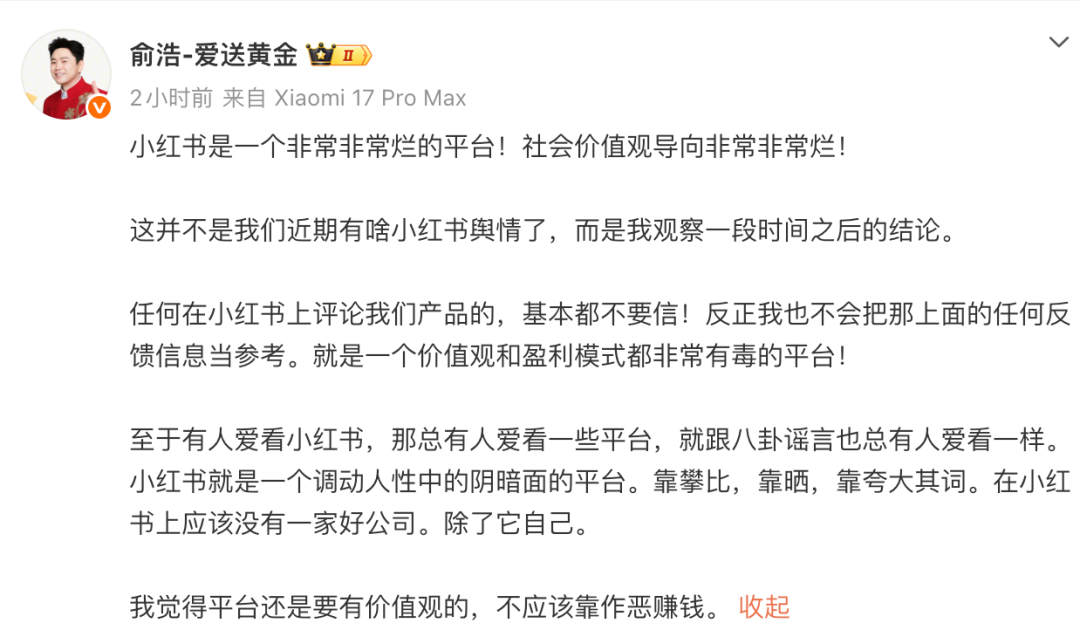
Yu Hao’s assessment of Xiaohongshu was scathing: “As for people who love browsing Xiaohongshu, well, some people always enjoy certain platforms, just like some people always enjoy gossip and rumors. Xiaohongshu is a platform that stirs up the dark side of human nature. It relies on comparison, showing off, and exaggeration. There should be no good company on Xiaohongshu, except itself.”
Now, Xiaohongshu has essentially absorbed content from platforms like Maimai and Xianyu, pushing a lot of content about internal personnel relationships at major companies, with a lot of JD.com-related content. I always feel something is off. Topics that should only be whispered among a few people are now openly turned into public content.
Another popular trend on Xiaohongshu involves content like denouncing one’s family of origin or blaming parents for not providing support… Of course, this reflects one aspect of society, but when a social platform’s algorithm collectively amplifies such content, it fosters a very unhealthy social atmosphere.
Anyone with normal intelligence and morals should understand that most parents are just ordinary people. Raising a child to adulthood and supporting their education is already commendable. Yet, a bunch of people claim, “If you can’t support me, why did you have me?”…
Freedom of speech should be respected, but when algorithms centralize negative values, it can cause immense harm to the collective consciousness of society, subtly eroding the finest aspects of Chinese civilization. We must not let Xiaohongshu turn into a “Little Black Book.”
The Algorithm Dilemma: “Neutral Technology” or “Malicious Collusion”?
In the comments section of Yu Hao’s post, tech media commentator and veteran blogger “Liu Huafang – Xiaofang Xia” bluntly stated: “Content platforms today all follow a purely technical path, claiming algorithms have no values.” Yu Hao, however, offered a harsher verdict: “Xiaohongshu’s algorithm intentionally recommends harmful content.”
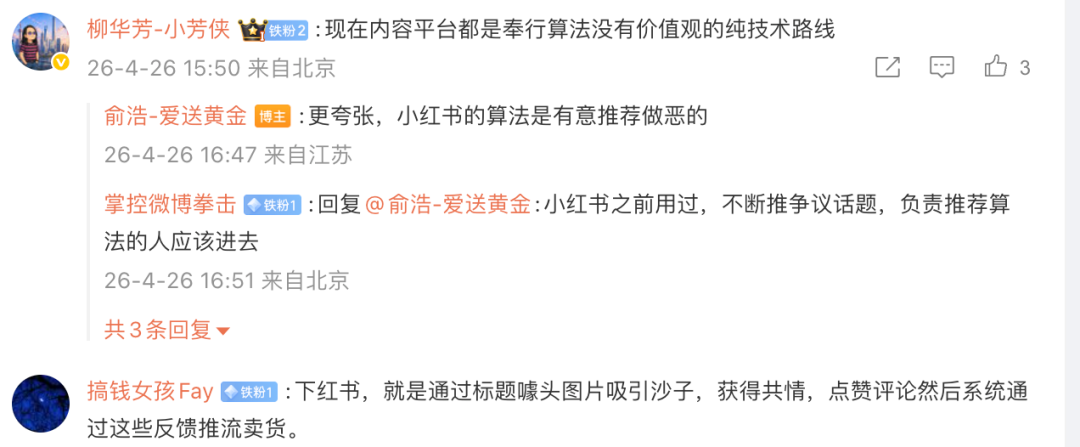
Xiaohongshu’s algorithm is a black box; outsiders can only speculate. Yu Hao’s remarks show he has suffered from it, and this debate highlights the core pain points of current algorithm governance:
1. Absolute Monopoly of Distribution Rights: Unlike platforms like Weibo, which are based on social relationships, Xiaohongshu downplays the repost function, leaving content diffusion almost entirely in the hands of the algorithm. Without the “repost” feature as an outlet for user sovereignty, the information flow becomes a one-way “black box,” where users can only reinforce their biases within algorithm-defined circles.
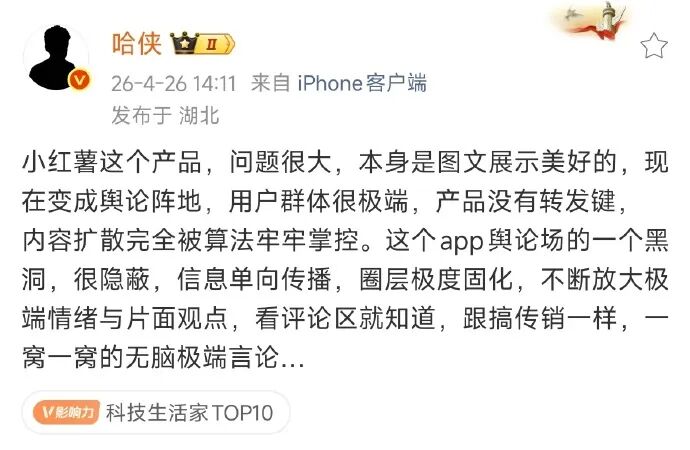
Algorithm Values: Can’t Just Profit Without Taking Responsibility
Yu Hao’s proposal of “joint lawsuits” makes sense. Although the content is created by Xiaohongshu users, the platform’s algorithm pushes and recommends it, so it should bear joint responsibility.
-
Failure of the Safe Harbor Principle: Traditional legal systems view platforms merely as carriers, absolving them of liability as long as they fulfill the “notice-and-takedown” obligation. But in 2026, with algorithms involved in deep recommendations, platforms have shifted from “carriers” to de facto “quasi-editors.” -
Tightening Platform Responsibility: Industry regulatory measures implemented in February 2026 have begun to emphasize that platforms, as both traffic distributors and rule-makers, must assume the role of “primary gatekeepers.” -
Xiaohongshu Should Learn from Weibo: Introduce a first-hand rumor-refutation mechanism to minimize the harmful impact of misinformation, preventing citizens or companies from suffering severe harm due to information asymmetry.
Xiaohongshu’s community atmosphere is moving from “sisterly mutual aid” to “extreme confrontation.” It may win in traffic, but society could be the loser.
Yu Hao believes that due to the lack of effective external checks on the platform, “it leads to this platform recklessly pushing all kinds of unverified fake news and acting with impunity.”
This reveals the deep-seated aversion of hardcore tech companies to the current state of social media, where “emotion trumps facts.” At the same time, identifying rumors should be Xiaohongshu’s technical responsibility, not something to be offloaded onto users. “Users” can be good people or bad actors.
As a leader in smart hardware, Dreame Technology became the biggest sponsor of the Year of the Horse Spring Festival Gala, gaining nationwide recognition overnight and riding a positive development wave. If its founder Yu Hao constantly sees the company being inexplicably dragged down or compared, his anger is understandable. That’s why he said: Platforms must have values and shouldn’t profit from evil.
As Yu Hao’s anger demonstrates, when platforms enjoy explosive growth driven by algorithmic traffic but still hide behind the shield of “technological neutrality,” refusing to bear social responsibility for the rumors amplified by their algorithms, the collapse of their brand image will be inevitable.
Red and Black: Algorithms Must Not Rule the Marketplace of Ideas
When algorithms are accused of “inciting controversy” and “amplifying bias,” so-called “technological neutrality” cannot serve as a shield to evade legal responsibility.
When you post “Who is more handsome, Xiao Zhan or Li Xian?” the platform will likely take it down for comparison-baiting. But when it comes to matters involving entrepreneurs, the algorithm often isn’t so smart.
Of course, I believe Xiaohongshu is trying to improve, but it needs deep reflection and correction at the platform principle level. When people post all kinds of thoughts on Xiaohongshu, its algorithm is no longer just about sharing life—it affects social atmosphere, a dimension that cannot be underestimated.
Social platforms cannot simply enjoy the traffic feast and commercial returns of the algorithmic black hole; they must also tame the algorithm and their own desires. Algorithms must not rule the marketplace of ideas, must not do harm, and must not manipulate humans.
Xiaohongshu is just one social platform; short-video social platforms may face similar issues. The unrestricted tipping mechanisms on some live-streaming platforms also represent a huge black hole of human nature.
I hope relevant authorities will refine legal revisions to constrain the algorithmic black holes of social and live-streaming platforms. Social platforms should not become hubs for the dark side of human nature, nor should live-streaming platforms turn into machines for exploiting loopholes and brainwashing the elderly.