

HangzhouApril 30, 2026 /PRNewswire/ — On April 30, “the world’s first medical imaging large model stock” — Hangzhou Deshi Biotechnology Co., Ltd. (stock code: 2526.HK, referred to as “Deshi”) released its first annual performance report since its listing. Deshi achieved a historic leap from technical validation to commercial validation: the company recorded annual revenue of approximately 164 million yuan, representing a strong year-on-year growth of about 133.7%; gross profit reached approximately 118 million yuan, with gross margin significantly improving to about 71.8%.
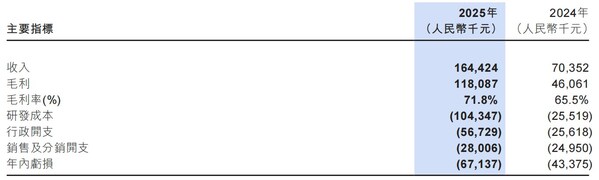
Thanks to the deep advancement of the platform strategy and the accelerated commercial deployment of the foundational large model, Deshi’s technology licensing business revenue, based on its proprietary iMedImage® medical imaging foundational large model, reached 84.34 million yuan, a substantial year-on-year increase of 331.7%, making it the company’s largest revenue source for the first time. This marks a successful transformation of Deshi’s growth engine from the traditional “equipment + software” single-point delivery to a composite, high-margin business model of “equipment entry + model platform + technology licensing.”
Paradigm Shift: From “Single-Point Refinement” to “Batch Production”
The medical imaging field carries approximately 80% of global clinical data volume and is the core battleground for the healthcare industry’s transition from digitalization to intelligence. Facing over 3,200 clinical testing items in China and about 5,000 globally, compounded by the explosive demand for diagnosis and treatment driven by an aging population, the traditional medical supply model has neared its efficiency limits. Traditional medical AI, constrained by the “one disease, one model” independent development approach, suffers from long R&D cycles, high data consumption, and extremely high deployment costs. As a result, the industry has covered only about 35 testing items over the past decade, failing to bridge the vast supply-demand gap.
The explosion of large model technology has effectively broken through the cost boundaries of medical AI development. Deshi’s proprietary iMedImage® medical imaging foundational large model has achieved a paradigm shift from “workshop-style single-point refinement” to “industrialized batch production” empowered by large models. iMedImage® boasts 104 billion parameters, comprehensively covering 19 medical imaging modalities and 26 clinical specialties, providing the underlying technical capability to support thousands of project scenarios.
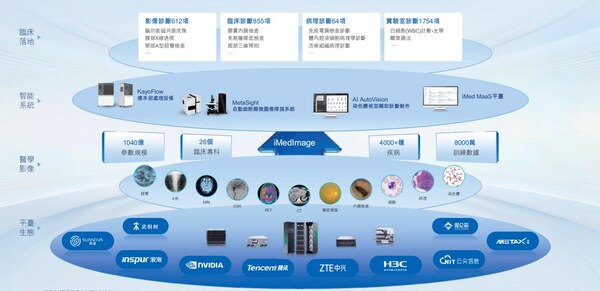
Supported by this underlying infrastructure, the threshold for developing a high-quality vertical specialized model has been greatly reduced — requiring as few as about 200 imaging data samples and a development cycle of 2 to 3 months, leading to an exponential leap in medical AI R&D efficiency. Within just six months of launching the iMed MaaS® platform in 2025, Deshi has achieved coverage of 32 human organs, deeply penetrated 64 disease directions, collaborated with 65 top-tier hospitals to successfully incubate 92 cutting-edge imaging specialized models, and undertaken a key project from the Ministry of Science and Technology, serving as the best testament to the batch production capability of large models.
Value Realization: Platform Strategy Bears Fruit
The leading foundational technology is rapidly translating into strong commercial value. According to the annual report data, Deshi’s technology licensing business revenue driven by large models reached 84.34 million yuan in 2025, a substantial year-on-year increase of 331.7%, with a gross margin as high as 87.3%. This marks Deshi’s departure from the reliance on hardware sales typical of traditional medical AI companies, as the platform strategy begins to realize commercial value at scale.
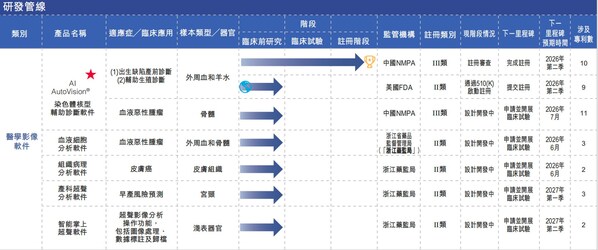
Meanwhile, the company’s core business remains solid. The medical imaging software and medical device business, represented by chromosome karyotype analysis, achieved revenue of 72.76 million yuan, a year-on-year increase of 78.2%, with a gross margin of 58.8%. The company’s core intelligent equipment, AI AutoVision®, was recognized by the National Medical Products Administration as a “Class III innovative medical device.” In multi-center real-world clinical trials, this product significantly reduced the average analysis time per case from 34.1 minutes with traditional manual methods to 11.3 minutes, with an accuracy rate exceeding 99%. Based on 2025 sales revenue, Deshi continues to hold the top market share in China’s chromosome karyotype analysis field.
To consolidate the generational advantage of its foundational large model, Deshi continued to increase investment in computing power and R&D in 2025. The company’s annual R&D costs surged to 104 million yuan, a year-on-year increase of 308.9%. Of this, up to 83.835 million yuan (approximately 80.3% of the total) was allocated to computing infrastructure supporting the training of the iMedImage® foundational model, ensuring the company maintains a leading edge in underlying technology in the global race for medical imaging intelligence.
Ecosystem Empowerment: Continuous Evolution to Tap into a Trillion-Yuan Blue Ocean Market
Looking ahead, the global AI medical imaging market represents a vast blue ocean. According to Frost & Sullivan, the global AI medical imaging market size is expected to surge from approximately $1.6 billion in 2024 to about $9.3 billion by 2030; China’s core AI medical imaging market is also projected to explode from about 2.4 billion yuan to approximately 40.1 billion yuan. Leveraging the medical imaging ecosystem restructured by large models, Deshi is comprehensively entering and profoundly transforming China’s annual 1.4 trillion yuan medical imaging testing market, as well as the hundreds of billions of yuan in general imaging equipment and consumables market.
Deshi has established solid underlying technical support, undergone rapid validation in real markets, and possesses the capability for continuous evolution and self-sustaining growth. Deshi will continue to build a complete closed loop connecting foundational models, intelligent devices, software and hardware, and large model services, transforming the world’s top medical expertise into replicable and scalable medical imaging intelligence capabilities.
“Future competition is not about who sells more equipment, but about who can become the continuously evolving intelligent infrastructure for medical institutions,” said Deshi Chairman Song Ning. “Deshi is willing to walk side by side with global shareholders, medical institutions, and partners, using leading technological innovation and sustained commercialization to jointly accelerate the global medical imaging industry’s stride into a new era of intelligence.”