

ShanghaiApril 30, 2026 /PRNewswire/ — In April 2026, the State Grid Corporation of China officially issued the “2026 Embodied Intelligent Development Plan,” launching large-scale centralized procurement with a 68 billion yuan special investment and 8,500 embodied intelligent devices, covering four core scenarios: power inspection, live-line work, emergency rescue, and warehousing logistics. Among them, a procurement plan for 500 humanoid live-line work robots marks the official transition of humanoid live-line work robots from pilot demonstrations to a new era of batch deployment.
Against this backdrop, at a live-line high-altitude welding site of Luxiao Technology, the Kepler K2 Bumblebee humanoid live-line robot recently completed the world’s first human-machine collaborative high-altitude live-line welding operation, breaking the application barriers for humanoid robots in high-altitude, high-risk scenarios and setting an industry benchmark for intelligent operations in high-risk power scenarios.
In a 20-meter high-altitude working environment, the Kepler K2 Bumblebee humanoid live-line robot, leveraging its self-developed immersive full-body remote operation system, achieved a seamless, hundred-millisecond-level linkage between the ground operator and the high-altitude robot. The operator, wearing a VR headset, naturally raises their hand, turns, and fine-tunes the welding torch angle, while the robot replicates every movement in real time with 0.1mm-level high precision. The 30-kilogram-class dual arms steadily hold the welding torch, maintaining stable posture and smooth trajectory during continuous 8-hour operations, with precise arc control and uniform weld formation. The entire process was completed without any stuttering or deviation, meeting high standards for the challenging high-altitude live-line welding task.
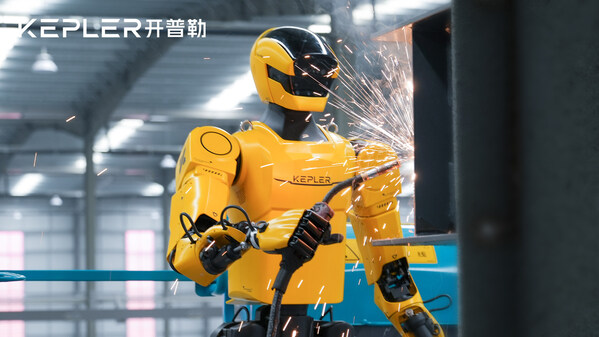
Currently, during the window of concentrated iteration of large models and rising industrial enthusiasm, Shanghai Kepler Robot Co., Ltd., leveraging the mature engineering capabilities of the K2 Bumblebee humanoid live-line work robot, the world’s first human-machine collaborative high-altitude welding benchmark case at Luxiao Technology, and the large-scale deployment results with leading industrial clients, combined with the newly released Kepler-OmniTac™ VTLA Full-Stack Force-Tactile Data Collection Solution and self-developed industrial-grade datasets, is deeply positioning itself in the State Grid robot sector. With a triple advantage of real-world cases, robust products, and full-stack technology, it is preemptively anchoring the new landscape of power embodied intelligent procurement.
I. The Opportunity Has Arrived: State Grid’s Embodied Intelligent Procurement Reshapes the Power Robot Industry Landscape
The State Grid’s 68 billion yuan procurement list clearly defines the industry’s incremental space: 5,000 quadruped inspection robots, 3,000 dual-arm inspection and operation robots, and 500 humanoid live-line work robots, with an average unit price of 5 million yuan. High-risk scenarios such as high-altitude inspection, distribution network maintenance, and live-line operations have become the core battleground for embodied intelligent deployment.
Power operation scenarios inherently demand high risk, high precision, and high endurance, imposing strict standards on robots’ load capacity, remote operation precision, environmental adaptability, and continuous operation. While most companies remain stuck in laboratory demos and concept showcases, Kepler Robot has moved beyond parameter competition, focusing on industrial pragmatism. Centered on real-world scenario deployment, it has completed a full layout from industrial high-risk operation validation to power scenario capability transfer, becoming one of the few humanoid robot companies in the industry with the mature strength to participate in State Grid procurement.
II. Pragmatic Breakthrough: Luxiao Technology’s Live-Line High-Altitude Welding Forges Power Scenario Strength
This benchmark deployment of Luxiao Technology’s live-line high-altitude welding not only achieved a breakthrough application of humanoid robots in high-risk industrial scenarios but also comprehensively validated the industrial-grade core capabilities of the Kepler K2 Bumblebee humanoid live-line robot, including strong load capacity, long endurance, and autonomous evolution. Operators are kept away from high-altitude falls, welding heat, and smoke hazards, leveraging multi-modal immersive perception (force, vision, touch, and hearing) for remote, seamless operations. During long-cycle operations, the robot simultaneously collects multi-modal data on force control, path adjustment, and load changes, accumulating high-value real-world samples for subsequent algorithm iteration and power-specific skill replication.
Kepler’s immersive full-body remote operation forms a complete closed loop of operation execution → data accumulation → autonomous evolution. With real-time force feedback during operations and a first-person view of the working conditions, and leveraging the long-endurance advantage of “1 hour of charging for 8 hours of continuous operation,” it quickly completes data accumulation and strategy optimization. After just 3-5 remote operation demonstrations, the robot can adapt to working condition tolerances, significantly reducing manual intervention, becoming more skilled and intelligent with use.
Through this high-altitude live-line operation practice, the Kepler K2 Bumblebee humanoid live-line robot is now fully adapted to the stringent operational requirements of all power scenarios:
- Equipped with insulation protection and strong anti-electromagnetic interference capabilities, it can operate stably in medium and high-voltage substations, distribution rooms, and other strong electromagnetic complex environments;
- Supports flexible operation in confined spaces and precise work in equipment gaps, enabling precise positioning of detection points and reliable sensor attachment;
- Features panoramic perception, intelligent obstacle avoidance, and complex terrain traversal capabilities, adapting to power site conditions such as automatic switch cabinet door operation and rodent-proof barrier passage;
- Possesses high-precision live-line detection, real-time fault diagnosis, and defect early warning capabilities, along with a high safety redundancy, rapid emergency stop, and full equipment self-check system, fully meeting the standards for high-risk tasks such as power live-line maintenance, line inspection, and equipment disassembly.
With stability at 20 meters high, it has honed its ability for live-line work on the power grid, also accumulating reusable and replicable operational paradigms and technical foundations for homologous scenarios such as power high-altitude inspection, tower maintenance, distribution live-line maintenance, substation duty, and distribution room intelligent detection.

III. Pragmatic Deployment Beyond Benchmarks: Large-Scale Validation by Leading Industrial Clients Strengthens Engineering Capabilities
A single case is a demonstration; batch deployment is the best proof of industrial strength.
Beyond industrial scenario validation, the Kepler K2 Bumblebee humanoid live-line robot is gradually aligning with the State Grid’s standard robot capabilities.
Currently, the Kepler K2 Bumblebee has been deeply deployed in multiple leading manufacturing and logistics companies, including SAIC-GM, Zhaofeng Shares, and Chunmi Technology, covering diverse scenarios such as flow rack handling, parts loading/unloading, precision assembly, automated warehouse sorting, and round-the-clock factory inspection.
At the SAIC-GM logistics factory, the robot completed on-site deployment in just 2 days, with autonomous path planning and precise grasping and transfer, achieving a stable overall operation success rate of 99%. At the Chunmi Technology factory, Kepler has already piloted the deployment of live-line work humanoid robots, leveraging the factory’s complex working conditions to simulate high-risk power operation environments, continuously validating the robot’s high-precision operation, long-duration continuous work, and complex environment adaptability, accumulating real-world experience for subsequent large-scale entry into power scenarios. Meanwhile, dozens of K2 Bumblebees are routinely deployed at the factory, covering autonomous identification, adaptive grasping, and batch handling of over ten SKU materials. Using binocular depth vision and VLA models, the entire process is unmanned. The long-endurance capability of 1 hour of charging for 8 hours of continuous operation fully covers the factory’s single-shift production rhythm, with an operation success rate of ≥98%.
From high-altitude, high-risk specialized operations to routine deployment on manufacturing lines and in warehousing logistics, and then to pilot live-line work scenarios at the Chunmi factory, Kepler has broken away from the industry’s common problem of “emphasizing display over deployment.” Through dual validation of large-scale commercial use and scenario pilots, it proves that the Kepler K2 Bumblebee humanoid live-line robot is not a laboratory exhibit but an industrial-grade humanoid robot capable of taking root on production lines and stably creating value. Its deployment efficiency, operational stability, and scenario adaptability fully match the State Grid’s core requirements for large-scale procurement and round-the-clock operation and maintenance.

IV. Core Product Foundation: Long Endurance and Strong Load Capacity Directly Address Core Needs of Power Live-Line Work
The Kepler K2 “Bumblebee,” as the world’s first commercially available humanoid robot with a Tesla-like hybrid architecture, leverages full-stack self-developed software and hardware, with over 80% self-developed hardware. It precisely meets the core needs of distribution, consumption, and live-line work scenarios with two key hard indicators:
- Ultra-long endurance, round-the-clock on duty: 1 hour of charging for 8 hours of continuous operation, adapting to unattended substations, long-duration high-altitude work, and shift-based operation and maintenance, eliminating frequent recharging downtime and aligning with the State Grid’s 24-hour uninterrupted operation and maintenance system;
- Strong load capacity and high stability, capable of complex operations: Self-developed roller screw power architecture, with dual arms providing a stable 30kg load output, capable of carrying power maintenance tools, welding equipment, and inspection instruments, meeting the precision and heavy-load requirements of switch cabinet operations, line inspections, and equipment disassembly;
Able to handle heavy work, work for long periods, and perform precise tasks—this is Kepler’s unwavering product foundation for industrial and power scenarios.
V. Technology Builds Barriers: VTLA Full Perception Solution + Self-Developed Industrial Dataset Ushers in the Era of Autonomous Robot Evolution
As hardware becomes increasingly homogeneous, perception, data, and models have become the next core competitive advantages for humanoid robots. Kepler officially released the Kepler-OmniTac™ Full-Stack Force-Tactile Data Collection Solution, becoming the first domestic full-stack self-developed industrial solution natively compatible with the VTLA full perception model. This achieves end-to-end integration of data collection kits, the OmniVTLA large model, and native industrial datasets, driving the industry from the single-vision VLA era into a new vision + force-tactile fusion VTLA full perception era.
The solution adopts a lightweight dual-architecture design, quickly adaptable to complex environments such as industrial workshops, distribution rooms, and outdoor sites, truly enabling robots to work, collect data, train, and evolve simultaneously, breaking the industry pain point of disconnection between traditional virtual data, pure visual data, and real industrial scenarios.
Leveraging long-term scenario accumulation, Kepler has built a 100,000+ full-modal real-world scenario dataset, covering 20+ categories of proprietary industrial skills and 40+ real application scenarios, characterized by authenticity, diverse coverage, full-modal integration, and leading scale. The accumulation of high-fidelity force-tactile data not only significantly improves the success rate of industrial precision assembly and flexible grasping but can also be quickly transferred to power scenarios with strong electromagnetic interference, confined cabinets, and complex high-altitude conditions. This endows the K2 Bumblebee humanoid live-line robot with underlying intelligent capabilities for precise perception, flexible operation, and autonomous obstacle avoidance, building a technological moat that differentiates it from competitors.

VI. Anchoring the Power Track: Positioning for State Grid Robots, Preparing for Embodied Intelligent Procurement
Relying on its complete technological accumulation in high-altitude remote operation, strong-load work, long-endurance operation, and the VTLA full perception data system, Kepler has deeply positioned itself in the State Grid-type power operation robot track, focusing on the core areas of distribution and consumption. It is developing whole-machine products such as humanoid live-line work robots and electric vehicle battery swap robots that meet industry standards, and customizing intelligent live-line work humanoid robots.
Addressing the stringent requirements of power scenarios, such as strong electromagnetic interference, confined space operation, high-precision live-line detection, and high safety redundancy, Kepler integrates self-developed technologies including multi-modal sensor fusion, six-dimensional force perception, and anti-strong electromagnetic lightweight dexterous hands. It has established deep cooperation with leading power companies, becoming one of the few humanoid robot companies in the industry capable of meeting the customized development and delivery requirements for high-risk, high-precision power scenarios.
From the technical validation of Luxiao Technology’s high-altitude welding, to the pilot deployment of live-line work scenarios at Chunmi Technology, to large-scale commercial use in leading factories and the technical foundation laid by the VTLA data collection solution and industrial datasets, Kepler’s scenario experience, hardware capabilities, and intelligent algorithms can be seamlessly transferred to core State Grid scenarios such as power inspection, live-line work, emergency repair, and auxiliary park inspection. It possesses the complete strength to participate in the entire process of embodied intelligent equipment procurement and achieve large-scale deployment.

VII. Setting Benchmarks with Pragmatism, Embracing the Opportunity with Technology, Empowering the New Future of Power Embodied Intelligence
2026 is a pivotal year for embodied intelligence to transition from technological exploration to industrial deployment. The State Grid’s 68 billion yuan procurement has defined a clear track and incremental space for the industry.
With the K2 Bumblebee humanoid live-line work robot as its vehicle, Kepler Robot has set a human-machine collaboration benchmark with Luxiao Technology’s high-altitude welding, pioneered the path with the Chunmi factory live-line work pilot, proven its engineering strength through deployment with leading industrial clients, built an intelligent foundation with the VTLA full perception solution and self-developed datasets, and strategically positioned itself in the core State Grid robot track.
Always adhering to the principle of “not creating flashy exhibits, only building pragmatic industrial robots,” Kepler will continue on the path of full-stack self-development, deep scenario cultivation, and data-driven progress. While deeply engaged in upgrading smart manufacturing production lines, it will also help drive the unmanned and intelligent transformation of high-risk operations in the power industry. In the wave of large-scale State Grid embodied intelligent deployment, it aims to seize the opportunity with hardcore strength and create long-term industrial value.