

BeijingMay 26, 2026 /PRNewswire/ — Recently, SGS, an internationally recognized testing, inspection, and certification organization, in collaboration with Zhongqi Brand Technology (Tianjin) Co., Ltd., conducted a systematic vehicle anti-motion sickness comfort verification on the AITO M6 in an open road environment in Chongqing. Test results indicate that the AITO M6 exhibits smooth and stable vehicle dynamic characteristics under various typical road conditions. Based on the outcomes of this testing and verification, the AITO M6 has been awarded the world’s first SGS Premium Performance Mark for low motion sickness at the vehicle level.
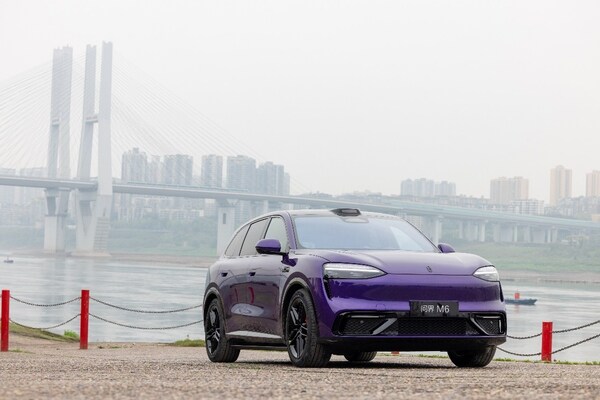
AITO M6 receives world’s first SGS vehicle-level low motion sickness Premium Performance Mark
Motion sickness has long plagued travelers. With the accelerated adoption of new energy vehicles, this issue has drawn increasing attention. Compared to traditional fuel vehicles, new energy vehicles exhibit significant differences in power output and control: the instantaneous high torque response of the electric motor, the deceleration drag from energy recovery, and frequent acceleration-deceleration transitions. These characteristics are more likely to cause inconsistencies in how drivers and passengers perceive the vehicle’s longitudinal, lateral, and posture changes during travel, thereby stimulating the vestibular system of occupants, making “electric vehicle motion sickness” a core pain point affecting ride comfort.
How to scientifically and objectively evaluate and improve a vehicle’s anti-motion sickness performance has become a key direction in the development of vehicle comfort technology. SGS previously participated as a major drafting unit in the development of the group standard “Technical Specification for Anti-Motion Sickness Quality Evaluation of In-Vehicle Display Devices.” From in-vehicle displays to vehicle-level low motion sickness, SGS continues to expand the technical boundaries of anti-motion sickness verification, providing the industry with a more comprehensive and scientific evaluation system.
During this joint testing process, a dual-dimensional evaluation system incorporating a “motion sickness bionic dummy” and “user human factors” was deployed for the first time in an open road environment in Chongqing. The motion sickness bionic dummy uses built-in sensors to collect real-time dynamic parameters such as vehicle acceleration, deceleration, pitch, and roll, outputting an objective motion sickness index. Meanwhile, real users simultaneously record physiological data during the ride, combined with subjective comfort ratings for comprehensive analysis. The two complement each other, providing a full assessment of the vehicle’s anti-motion sickness performance from both objective quantification and subjective experience perspectives.
The intelligent “Motion Sickness Relief” mode equipped in the AITO M6 is an anti-motion sickness mode developed by SERES based on in-depth research into motion sickness mechanisms through human factors engineering, combined with extensive real-vehicle test data. Using multi-dimensional perception modeling and quantitative analysis, it precisely defines key parameter thresholds for vehicle dynamic responses at different motion sickness sensitivity levels. With this as the core technical benchmark, the system employs dynamic iterative algorithms to finely tune power and braking responses, deeply reconstructing the chassis suspension control strategy. This fundamentally suppresses the impact of unintended motion stimuli on occupants’ vestibular systems, systematically reducing the risk of motion sickness and thereby enhancing ride comfort and stability.
Test data shows that in nine typical scenarios in Chongqing, including congestion, turns, bumps, and lane changes, the vehicle’s anti-motion sickness performance is excellent when the mode is activated. Users’ subjective discomfort significantly decreases, effectively reducing the likelihood and intensity of motion sickness during travel, with overall motion sickness comfort improving by 16.77%.
The SGS vehicle-level low motion sickness Premium Performance Mark, in collaboration with Zhongqi Product Science, transforms anti-motion sickness performance from subjective perception into measurable and reproducible technical indicators. This provides consumers with a scientific reference for selecting vehicles with genuine anti-motion sickness technology and clearly affirms the value of implementing anti-motion sickness patented technologies in production models.
Mark Lohmann, Chief Certification Officer for Global Product Certification at SGS, stated: “This is SGS’s first systematic exploration of vehicle-level low motion sickness performance on a global scale, and its significance extends far beyond a single vehicle model test. By introducing bionic testing methods combined with real-road and real-perception evaluations, this system pushes vehicle comfort evaluation from traditional single physical indicators toward a comprehensive assessment approach integrating vehicle dynamic characteristics and human perceptual responses. We look forward to SERES continuing to deepen related technical research and continuously improving users’ overall travel comfort experience.”
In the future, SGS looks forward to deeper collaboration with more industry partners in anti-motion sickness technology testing and evaluation systems, jointly promoting the iterative upgrade of anti-motion sickness technical standards and the continuous development of vehicle comfort technology toward more scientific and verifiable directions, making intelligent comfort a standard feature of smart travel.