

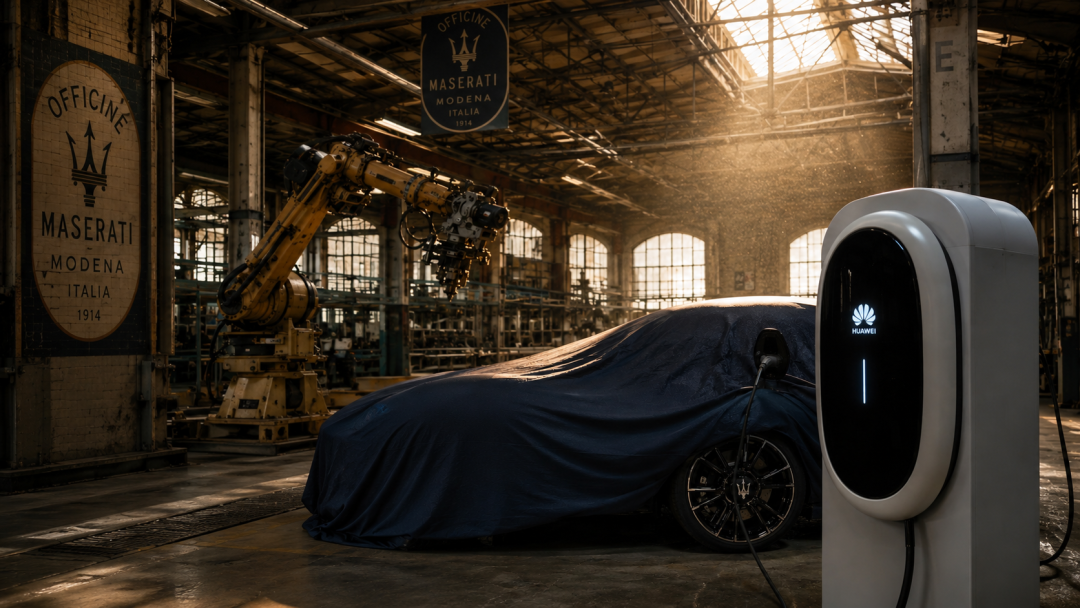
In Maserati’s factory in Modena, Italy, the Trident emblem still gleams, but the roar of the production line no longer echoes with the same vibrancy of the past.
This luxury brand, born in 1914, is experiencing the most awkward misalignment in its century-long history—on one hand, the Tipo 6CM race car commands sky-high prices at vintage car auctions; on the other, its latest electric vehicles in showrooms are being mocked by Chinese netizens on social media as “Nokia in an Armani suit.”
On June 18, 2026, a statement from Stellantis Group CEO Antonio Filosa during a parliamentary hearing finally tore through this veneer of silence. He acknowledged that the group is engaged in “intense commercial negotiations” with two potential partners and will soon make a final choice between them. But Filosa immediately followed up with a somewhat abrupt declaration, dousing cold water on any potential acquirers: “Maserati is not for sale.”
Not for sale, yet seeking collaboration. This means that the Italian beast, which once shared a V8 engine with Ferrari and tore through the streets of Old Havana in “Fast & Furious,” is about to welcome a “technology partner” from the East in the era of electrification. The stakes of this alliance are not just whether Maserati can survive, but how this storied luxury brand will face the world of 2030.
The “Non-Sale” Card and a New Chessboard
Addressing concerns from Italian lawmakers and the industry, Filosa gave a dual confirmation at the parliamentary hearing: Maserati will not be sold, and the Cassino plant will not be transferred. He emphasized that Maserati is an “iconic brand of Italian style” and plays a “very special role” within the group.
This statement sets the tone for the brand’s future. However, behind the refusal to sell lies a complex path of collaboration that Stellantis has charted for Maserati.
Filosa revealed that the two potential partners can bring “advanced technology and a range of high-quality solutions,” and the collaboration model may mirror the existing framework between Stellantis and China’s Leapmotor and Dongfeng, namely establishing a joint venture with Stellantis holding a 51% stake.
This clearly indicates that Stellantis is seeking deep technological complementarity, not mere capital maneuvers.
Sales Collapse and the Urgency of a “Technology Transfusion”
Maserati’s predicament is the direct driver of this strategic shift. The former “Queen of Sports Cars” is facing an unprecedented market winter.
Its global sales plummeted from nearly 27,000 units in 2023 to about 7,900 units in 2025. In the Chinese market, which once contributed nearly 30% of sales, only a little over 1,000 units were sold in 2025, with dealer terminal prices collapsing and some models discounted to as low as 40% off.
In the wave of electrification and intelligence, Maserati has lagged severely. Its pure electric models have received a lukewarm response in the European market, while in China, its smart cockpit and driving experience have been comprehensively surpassed by local new forces.
Stellantis Group itself is under immense financial pressure, recording a net loss of 22.3 billion euros in 2025. In this context, introducing external advanced technology—especially electrification and intelligence capabilities from Chinese tech companies—is seen as the most realistic path to save Maserati from its dire straits.
The Biggest Suspense: Huawei and JAC’s “Golden Combination”
Although Filosa did not disclose the identities of the potential partners, industry rumors have long pointed to Huawei’s Harmony Intelligent Mobility and JAC Motors.
According to multiple reports, negotiations involving four parties have been secretly underway for some time, with the core framework highly similar to the Harmony Intelligent Mobility model: Huawei leads product definition and core technology, JAC is responsible for joint R&D and manufacturing, while Maserati contributes its century-old design heritage and brand endorsement.
Even more striking is the possible “dual-brand” strategy: Collaborative models might fall under the Harmony Intelligent Mobility’s “Zunjie” brand in the Chinese market, while globally, they would bear Maserati’s Trident emblem.
The first model is already in the design phase, targeting mass production in the second half of 2026. If these rumors come true, this would mark the first time a multinational luxury brand has engaged in full-stack technology collaboration with a Chinese tech company at such depth and scale, with significance far beyond simple contract manufacturing.
Revival Blueprint and the Tightrope Challenge
Maserati’s story is being rewritten from a self-admiring family epic into a joint venture script full of strategic games. Filosa repeatedly emphasized “Italian style” and “unique heritage” at the hearing, but the reality is that young people today may know the Trident more from luxury brand collaborations than from racing legends.
Choosing a technology partner is essentially a decision between two risks: If they pick an overly dominant tech company, Maserati could become a “walking chassis and logo,” with brand premium eroded by the tech halo; if they choose a partner lacking strength, they might miss the final window for electrification, ending up as a museum exhibit.
A deeper dilemma lies in time. Two new E-segment large cars won’t launch until 2030, while facelifts are merely mid-cycle “patches.” In the Chinese market, new forces are devouring every price segment with 18-month iteration cycles—Maserati’s “four-year plan” versus competitors’ “quarterly offensives” constitutes the most brutal time lag in this race.
Yet, the dice have been cast. Filosa promised to unveil a comprehensive revival plan by December this year, and according to industry rumors, the first “Eastern-core Maserati” equipped with HarmonyOS cockpit and ADS 3.0 intelligent driving system could roll off the production line as early as late 2026—a full three years ahead of the officially planned E-segment cars.
Perhaps one day, when the Trident emblem and Huawei’s “petal” logo appear side by side on the same car’s tailgate, we might recall what Alfieri Maserati said in his Bologna garage in 1914: “We build only machines that can stir the soul.”
One hundred and twelve years later, the soul still yearns to be stirred, but what drives it is no longer gasoline.