By Sima Chunshan, Rui Niu Finance
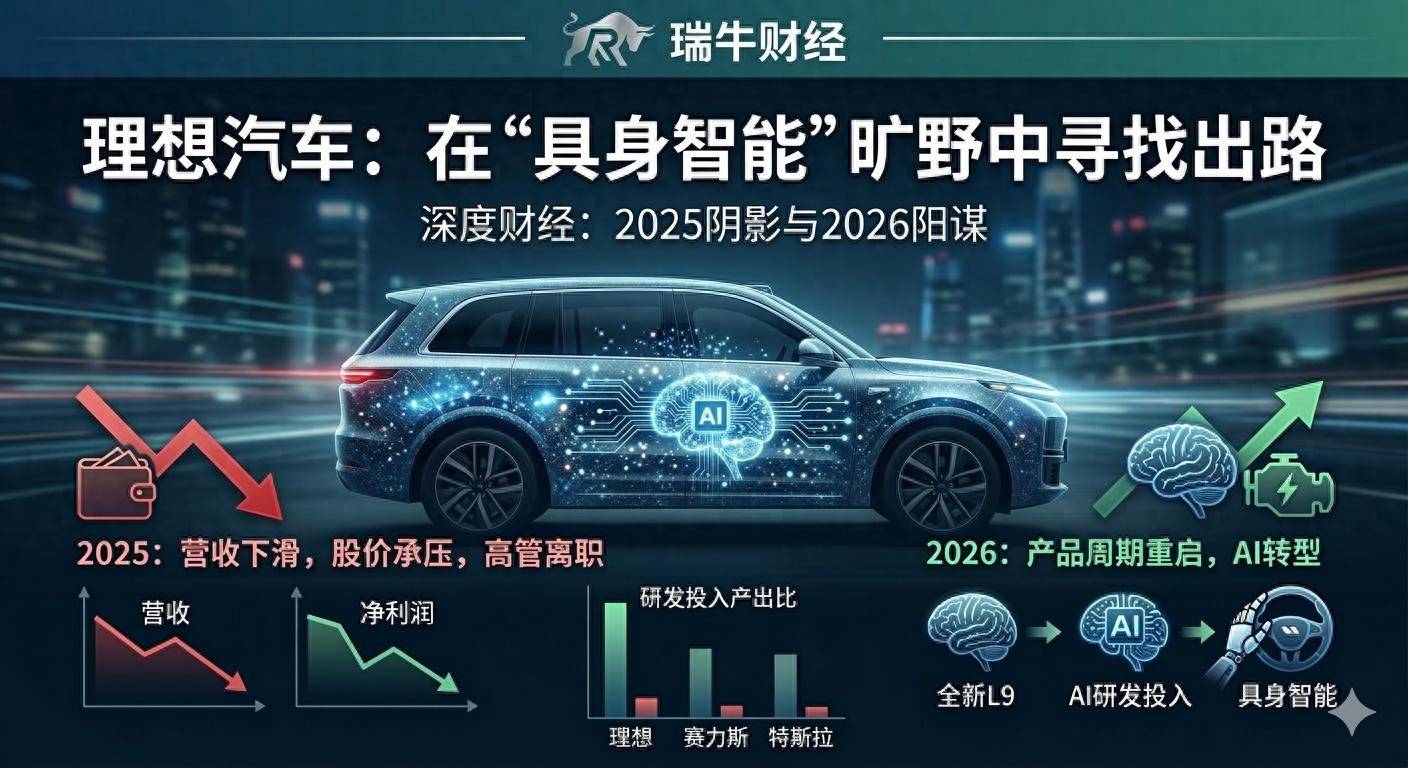
On March 12, 2026, Li Auto delivered a somewhat heavy 2025 report card. The financial report shows that Li Auto’s total revenue for 2025 was 112.3 billion yuan, a year-on-year decrease of 22.3%; net profit was 1.1 billion yuan, a sharp contraction of 85.8% compared to the 8 billion yuan in the same period last year.
If 2024 was the “highlight moment” when Li Auto reached the peak among new energy vehicle makers, then 2025 was more like a cold “painful period” at high altitude. Declining revenue, stock price pressure, executive departures, and cash flow fluctuations—all signs indicate that this once most family-savvy new automaker is facing its most severe strategic transformation test since its founding.
Financial Fundamentals: Growth Dilemma Under the “Remaining Warmth” of Profitability
On the surface, Li Auto still maintains its dignity as a “profitable new force,” but the logic of its growth has drastically changed.
Decline in Both Revenue and Deliveries: Vehicle sales revenue in 2025 decreased by 23% year-on-year, and deliveries fell from the 500,000-unit level to approximately 406,000 units. This means that under the siege of strong competitors like AITO, Li Auto’s once-stable market share is being eroded.
Structural Pressure on Gross Margin: The gross margin for 2025 dropped to 18.7%. Although it rebounded to 17.8% in Q4 quarter-on-quarter, this “resilience” was built on the delivery of the lower-priced i6 model and organizational contraction, far from restoring the golden level of over 20% seen in the past.
“Red Light” Warning for Cash Flow: Most notably, Li Auto’s operating cash flow turned negative in 2025 (negative 8.6 billion yuan), and free cash flow recorded a negative 12.8 billion yuan. Although the company still has 101.2 billion yuan in cash reserves on its books, if this “spending more than earning” trend continues, it will directly threaten its high R&D investments.
Roots of the Pain: The Shadow of MEGA and the Side Effects of Organizational “Tightening the Screws”
Li Auto’s slowdown in 2025 was not accidental but the result of the combined effects of product rhythm and internal governance.
First, the cost of recovery after strategic misjudgment. The recall of the Li Auto MEGA in 2025 not only brought direct cost losses but also disrupted the rhythm of Li Auto’s dual-track strategy for pure electric and extended-range vehicles. A stock price drop of over 30% within six months reflected capital market concerns about Li Auto’s shift from a “hit-maker” to “mediocre growth.”
Second, the “collective exodus” of organizational talent. Against the backdrop of the earnings release, an undeniable fact is the successive departures of several core executives (such as Zhang Xiao, Chen Wei, Lang Xianpeng, etc.) to start their own ventures. This exposes the downside of Li Auto’s high-pressure “tightening the screws” management style: while it can produce extreme efficiency in favorable times, it easily leads to talent drain during adversity. The loss of AI and intelligent driving talent, in particular, is akin to pulling the firewood from under the cauldron for Li Auto, which aspires to transform into “embodied intelligence.”
2026: The Daring Leap from “Building Cars” to “Building People”
Facing the predicament, Li Xiang’s prescription in the earnings call was: embodied intelligence.
This is an extremely ambitious and risky term. Li Auto aims to define the car as a “living intelligent entity” and increase the proportion of AI R&D investment to 50%.
Restarting the Product Cycle: The new Li Auto L9, set to launch in Q2 2026, carries high hopes. Whether its generational improvements in powertrain, intelligent driving, and chassis can recapture the family users lost to competitors is key to Li Auto’s potential turnaround this year.
AI Organizational Restructuring: Li Auto claims to be introducing Agent collaboration, attempting to use AI to reverse the efficiency decline brought by company scale expansion. This attempt to “use AI to manage an AI company” is unprecedented in the automotive industry.
Conclusion: Concerned but Not Dismissive
We are concerned about Li Auto because it is in the most dangerous “second entrepreneurship” leap period. Transitioning from a “product manager company” selling extended-range vehicles to a “fundamental technology company” selling embodied intelligence involves bridging technological gaps, competitive barriers, and organizational friction.
However, we cannot dismiss Li Auto entirely. As of the end of 2025, its 101.2 billion yuan in cash reserves remain its thickest moat; its record of profitability for three consecutive years also proves its solid operational capabilities.
Li Auto is in the deepest darkness before dawn. In 2026, if the L9 can regain its glory and the AI strategy can truly translate into commercial value, then the losses and turbulence of 2025 will become necessary tuition on this company’s path to a hundred-billion-dollar market cap. Conversely, if embodied intelligence becomes mere marketing rhetoric, Li Auto will face the real risk of being marginalized by the new energy tide.