Efficiency Doubled!
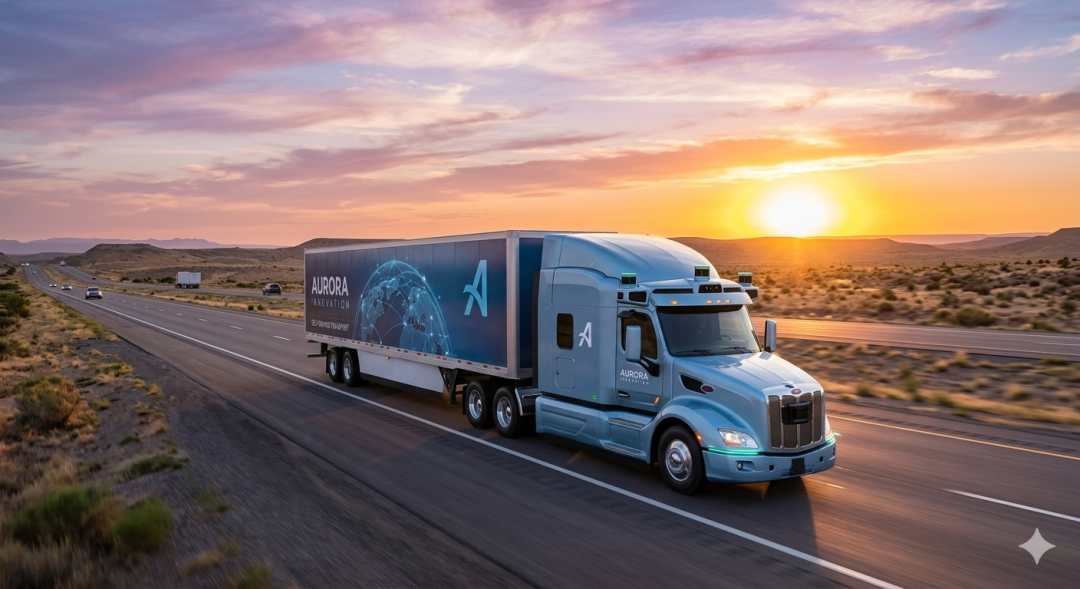
[Jikainews, March 16] As the demand for automation technology in long-haul freight becomes increasingly urgent, the commercialization of autonomous driving is reaching a critical breakthrough. Recently, the leading US autonomous driving company Aurora Innovation announced that its self-developed autonomous truck successfully completed a continuous long-haul transportation task of approximately 1,600 kilometers (1,000 miles) without any human intervention, taking only about 15 hours for the entire journey.
This achievement not only demonstrates the inherent endurance advantage of AI drivers but also marks the official entry of the freight industry into a transformative year of “round-the-clock, high-turnover” operations.
1. Breaking Physiological Limits: Covering a 2-Day Human Journey in 15 Hours
In the long-haul freight sector, driver fatigue has long been a primary cause of traffic accidents. According to current traffic regulations, human drivers face stringent restrictions when covering the same distance:
- Human vs. Machine Comparison: Truck drivers are limited to a maximum of 11 hours of driving per day and must take mandatory rest after 8 consecutive hours of driving. Completing 1,600 kilometers typically requires a cumulative total of about 28 hours (including mandatory breaks), taking nearly two days.
- Efficiency Leap: Aurora’s autonomous truck requires no stopping for rest, directly reducing transportation time by nearly **50%**. This “superhuman-level” asset utilization provides logistics companies with the potential to double their transport capacity.
2. The Core Brain: Aurora Driver 6.0 Enables Round-the-Clock Operation
The core of this milestone journey is the Aurora Driver 6.0 system. As the first “feature-complete” commercial version, this system possesses the following core capabilities:
- Full-Scenario Coverage: The vehicle can not only drive autonomously on highways but also handle complex urban roads, construction zones, and unexpected road conditions.
- Adverse Weather Adaptation: Utilizing its self-developed FirstLight LiDAR (with a detection range of 1,000 meters), the system can safely navigate extreme weather conditions such as heavy rain, dense fog, strong winds, and sandstorms, ensuring freight operations are not halted by weather.
- Redundant Safety: Even if sensors are interfered with, the system can determine the optimal evasive action through multi-source data fusion.
3. Commercial Deployment: 10 Major Routes from Texas to Arizona
Aurora’s commercial footprint is rapidly expanding. As of March 2026, its operational status is as follows:
- Route Scale: It has opened 10 core routes extending from Texas to Arizona, covering the economically vibrant “Sun Belt” region of the United States.
- Operational Data: Currently, 30 autonomous trucks are in regular operation, with cumulative test mileage exceeding 3 million miles, of which 250,000 miles are purely driverless.
- Revenue Generation: The commercial fleet currently generates approximately $400,000 in monthly revenue. Aurora plans to expand the fleet size to over 200 trucks by the end of 2026, with projected annualized revenue run-rate reaching $80 million by then.
Industry Perspective
Aurora CEO Chris Urmson stated that 2026 will be an “inflection point” for autonomous freight. Against the backdrop of driver shortages and rising operational costs, the autonomous driving service cost of about $0.85 per mile (lower than the average $1 per mile cost for human drivers) will possess strong market competitiveness.
2025 Net Profit Plummets, 2026 Must Win: Li Auto Bets on Embodied AI
Shangjie Z7 Coupe, Shangjie Z7T Shooting Brake: Twin Z7s Debut, Aimed at Young Consumers