By Yi Jiang Chun Shui, Ruinews
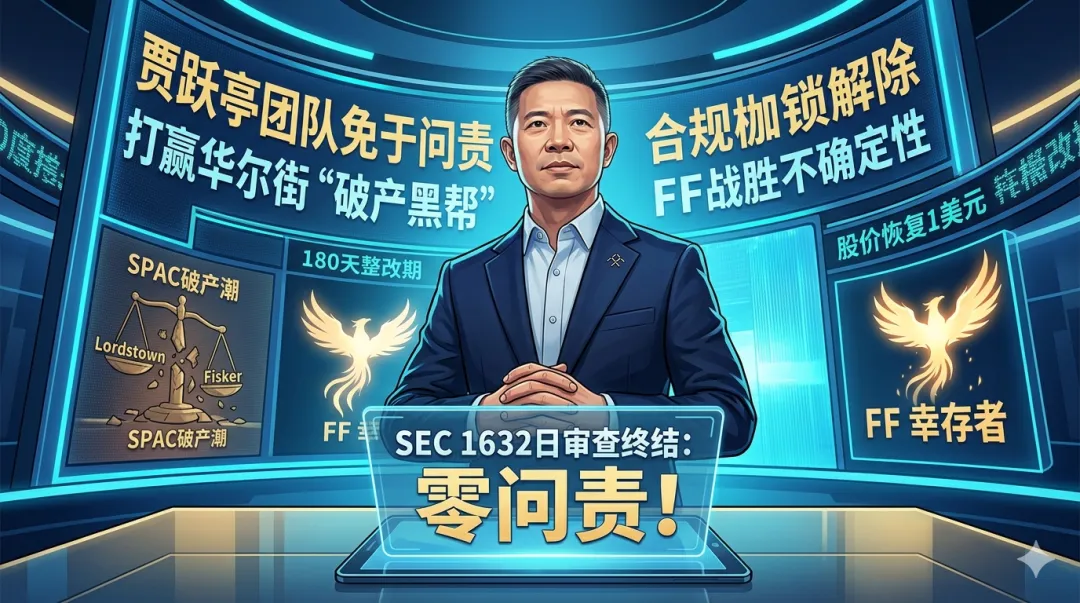
After nearly five years and a protracted 1,632-day struggle, Faraday Future (FF) has finally shed its heaviest shackles. On March 22, 2026, the U.S. Securities and Exchange Commission (SEC) officially closed its case: **no enforcement action or penalties will be taken against FF, its founder Jia Yueting, or its management team.**
Amidst the wreckage of numerous bankrupt and liquidated SPAC-listed EV companies, FF has emerged as the “sole survivor.”
Case Closed with Zero Accountability: A “Compliance Self-Defense” Penetrating Millions of Documents
Since the investigation was triggered by short-seller allegations in October 2021, the SEC’s scrutiny has been exhaustive.
- Scope of Review: Millions of internal emails, instant messaging records, and underlying financial statements were examined.
- Investigation Period: Spanning five years, covering FF’s entire journey from listing to delisting crisis and strategic transformation.
- Final Ruling: Zero penalties, zero accountability.
This outcome not only legally exonerates FF’s management but also logically shatters the core weapon used by Wall Street short-sellers against FF over the past five years—**”compliance uncertainty.”** For Jia Yueting, long at the center of the media storm, this is not just a legal victory but a belated vindication of the “entrepreneurial dignity” he has repeatedly emphasized.
A Brutal Frame of Reference: Why Did FF Become the “Sole Survivor”?
Looking back at the EV listing frenzy of 2020-2021, market euphoria spawned a group of star startups. However, under the dual pressures of SEC compliance crackdowns and broken funding chains, that list has turned into a long “casualty roster”:
| Company Name | Final Fate |
|---|---|
| Lordstown Motors | Bankruptcy Liquidation |
| Fisker | Bankruptcy Liquidation |
| Arrival | Bankruptcy Liquidation |
| Proterra | Bankruptcy Liquidation |
| Faraday Future (FF) | Case Closed, Operations Continue |
Compared to the rapid collapse of the aforementioned companies following investigations, FF demonstrated remarkable resilience. Behind this “tough survival” lies not only Jia Yueting’s highly controversial persistence but also the company’s ability to maintain a closed loop of technological R&D and minimal-scale deliveries while cooperating with the investigation.
Shackles Removed: The “Restart Button” for Financing Channels and AI Strategy
The most direct benefit of the SEC closing its case for FF is not reputation, but the renewed access to **survival resources**.
- Breaching the Financing “Compliance Wall”: Over the past five years, major investment banks and institutional investors, due to risk controls, could not provide substantial funding to a company under SEC investigation. With this obstacle removed, FF is poised to regain favor with mainstream capital markets.
- Freeing Up Management Bandwidth: Jia Yueting stated frankly that the company expended enormous human and material resources over the past five years to cooperate with the investigation. Now, management can devote 100% of its energy to business advancement.
- Expanding Horizons: FF announced the relocation of its headquarters to Los Angeles’s “Silicon Beach” and clarified a strategic upgrade from pure EV manufacturing to an integrated ecosystem of EAI EV (AI-powered Electric Vehicles) and EAI Robotics.
The Final 180 Days: The Stock Price Compliance Battle is the Real “Survival Line”
Despite the removal of compliance risks, FF is not yet in the “safe zone.”
On March 20, Nasdaq issued a final ultimatum: a **180-day cure period**. FF must raise its stock price above $1 without a reverse stock split. This is not just a battle for reputation but a real capital market showdown.
To this end, FF has launched a “Ten-Point Reform Package,” with the core objective of the first phase being crystal clear: **win the stock price compliance battle.**
Ruinews Perspective: With the SEC investigation gone, Jia Yueting no longer has an excuse for slow business progress. The next six months will be the most decisive moment in FF’s twelve-year entrepreneurial history—either leveraging the tailwind of compliance to secure financing and achieve mass production for a turnaround, or exiting regretfully under the rules of the capital market.
Conclusion: The Original Aspiration of “Never Give Up” and the Gravity of Reality
“Over 12 years, we have undergone one disruptive reshaping after another,” Jia Yueting’s reflection highlights FF’s surreal journey. Now, with the shackles of history removed, FF has finally returned to the pure arena of business competition.
In the fields of AIEV and robotics, can FF transform its technological assets into positive cash flow? This is no longer a question for the SEC, but the ultimate test posed by the market.