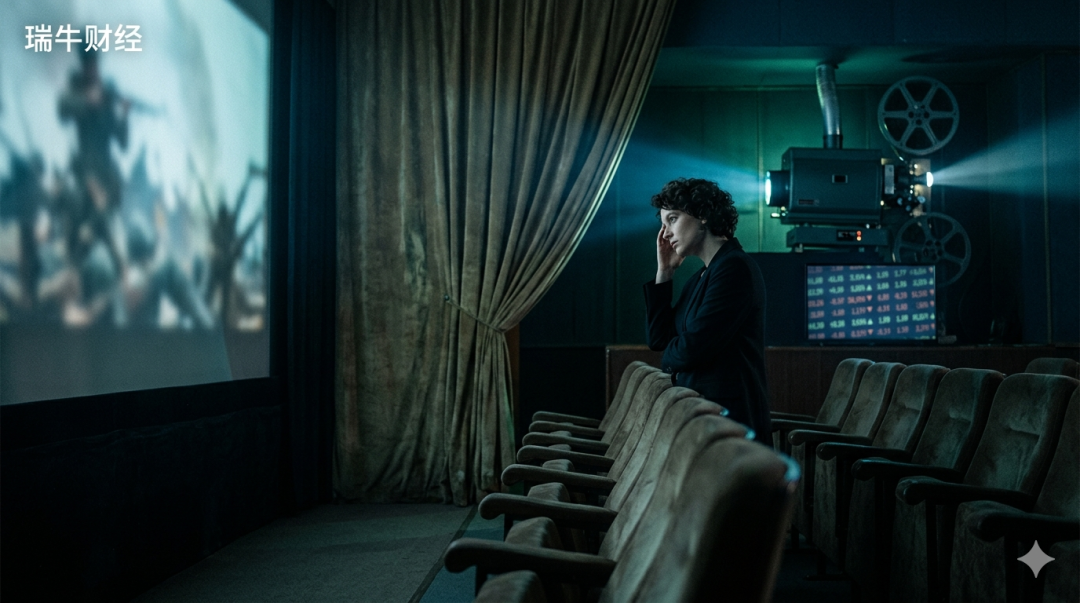
Introduction: Bona Film Group, once invincible in the film and television industry with its “mainstream theme + commercialization” model, is now facing its darkest hour since going public.
The projected staggering loss of up to 1.5 billion yuan for 2025 is not just a numerical decline on the financial statements; it signifies the systemic failure of the “dual-engine drive” logic upon which Bona has relied for survival.
I. Performance Shockwave: The Backlash of Content “Heavy Industrialization”
Bona Film Group’s collapse in 2025 is essentially the result of a collision between failed content cost control and a shift in aesthetic cycles.
- The Waterloo of “Operation Jiaolong”: As a heavily invested “sequel project” for Bona, its performance during the 2025 Spring Festival season was disastrous. A box office of 393 million yuan for a high-budget, heavy-industrial blockbuster对标 (targeting/comparable to) “Operation Red Sea” means the loss from this single film likely pierced through Bona’s annual profit bottom line.
- The Tragedy of “Inverted” Gross Margin: The gross margin for the first three quarters of 2025 was shockingly low at -64.51%, an extremely rare occurrence in the film industry. This means for every movie ticket Bona sells, it not only fails to recoup production costs but also loses money on marketing and basic operations. This situation of “burning money without a sound” reflects how its once-proud model of massive investment and large-scale production has become a heavy shackle.
II. Theater Chain Under Pressure: Ballast or Millstone?
Bona has long touted its “film production + theater chain” dual-engine drive. However, in the market environment of early 2026, the theater chain business has transformed from a safe haven into a drag.
- Market Bleeding: The 2026 Spring Festival box office plummeted by 40% year-on-year, with the number of moviegoers shrinking by 35.8%. As a heavy-asset player with about 100 cinemas, Bona must face rigid rental and labor costs. With low occupancy rates on regular days, the theater business’s 10%-15% gross margin is utterly insufficient to cover the massive hole in the production segment.
- Audience Flow Dilemma: Data shows the proportion of audiences under 25 has dropped from 42% to 18%. This indicates that mainstream theme narratives are losing the most dynamic consumer group. Lacking new content that matches younger tastes to support it, the revenue per square meter of Bona’s theater channels continues to decline.
III. Capital Conundrum: The “Tightening Curse” of the Funding Chain
The stock price shrinking from 13.72 yuan to 7.68 yuan, with a market cap evaporation of 6 billion yuan, reflects not just retail investor panic but also institutional exodus.
- Financial Red Lines Under High Leverage: A 65.03% asset-liability ratio stands out glaringly in the film industry, which has relatively light-asset attributes. With annual financial expenses exceeding 140 million yuan and operating cash flow barely over 70 million yuan, Bona’s pressure to borrow new to repay old has reached a critical point.
- Pledge Risks Surface: Nearly half of the controlling shareholder Yu Dong’s shares are pledged, with some even frozen. This is the most dreaded signal in capital markets. Once the stock price hits the liquidation line, Bona could face secondary disasters from动荡 (turmoil) in its equity structure.
IV. In-Depth Analysis: How Can Bona “Save Itself”?
Bona’s current predicament is one of an “outdated model.” Over the past decade, Bona capitalized on the红利 (dividends) of national sentiment and big-screen infrastructure development. However, when audiences grew weary of the “explosion scenes + grand slogans” formula, Bona failed to pivot timely towards lighter, more diversified content production.
Short-term view: Bona urgently needs to achieve cash flow recovery through reserve projects like “Four Crossings” and undergo aggressive asset impairment provisions (a financial “big bath”) to start 2026 with a lighter load and avoid touching delisting red lines.
Long-term view: Cost reduction and efficiency improvement cannot rely solely on layoffs or store closures. As mentioned in your materials, it should accelerate the布局 (layout) of AI film production. Only by compressing per-film costs from hundreds of millions to tens of millions while maintaining visual standards can it survive in the increasingly segmented film market.
- To see if Bona still has a chance to turn things around,横向对比 (horizontal comparison) is crucial.
Bona’s current situation is entirely different from that of Enlight Media, which pursues a “small but beautiful, light-asset” strategy, and China Film Group, which possesses the “monopoly advantage of the entire industry chain.”
The film and television sector is currently experiencing extreme polarization: Enlight is winning effortlessly with “animation IP,” China Film is collecting rent with its “full industry chain,” while Bona is deeply mired in the quagmire of the “heavy-industrial model.”
Below is a three-dimensional comparative analysis of the three major film and television giants for the 2025-2026 period, compiled for you:
I. Core Financial Indicator Comparison (2025 Annual / 2026 Q1 Estimates)
| Indicator | Bona Film Group (001330) | Enlight Media (300251) | China Film Group (600977) |
|---|---|---|---|
| 2025 Profit/Loss Forecast | Loss 1.26B – 1.48B yuan | Profit 1.5B – 1.9B yuan | Estimated slight profit (0.2-0.4B yuan) |
| Revenue Structure | Theaters (80%) + Film Investment (20%) | Film Investment (90%+) | Distribution + Exhibition + Technology (Full Industry Chain) |
| Core Gross Margin | -64.51% (Extremely Low) | ~40%-50% (Stable) | ~15%-20% (Stable) |
| Debt Ratio | 65.03% (High Risk) | < 15% (Very Low) | ~30% (Healthy) |
| 2026 Stock Price Trend | Plummeted -44%, Capital Stampede | Fluctuating Upward, Heavily Held by Institutions | Fluctuates with Market, Strong Defensive Attributes |
II. Business Model & 2026 Core Film Slate Comparison
1. Bona Film Group: The Heavy-Asset “High Roller”
- Model: “High-Budget Mainstream Themes + National Theater Chain.” Bona is typical of “heavy-industrial” thinking, with single-film investments often reaching 300-500 million yuan.
- 2026 Dilemma: With the 2026 Spring Festival box office shrinking by 40%, Bona’s high-leverage, high-turnover model is the first to collapse.
- Key Projects: “Four Crossings,” “Kashmir.” Risk Point: Audience fatigue with严肃叙事 (serious narratives). If box office falls below 1 billion yuan, Bona will face its 5th consecutive year of losses.
2. Enlight Media: The Light-Asset “IP Harvester”
- Model: “Animation IP + Artist Management.” Sweeping 2025 with “Ne Zha 2″‘s global 15.8 billion yuan box office, Enlight now holds nearly 10 billion yuan in cash.
- 2026 Advantage: Doesn’t operate cinemas, no rental burden. Continues to advance its “Mythology Universe” in 2026, with极强的 (extremely strong) risk resistance.
- Key Projects: “Xiao Qian,” “Go to Your Island.”
3. China Film Group: The Full-Industry-Chain “Gatekeeper”
- Model: “Import Revenue Sharing + Theater Affiliation + Film Technology.” As the industry老大 (big brother), China Film profits from “toll fees.”
- 2026 Advantage: No matter who produces a blockbuster, China Film profits from distribution and its theater chain revenue sharing. Even if the overall market declines in 2026, its CINITY system exports and import film份额 (share) provide a stable底价 (floor/base).
III. Summary & Investment Judgment
“Bona is swimming naked, Enlight is collecting rent, China Film is guarding the gate.”
- Bona Film Group: Currently in a “triple kill” phase of valuation, performance, and margin call slaughter. For Bona’s heavy-asset, low-efficiency traditional film model, the certainty of financial recovery is extremely low before the true advent of the AI film era.
- Sector Recommendation: The logic for film and television investment in 2026 has shifted from “betting on blockbusters” to “watching cash flow.” Enlight is the首选 (preferred choice) for防御性 (defensive) plays. Bona currently更像 (more resembles) a distressed turnaround target requiring等待 (waiting for) signals of “debt restructuring” or “content transformation.”