

A research team from Chulalongkorn University is revolutionizing chemistry education through an immersive 3D “Chemistry Metaverse” platform. This platform integrates gaming with scientific training, aiming to broaden educational accessibility, enhance safety, and better align learning with real-world skills.
BangkokApril 29, 2026 /PRNewswire/ — Developed under the “Metaverse of Academic Nexus for Global Opportunities” (abbreviated as “MANGOs“) project, the platform allows students to enter a virtual “digital twin” of the university’s Faculty of Science. Within this virtual space, students can conduct experiments, operate high-end instruments, and solve real-world problems through interactive simulations.
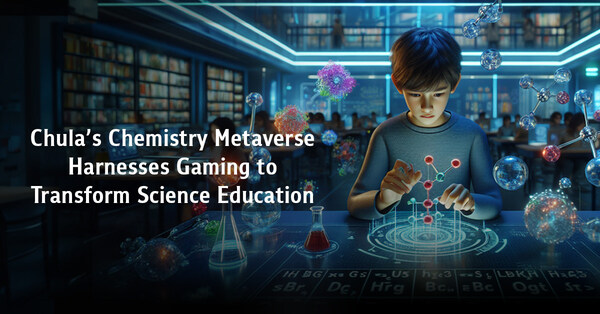
Chulalongkorn University’s Chemistry Metaverse Platform Revolutionizes Science Education with Gamification Technology
This idea originated from chemistry researcher and avid gamer, Associate Professor Dr. Chadin Kulsing. He saw the potential to transform the appeal of virtual worlds into meaningful learning. A chance collaboration with Professor Dr. Lunchakorn Wuttisittikulkij from the Faculty of Engineering brought this vision to life, resulting in an interdisciplinary project merging chemistry, electrical engineering, and 3D game development.
Traditional labs are often constrained by costs, equipment shortages, and safety hazards. In contrast, the Chemistry Metaverse provides a risk-free environment where students can freely conduct experiments without worrying about real-world consequences, while reinforcing safety awareness and scientific reasoning skills.
The platform is built around an outcome-based education philosophy, focusing on practical skill development rather than mere theoretical knowledge. Universities can collaborate with industry partners to design teaching modules, specifically targeting skills such as operating complex instruments and optimizing chemical processes.
The platform employs a tiered gamified learning system, using “missions” to guide users from novice to expert levels. Learning modules include virtual titration experiments and forensic investigations (where students solve simulated cases by analyzing DNA samples). High-end equipment like gas chromatographs, typically inaccessible to undergraduates, is also available for use in the virtual environment.
One of the platform’s most innovative features is the integration of scent-release technology, allowing users to experience “virtual smells” associated with digital objects, such as plants in a simulated herb garden. This multi-sensory teaching approach aims to enhance learning engagement and depth of understanding. Beyond teaching, the Chemistry Metaverse also functions as a virtual research center, offering databases of compounds and natural products that can support industries like cosmetics and fragrances.
Although the platform’s widespread adoption depends on institutional policies, the project has already attracted international attention, with partners from Australia, Italy, and Southeast Asia exploring access. The research team states that the long-term goal of the project is to create an interconnected global virtual campus network.
The Chemistry Metaverse blends gaming with science, turning every laptop into a laboratory and reshaping how students learn chemistry.