

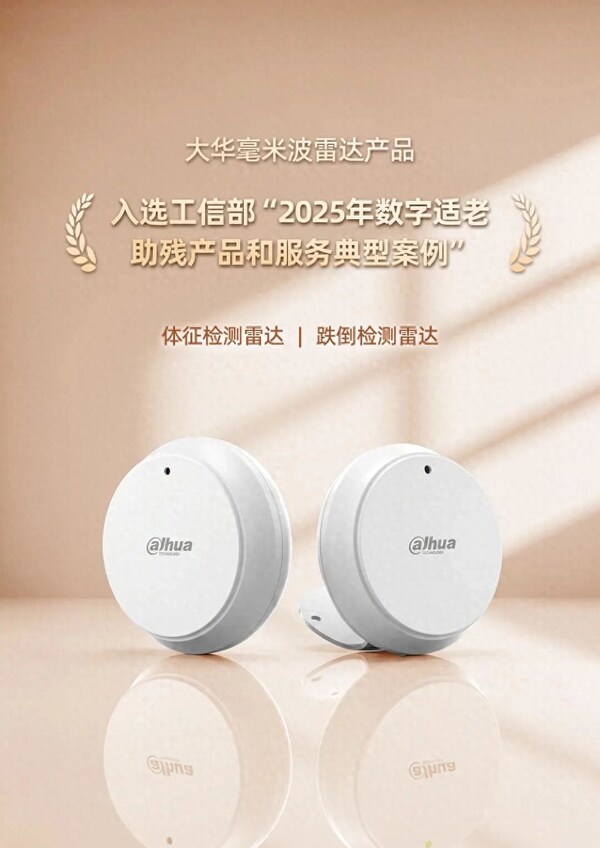
HangzhouMay 27, 2026 /PRNewswire/ — Recently, the General Office of six departments, including the Ministry of Industry and Information Technology, announced the “2025 Typical Cases of Digital Products and Services for the Elderly and Disabled.” Dahua Technology’s millimeter-wave radar was successfully selected as a typical case in the hardware product category.
As China’s aging population accelerates, the gap in elderly care is becoming increasingly prominent. According to statistics, the fall incidence rate among people aged 65 and above in China is as high as 20% to 30%. If timely assistance is not provided after a fall, it can seriously threaten life safety and health. Meanwhile, the number of patients with cardiovascular and cerebrovascular diseases in China has exceeded 330 million. Timely warnings of abnormalities such as tachycardia or bradycardia can buy critical time for emergency treatment, becoming a key part of preventing sudden cardiac death.
From Passive Care to Active Protection: Making Care More Unobtrusive and Reassuring
Truly age-friendly smart technology should not add burdens. Traditional care methods often require the elderly to actively seek help or cooperate with devices: emergency buttons may be out of reach after a fall; smart wristbands require long-term wear and have an adaptation threshold; camera-based monitoring raises privacy concerns; and high-risk scenarios like nighttime and bathrooms are even harder to monitor continuously.
The key to age-friendly technology is not making the elderly adapt to devices, but having technology actively adapt to the lives of the elderly.
Dahua Technology leverages millimeter-wave radar intelligent sensing technology, which requires no wearables and captures no images. While respecting the privacy and daily habits of the elderly, it senses vital signs such as breathing and heart rate, identifies abnormal states like getting out of bed or falling, and provides timely warnings of potential risks. With a more unobtrusive and respectful care approach, it makes care more proactive, timely, and compassionate.
Whether by the bedside, in a room, or in private settings like bathrooms, protection is provided without disturbance. This not only reassures children who are away from home but also adds warmth to every act of care.
One Step Further in Technological Innovation, One Point More Accurate in Unobtrusive Protection
The reliability of unobtrusive protection comes from continuous understanding and technological optimization of real care scenarios. The health monitoring environment for the elderly is complex, with factors such as changes in sleeping posture, weak vital signs, environmental interference, and misjudgment of abnormal movements potentially affecting monitoring accuracy. Through multiple intelligent sensing technologies, we continuously enhance vital sign monitoring and risk identification capabilities, making health protection more precise and trustworthy.
More Accurate Sensing, No Deviation in Protection
To address the positioning challenges caused by changes in the elderly’s sleeping posture, we have developed self-developed intelligent sensing adaptive beam dynamic control technology. It automatically follows changes in body posture, precisely locks onto the chest position, and stabilizes the monitoring of vital signs such as breathing and heart rate.
More Stable Signals, More Reliable Data
To tackle issues like weak heart rate signals and susceptibility to interference in the elderly, we use multi-layered heart rate signal enhancement technology to improve the extraction of weak signals hidden in noise, ensuring that every vital sign monitoring result is authentic and reliable.
Fewer False Alarms, More Reliable Warnings
By analyzing the continuity and rationality of target movement trajectories, combined with micro-Doppler feature extraction and pattern recognition, we have significantly improved fall detection accuracy while reducing false alarms and unnecessary alerts. This better assists caregivers in timely judgment and rapid response, providing more precise and efficient care services for the elderly.
Full-Scenario Digital Age-Friendly Care: A New Paradigm for Care Services
Dahua Technology’s “unobtrusive protection” technology, driven by millimeter-wave radar intelligent active sensing, operates through a closed loop of “unobtrusive monitoring, intelligent warning, and rapid response.” It is seamlessly integrated into scenarios such as elderly care institutions, medical facilities, and homes, helping operators and individuals enhance smart supervision efficiency and provide better service experiences for the elderly and vulnerable groups.
In Elderly Care Institutions: More Proactive Protection
The system can monitor risk states in real time, such as the elderly not returning to bed for an extended period or abnormal heart rate fluctuations. Through a tiered alert mechanism, it promptly pushes warning information to caregivers, family members’ terminals, and management platforms, enabling rapid response and efficient handling of abnormal situations. Additionally, it effectively reduces the frequency of nighttime rounds, avoiding disturbance to the elderly’s rest, and supports integration with emergency centers and community health service platforms to further strengthen the health and safety防线 of the elderly.
In Medical Facilities: More Timely Response
The system can monitor breathing and heart rate in real time, accurately identify movements such as turning over and sitting up, and display them centrally on a large screen at the nurse station. In case of abnormalities, the system automatically alerts, helping medical staff intervene promptly and reduce caregiving pressure. Particularly in high-fall areas like bathrooms and showers, the system can achieve second-level alerts and precise positioning, aiding in seizing the “golden rescue” time, so the elderly no longer have to rely solely on calling for help or passive discovery.
In Home Scenarios: More Reassuring Companionship
The system captures no images and records no audio. Without disturbing the elderly’s daily life, it continuously monitors abnormal situations such as prolonged stillness or suspected falls and promptly alerts family members. Even when not by their side, family members can stay informed about the elderly’s basic activity status, reducing worry and anxiety, and adding a layer of reassuring protection to home-based elderly care.
The true significance of digital age-friendly technology is to ensure that the elderly are not left behind in the digital age, achieving genuine “support for the elderly, safety for the elderly, and happiness for the elderly.” Dahua Technology will continue to explore innovations, embedding digital technology into every corner of public services and elderly care, making technology compassionate and allowing more elderly people to experience the happiness brought by technology.